
Library | Sustainable Finance Practices
Product development and trends
Insights into the creation and evolution of sustainable financial products, such as managed funds, green bonds, and ESG-linked loans, highlight innovations aligned with sustainability goals and benchmark evolving practices, consumer demand, and stakeholder expectations.
Refine
237 results
REFINE
SHOW: 16


Environmental beta or how institutional investors think about climate change and fossil fuel risk
This report examines how institutional investors think about climate change and fossil fuel risk. It finds that investors consider these issues subjectively and are primarily concerned with short-term investment horizons. The report argues that understanding investor perspectives is crucial for enhanced mechanisms both to mitigate GHG emissions and minimise climate change-related financial instability.

Wealthy private investors and socially responsible investing: The influence of reference groups
The study investigates how wealthy private investors engage with socially responsible investing (SRI) and how reference groups influence their investment behaviour. Qualitative data from 55 interviews with high-net-worth individuals (HNWIs) and industry experts show that while family members emphasize profit, fellow SRI-oriented HNWIs prioritise similarity and reputation.

The hidden risk in state pensions: Analysing state pensions’ responses to the climate crisis in proxy voting
This report analyses the proxy voting strategies of 19 state pensions, as well as the five New York City Comptroller systems, managing over US$2 trillion in assets. Results reveal that most pensions failed to address climate-related financial risk, especially in areas such as lobbying, environmental justice, and Indigenous rights.

UN Environment Programme's adaptation gap report series
The Adaptation Gap Report series provides yearly updates on global progress in climate change adaptation. It assesses the status of adaptation planning, implementation, and finance, highlighting the increasing gap between the need for adaptation and the actions taken.

Circular to management companies of SFC-authorised unit trusts and mutual funds ESG funds
The Securities and Futures Commission (SFC) released a new circular prescribing disclosure requirements and periodic assessments for SFC-authorised unit trusts and mutual funds that focus on environmental, social, and governance (ESG) factors. Fund managers must include comprehensive disclosures in annual reports and take regular steps to ensure ESG investments align with a fund's intention.

RIAA's benchmarking impact investing series
This is a series of benchmark reports providing comprehensive insights into the impact investing market in Australia. It covers investor motivations, market size, and performance metrics, aiding stakeholders in understanding and enhancing their impact investment strategies.

'Signals of seriousness' for human rights due diligence
This discussion draft proposes a list of "signals of seriousness" that could inform administrative assessments of companies' HRDD efforts under potential EU legislation. The document provides comprehensive guidance on human rights and environmental due diligence and highlights key features of HRDD practices, offering critical insights to regulators seeking to enforce the proposed legislation.

The state of AI in 2022 - and a half decade in review
The adoption of AI has more than doubled, with a peak of 58% in past years. The report highlights the importance of best practices and investing in AI as it is shown to bring financial returns. However, the majority of organisations are not mitigating risks associated with AI despite increasing use.
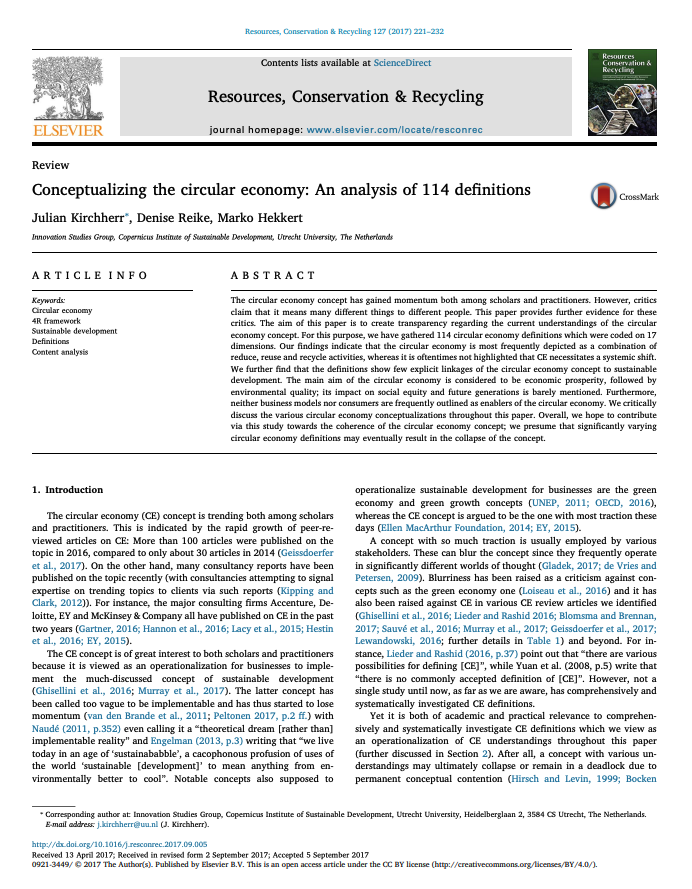
Conceptualizing the circular economy: An analysis of 114 definitions
The aim of this paper is to create transparency regarding the current understandings of the circular economy concept. The findings indicate that the circular economy is most frequently depicted as a combination of reduce, reuse and recycle activities. Concerningly, many definitions overlook that circular economy necessitates a systemic shift.
Inter-agency Task Force on Financing for Development's financing for sustainable development report series
The Financing for Sustainable Development Report is an annual series produced by the United Nations Inter-agency Task Force. It provides a comprehensive assessment of global financing trends, policies, and frameworks supporting sustainable development, tracking progress across key areas such as public finance, private investment, debt, and international cooperation.

Private equity and value creation: A fund manager's guide to gender-smart investing
This report examines the increase in adoption of gender-smart investing within the private equity industry by general partners (GPs) and limited partners (LPs). Lessons from over 160 fund managers have been utilised in this step-by-step guide to choosing gender-smart investment strategies, and putting policies into practice within firms and portfolios.
Project SAGE series - Gender-lens investing
The 'Project SAGE' series are benchmark reports released by the Wharton Social Impact Initiative, tracks venture capital, private equity, and private debt investments with a gender lens. The project's goal was to provide a “point in time” capture of the expanding gender lens investing opportunities globally.

Tracking the transition
This report examines the impact of China’s coal-fired power companies, and their inaction in responding to climate change. The report presents China’s six largest listed power companies and their associated CO2 emissions, as well as recommendations for investors to act on.

A market review of nature-based solutions: An emerging institutional asset class
This report presents a global review of nature-based solutions (NbS), identifying and analysing 88 existing NbS investments between 2002 to 2021. The report identifies common trends of existing investments, both opportunities and barriers to NbS investments and suggests recommendations to institutional investors and policymakers.

Global ESG disclosure standards for investment products
This report presents the “Global ESG disclosure standards for investment products” developed by the CFA Institute to facilitate fair representation and full disclosure by investment managers in relation to how environmental, social and governance (“ESG”) issues are considered in an investment product’s objectives, investment process or stewardship activities.

A status report on financial institutions’ experiences from working with green, non green and brown financial assets and a potential risk differential
This 2020 report presents the results from a survey that assesses whether a risk differential can be detected between green, non-green and brown financial assets (loans and bonds). Based on information obtained by 49 banks, it presents a snapshot of current practices among financial institutions in their asset allocation.


