

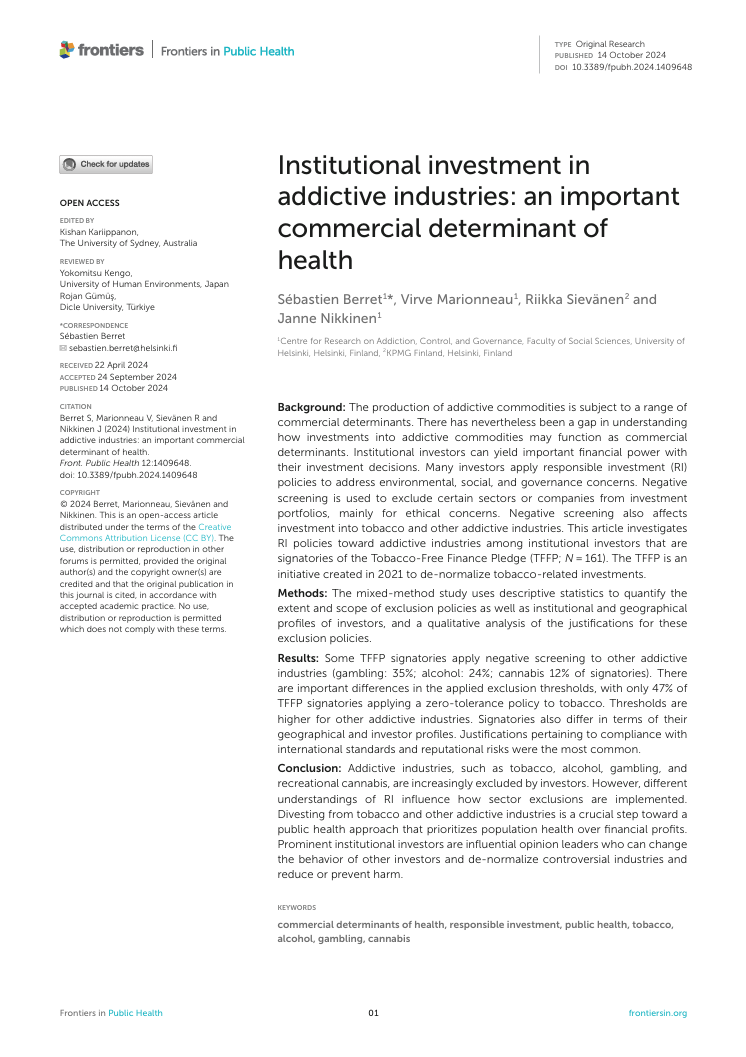
Institutional investment in addictive industries: An important commercial determinant of health
The study examines how Tobacco-Free Finance Pledge signatories apply exclusion policies to addictive industries. Investors show diverse thresholds, with European institutions more likely to exclude alcohol, gambling, and cannabis. Reputational and compliance considerations dominate justifications, highlighting investment decisions as significant commercial determinants of health.
Please login or join for free to read more.

OVERVIEW
Institutional investment in addictive industries: an important commercial determinant of health
The study analyses how institutional investors that signed the Tobacco-Free Finance Pledge (TFFP) apply responsible investment (RI) exclusion policies to tobacco, alcohol, gambling, and recreational cannabis. It highlights heterogeneity in exclusion thresholds, geographic and investor-type differences, and the moral and strategic justifications used. Findings indicate that investment decisions can reinforce or mitigate commercial determinants of health.
Introduction
Addictive industries—including tobacco, alcohol, recreational cannabis, and gambling—contribute significantly to global health harms, with non-communicable diseases accounting for 71% of global deaths. These industries maintain markets through marketing, lobbying, and corporate social responsibility practices. Institutional investors influence these sectors through capital allocation and exclusion policies. Negative screening is a central RI tool, though its financial impact remains debated. Earlier research shows investors more commonly exclude tobacco than alcohol or gambling, and exclusion policies are most prevalent in Europe. The TFFP (launched 2021) aims to de-normalise tobacco investment. This study examines whether signatories extend exclusions to other addictive industries, the thresholds applied, and their stated justifications.
Methods
The dataset comprises 161 TFFP signatories’ 2020 UN Principles for Responsible Investment (UNPRI) transparency reports, supplemented by RI policies from signatory websites where necessary. Exclusion policies were identified for 71% of signatories. Data included asset size categories (USD 40m to USD 1tn), investor type, and geographic origin. Descriptive statistics were used due to sample size. Qualitative justification analysis applied Boltanski and Thévenot’s framework of “orders of worth”. A total of 682 coded statements from 87 reports informed the qualitative analysis.
Results
Exclusion thresholds
All signatories excluded tobacco, but only 47% used zero-tolerance thresholds. About 18% permitted investment in firms deriving ≥5% of revenue from tobacco, and three signatories allowed thresholds over 20%.
For alcohol, gambling, and cannabis, most investors reported no exclusion thresholds. Zero-tolerance policies were applied by only 6–7% of signatories for these sectors. A 5% threshold was the most common for alcohol and gambling (23 and 14 investors respectively). European investors were more likely to adopt stricter thresholds.
Legal origin
Europe accounted for 53% of signatories and showed the highest exclusion levels: 44% excluded gambling, 32% excluded alcohol, and 19% excluded cannabis. Northern and Central European investors were especially active, with 50–64% excluding alcohol or gambling. North American and Oceania investors showed moderate exclusion, while Asian signatories disclosed no sector-specific exclusions.
Investor types
Asset managers (30% of signatories) were most likely to exclude alcohol (43%), gambling (61%), and cannabis (22%). Banks and insurers displayed lower rates. European dominance within asset-management signatories partly explains this concentration of exclusions.
Assets under management
Exclusion patterns followed a U-shape: the smallest investors (<USD 1bn) and largest (>USD 100bn) displayed the highest exclusion rates for alcohol and gambling. Mid-sized investors showed lower adoption. Cannabis exclusions were consistently low across size groups.
Justifications for the RI approach
The most frequent justifications aligned with worth of fame, referencing compliance with international standards and reputational risk mitigation. Market-based justifications were also common, citing exposure to regulatory change, litigation, and shifting consumption behaviours. Industrial-worth justifications focused on metrics, ratings, and performance frameworks. Civic, inspired, and domestic worths appeared infrequently, but included appeals to long-term societal interests, religious principles, or longstanding RI traditions.
Discussion
The findings show substantial heterogeneity and incomplete disclosure. Twenty-nine percent of signatories provided no publicly accessible exclusion information. Tobacco exclusions are well established, yet about 20% still invest in companies with some tobacco revenue. Alcohol, gambling, and cannabis exclusions remain less common, reflecting differing reputational pressures and social perceptions of harm. European regulation (e.g., SFDR, CSRD) appears to encourage stricter exclusion practices compared with other regions. Reputational risk, public norms, and financial considerations collectively shape decisions. As investment can expand or constrain harmful industries, stronger international alignment and advocacy may encourage broader adoption of exclusion practices.
Conclusion
Significant variation exists in exclusion policies among TFFP signatories. European investors and large or very small funds are most likely to exclude additional addictive industries. Reputational and compliance-based justifications dominate. The study suggests further pledges and regulatory efforts could support divestment from harmful sectors and reduce health impacts.




