

Market assessment on critical minerals innovation in developing countries
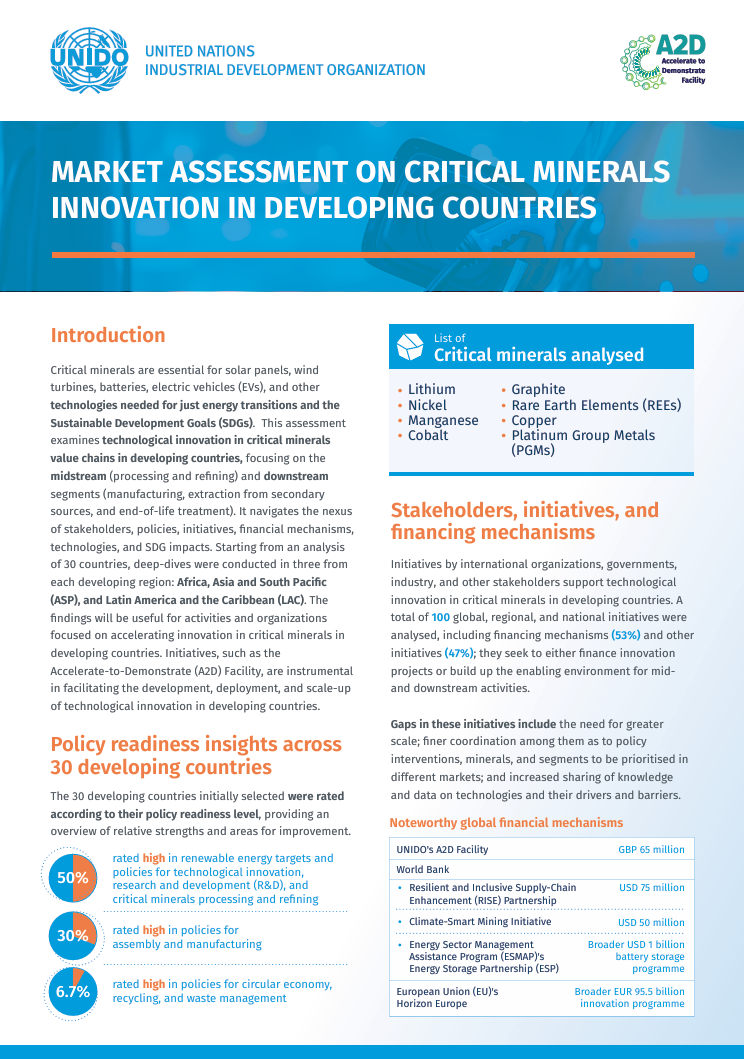
This report assesses critical minerals innovation in developing countries, focusing on midstream processing and downstream manufacturing, recycling and end-of-life treatment. It reviews 30 countries, highlights policy and financing gaps, and recommends stronger infrastructure, coordination, technology transfer and support for innovation ecosystems.
Please login or join for free to read more.

OVERVIEW
Introduction
The report examines innovation across critical minerals value chains in 30 developing countries, focusing on midstream processing and downstream manufacturing, recycling and end-of-life treatment. It covers minerals including lithium, cobalt, nickel and rare earth elements, assessing stakeholders, policies, financing mechanisms and their contribution to energy transitions and SDGs.
Stakeholders, initiatives and financing mechanisms
Around 100 initiatives were analysed, with 53% focused on financing and 47% on enabling environments. These include global programmes such as UNIDO’s GBP 65 million A2D Facility and the World Bank’s USD 75 million RISE Partnership. Broader programmes, including Horizon Europe (EUR 95.5 billion), also support innovation. However, gaps persist in scale, coordination and knowledge-sharing across regions, minerals and value chain segments. Strengthening alignment and improving access to data on technologies are identified as priorities.
Policy readiness insights across 30 developing countries
Countries show uneven policy readiness. Around 50% perform strongly in renewable energy targets, R&D and processing policies, while only 30% have strong frameworks for assembly and manufacturing. Just 6.7% demonstrate robust circular economy and recycling policies. This indicates a structural imbalance, with downstream and circular segments underdeveloped. The findings suggest the need for targeted policy reforms to support manufacturing capacity and end-of-life management.
Technological innovation in developing countries
Innovation is largely driven by technology transfer from developed economies, though domestic capabilities are emerging. Over the past five years, policy frameworks and incentives have supported growth in midstream and downstream innovation. Notable technologies include lithium extraction from brines and clays, nickel processing, battery-grade material production, and lithium-ion battery recycling using safer processes. Regional specialisation is evident, with countries such as Indonesia focusing on nickel processing and battery production, and Argentina and Brazil advancing lithium-based value chains.
Emerging innovation ecosystems remain uneven, with limited scaling of local technologies. The report highlights the importance of strengthening domestic R&D, fostering industrial linkages and supporting pilot-to-commercial deployment pathways. Initiatives like A2D play a role in bridging early-stage innovation gaps.
Regional deep-dives and technology trends
Case studies across Africa, Asia-Pacific and Latin America show varied technological maturity. For example, Zambia and Indonesia are advancing battery manufacturing linked to copper, cobalt and nickel resources, while India is developing capabilities in battery recycling and e-waste processing. South Africa focuses on platinum group metals, while Türkiye is active in rare earth processing and solar manufacturing. These examples illustrate growing diversification across value chains, though many countries remain concentrated in early-stage processing.
Key findings and implications
The report finds that innovation ecosystems are constrained by limited financing scale, fragmented initiatives and insufficient policy coverage in downstream and circular activities. While significant global funding exists, access and coordination remain challenges for developing countries. Expanding infrastructure, improving policy coherence and strengthening technology transfer mechanisms are critical to unlocking value chain participation.
Greater emphasis on recycling and circular economy policies is needed to address sustainability and supply security. The report underscores the importance of integrated approaches combining finance, policy and technology development to accelerate innovation and enable developing countries to capture greater value from critical minerals.




