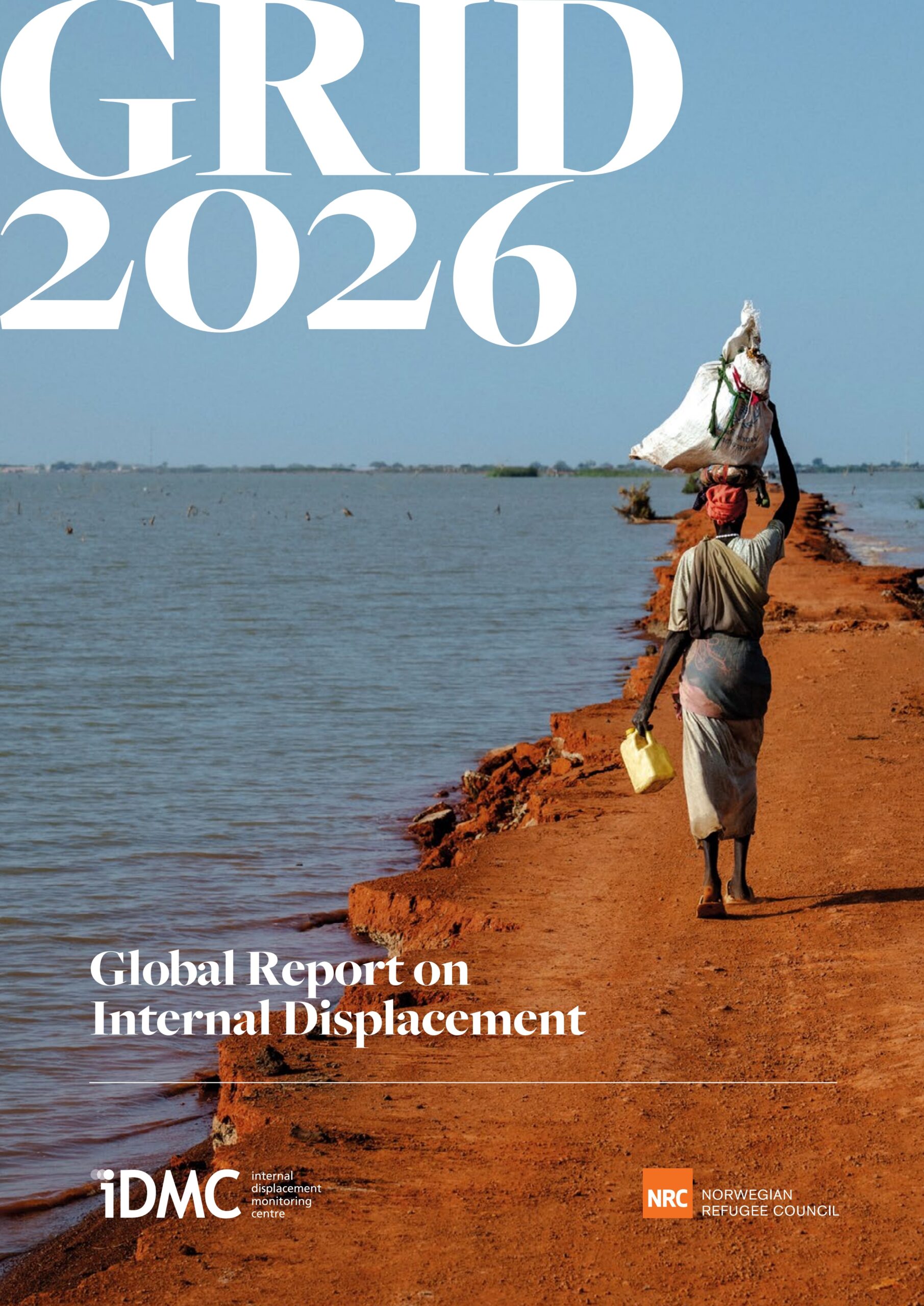
Global report on internal displacement series
The Global Report on Internal Displacement (GRID) is an annual benchmark series published by the Internal Displacement Monitoring Centre (IDMC). It tracks the scale, drivers, and geography of internal displacement worldwide, covering both conflict- and disaster-driven movements across countries and regions.
Please login or join for free to read more.

OVERVIEW
The Global Report on Internal Displacement (GRID) is an annual benchmark series produced by the Internal Displacement Monitoring Centre (IDMC) in partnership with the Norwegian Refugee Council (NRC). First published over a decade ago, the series provides the most comprehensive and internationally comparable dataset on internal displacement globally, distinguishing between displacement driven by conflict and violence and that driven by disasters.
What the Series Tracks
The GRID monitors two core metrics. The first is the number of internally displaced people (IDPs) — a stock measure representing the total number of individuals living in internal displacement at a given point in time, typically at the end of each calendar year. The second is the number of internal displacements — a flow measure counting each forced movement within a country during the year, including repeated movements by the same individual.
The series covers displacement across all regions: Sub-Saharan Africa, the Middle East and North Africa, South Asia, the Americas, Europe and Central Asia, and East Asia and the Pacific. Country-level data is presented alongside regional overviews and in-depth spotlight analyses of specific crises or themes.
Methodology
IDMC aggregates, verifies, and harmonises data from a wide range of sources, including government agencies, UN bodies such as IOM’s Displacement Tracking Matrix (IOM-DTM), UNHCR, and OCHA, as well as civil society organisations and media reports. Each year, IDMC reviews thousands of documents from hundreds of sources globally.
Where a single primary source exists, it is systematically validated and triangulated against supplementary data. In most countries, estimates draw on multiple independent sources to address temporal and geographical data gaps. IDMC applies consistent definitions across all settings to enable meaningful cross-country and over-time comparisons.
The series also monitors data availability itself, flagging countries where assessment frequency or geographical coverage has declined, and adjusting methodologies accordingly.
Key Findings and Themes from the 2026 Edition
The 2026 edition covers displacement recorded during 2025. More than 82.2 million people were living in internal displacement across 104 countries and territories at the end of 2025 — the first recorded decrease in a decade, though figures remain close to record levels. Of this total, 68.6 million were displaced by conflict and violence, and 13.6 million by disasters.
A total of 62.2 million internal displacements were recorded during 2025 across 146 countries and territories. For the first time on record, conflict and violence triggered more displacements than disasters, reaching 32.3 million — a 60 per cent increase on 2024 and the highest figure recorded. Disaster displacements fell 35 per cent to 29.9 million, though this remained 13 per cent above the decadal average.
Key drivers of conflict displacement included large-scale evacuations in Iran linked to Israeli military operations (approximately 10 million movements), record displacement in the Democratic Republic of the Congo (9.7 million movements), and ongoing hostilities in Palestine, Sudan, and South Sudan. Border conflicts between Thailand and Cambodia, and between India and Pakistan, contributed to a global rise in displacement associated with international armed conflict.
On the disaster side, storms remained the dominant trigger at 17.9 million movements. The Philippines accounted for 36 per cent of global disaster displacements. Wildfires reached their second-highest displacement level in a decade, with notable events in the United States, Korea, Greece, and Türkiye. Geophysical hazards, including tsunami alerts triggered by a major earthquake off Russia’s Kamchatka peninsula, prompted large-scale pre-emptive evacuations in Chile and Japan.
A recurring theme in this edition is the growing pressure on displacement data systems. IDMC observed reduced data availability in 15 per cent of monitored countries — three times the share affected in 2024 — partly attributable to funding cuts affecting humanitarian data collection operations.
Relevance and Uses for Finance Professionals
For finance professionals, the GRID series offers a structured, evidence-based framework for assessing humanitarian, geopolitical, and climate-related risks across sovereign and sub-sovereign contexts. Displacement data can inform sovereign risk assessments, particularly in fragile states where large IDP populations signal governance failure, infrastructure stress, and constrained fiscal capacity.
The series also provides relevant inputs for environmental, social, and governance (ESG) analysis, disaster risk financing, and climate adaptation investment. Pre-emptive evacuation data and the economic cost analysis introduced in the 2026 edition — including estimates of productivity losses from wildfire displacement in Korea — point to a growing methodological toolkit for quantifying the economic consequences of displacement events.
Development finance institutions, insurers, and impact investors operating in displacement-affected regions will find the GRID’s country-level data and regional breakdowns useful for due diligence, portfolio risk assessment, and the evaluation of resilience-building investments.
LINKS & ATTACHMENTS
-
Go to source

-
2457 - 2026 - Global report on internal displacement
-
2457 - 2025 - Global report on internal displacement
-
2457 - 2024 - Global report on internal displacement
-
2457 - 2023 - Internal displacement and food security
-
2457 - 2022 - Children and youth in internal displacement
-
2457 - 2021 - Internal displacement in a changing climate