

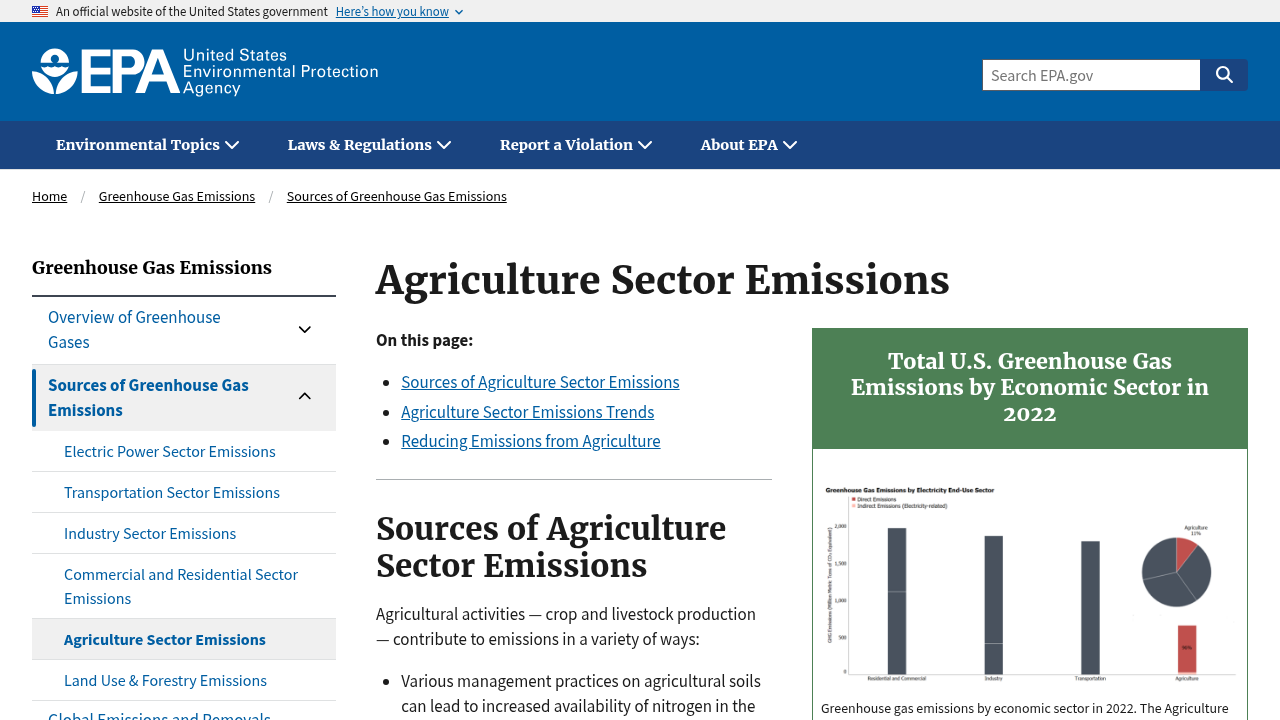
Greenhouse Gas Emissions Inventory: Agriculture Sector Emissions
A US EPA resource providing detailed data on greenhouse gas emissions from the agricultural sector, including livestock, manure, and soil management trends since 1990.
Please login or join for free to read more.

OVERVIEW
The Greenhouse Gas Emissions Inventory: Agriculture Sector Emissions is a comprehensive data resource providing detailed estimates of greenhouse gas (GHG) emissions from crop and livestock production in the United States. It identifies the primary sources of agricultural emissions, including soil management, enteric fermentation, and manure management. This tool is essential for finance professionals assessing carbon footprints and transition risks within the agribusiness and food production sectors.
Organisation behind the tool
The tool is developed and maintained by the US Environmental Protection Agency (EPA), an official government organisation in the United States. The data is sourced from the broader “Inventory of U.S. Greenhouse Gas Emissions and Sinks,” which follows Intergovernmental Panel on Climate Change (IPCC) guidelines.
What the tool does
- Provides annual estimates of agricultural emissions of methane (CH4), nitrous oxide (N2O), and carbon dioxide (CO2).
- Breaks down emissions by sub-sector, such as agricultural soil management (50% of sector emissions), enteric fermentation (25%), and manure management (14%).
- Offers historical trend analysis dating back to 1990, showing an 8% increase in agricultural emissions over the period.
- Outlines specific reduction opportunities, such as improving pasture quality, adjusting nitrogen application, and capturing methane for renewable energy.
Target audience
The primary users include environmental researchers, policymakers, agricultural producers, and sustainability analysts. It also serves as a critical resource for institutional investors and financial analysts monitoring climate-related risks.
Relevance to finance professionals
- Risk assessment – Evaluation of physical and transition risks for portfolios with high exposure to US agricultural commodities.
- ESG analysis – Access to primary government data for benchmarking corporate disclosures against national sector averages and trends.
- Market/commodity insights – Analysis of how livestock and crop management practices may be impacted by future carbon pricing or environmental regulations.
- Investment context – Identification of growth opportunities in agricultural technology and carbon sequestration projects.




