

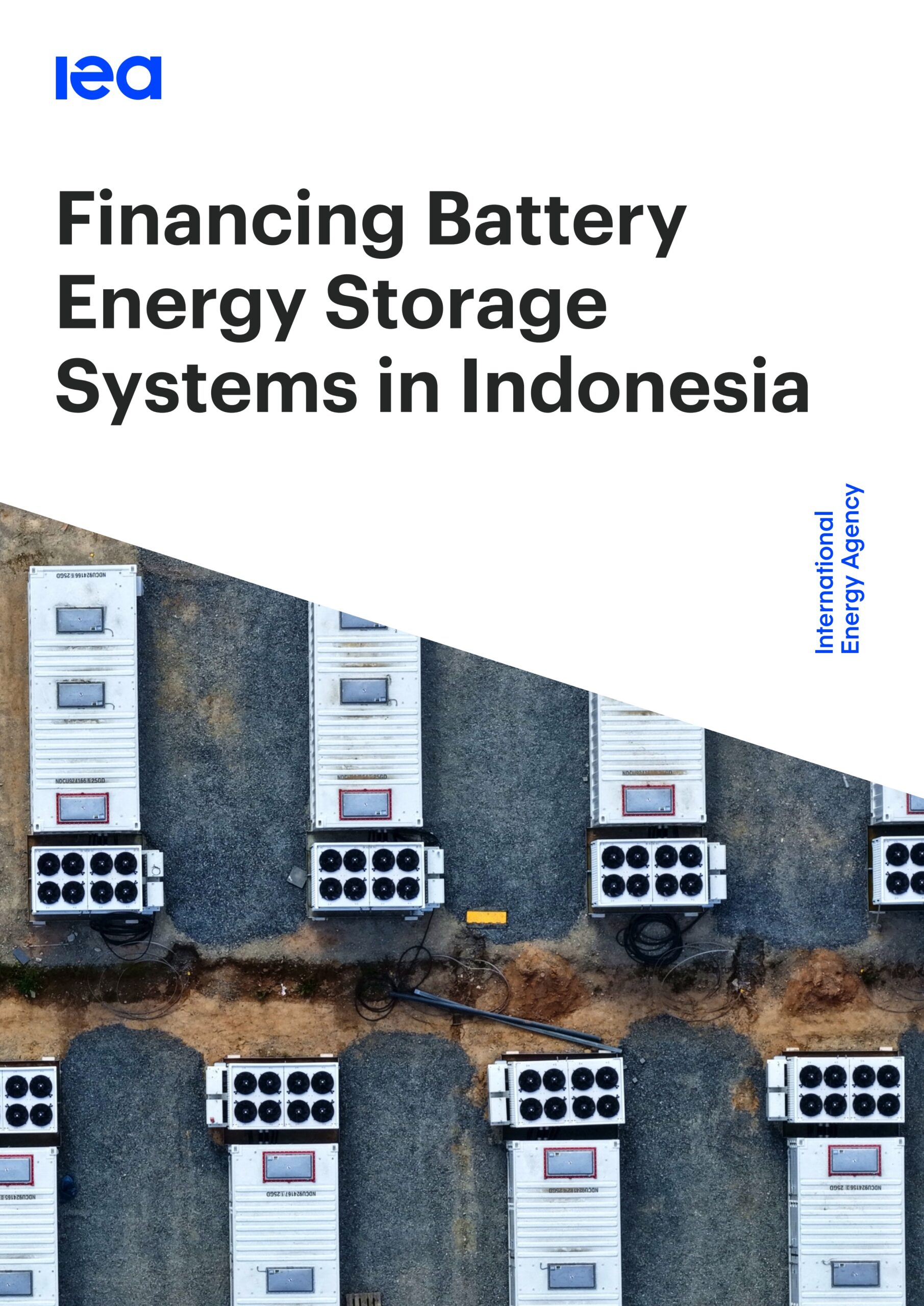
Financing battery energy storage systems in Indonesia
This report analyses financing requirements for 9.6 GW of battery energy storage in Indonesia’s RUPTL 2025-2034. Total investment needs reach USD 5 billion. It evaluates business models and the role of concessional funding in bridging bankability gaps for standalone and hybrid projects across various island systems.
Please login or join for free to read more.

OVERVIEW
Setting the scene: BESS and Indonesia’s energy transition
Indonesia’s power sector is undergoing a significant transformation, with electricity demand forecast to rise from nearly 500 terawatt-hours (TWh) in 2025 to nearly 800 TWh by 2035. PT Perusahaan Listrik Negara (PLN), the state-owned utility, has published the Electricity Supply Business Plan (RUPTL) 2025-2034 to address this growth. The plan targets 69 gigawatts (GW) of new power capacity, including 6 GW of standalone battery energy storage systems (BESS) and 3.6 GW of hybrid (solar PV-plus-BESS) capacity. Globally, BESS technology has matured rapidly, with the average cost of turnkey 2-hour duration systems declining by 46% from 2020 to 2025. Lithium iron phosphate (LFP) chemistries now dominate utility-scale installations, now accounting for over 90% of the BESS market globally.
In Indonesia, BESS deployment is in its early stages, with approximately 30 MW operational by the end of 2025. The electricity sector is characterised by a highly centralised structure, where PLN accounts for close to 70% of power generation. PLN’s financial position is critical, with total assets of IDR 1 837 trillion (approximately USD 110 billion) at the end of 2025. However, the utility relies heavily on government support; in 2024, PLN received an estimated total of IDR 713.5 trillion (USD 46 billion) in subsidies. In 2022 alone, subsidy and compensation transfers from the government of Indonesia amounted to around IDR 123 trillion (approximately USD 9 billion).
BESS project implementation in Indonesia
Standalone projects are likely to be remunerated under full tolling agreements, providing fixed-priced capacity payments in exchange for grid services. Hybrid projects, which pair storage with renewable generation, typically operate under power purchase agreements (PPAs). Regulatory foundations are established through Presidential Regulation 112/2022, which introduced ceiling tariffs differentiated by technology and location. Recent updates, such as MEMR Regulation 5/2025, have improved bankability by fixing maximum PPA durations at 30 years and transitioning to a build-own-operate (BOO) structure, allowing independent power producers (IPPs) to retain asset ownership. Regulation 19/2025 represents one of the first official recognitions of BESS within Indonesia’s power infrastructure, focusing on projects replacing diesel generation in remote areas.
Investment needs and financing structures for BESS in Indonesia
Completing the RUPTL pipeline requires a total investment of USD 5 billion. Annual investment needs average nearly USD 560 million from 2026 to 2034. While PLN is responsible for over 70% of total capacity additions, it accounts for 60% (nearly USD 3 billion) of overall BESS spending needs. Private sector investment accounts for the remaining USD 2 billion. Based on modelled structures, commercial financiers provide an estimated USD 2.5 billion, representing half of total investment needs. Public finance, including equity injections from the Indonesian government and sovereign wealth funds, provides an estimated USD 2.3 billion. International public finance (IPF) reaches an estimated USD 275 million.
The cost of capital remains high, with the weighted average cost of capital (WACC) for BESS in Indonesia lying between 9% and 11% in 2024. To mitigate risks, the Indonesia Just Energy Transition Partnership (JETP) aims to mobilise USD 20 billion in financing. Concessional funding from international and domestic public financiers—estimated at USD 460 million, or nearly 10% of total investment—is needed to de-risk first-of-a-kind projects. For Indonesia’s first standalone BESS projects, replacing commercial debt with concessional terms could lower necessary availability payments by around 6%.
Implications for achieving RUPTL 2025-2034 objectives
Standalone BESS dominate large grids in Java, Madura, Bali, and Sumatra, where 4.2 GW and 1.1 GW are planned respectively. These assets provide flexibility, frequency regulation, and load smoothing. Bankability modelling indicates required availability payments ranging from approximately USD 111 per kilowatt (kW) per year in Java, Madura and Bali to almost USD 300/kW/year in remote regions. For hybrid projects, the BESS component adds a PPA tariff uplift ranging from USD 8 per megawatt-hour (MWh) to USD 18/MWh. Hybrid systems are vital in Sulawesi and Maluku to support de-dieselisation. The required tariff uplift is more sensitive to capital expenditure (CAPEX) than to financing costs, with BESS CAPEX expected to fall by more than 25% over the RUPTL period.
Key recommendations
Strategic actions are recommended to accelerate deployment. These include legally recognising standalone BESS as network assets and integrating BESS functionality into the national grid code. Standardised tolling agreements and PPA frameworks should be created, specifying requested services and their remuneration mechanisms. Pilot projects should be prioritised in Java, Madura and Bali for standalone systems and Sulawesi for hybrid assets. Furthermore, the Indonesian government should leverage concessional financing to support de-dieselisation in eastern islands where system sizes are small and isolation poses bankability challenges. Establishing a working group comprising stakeholders from MEMR, PLN, and the Ministry of Finance is recommended to ensure BESS-related regulations accurately reflect system needs and costs.




