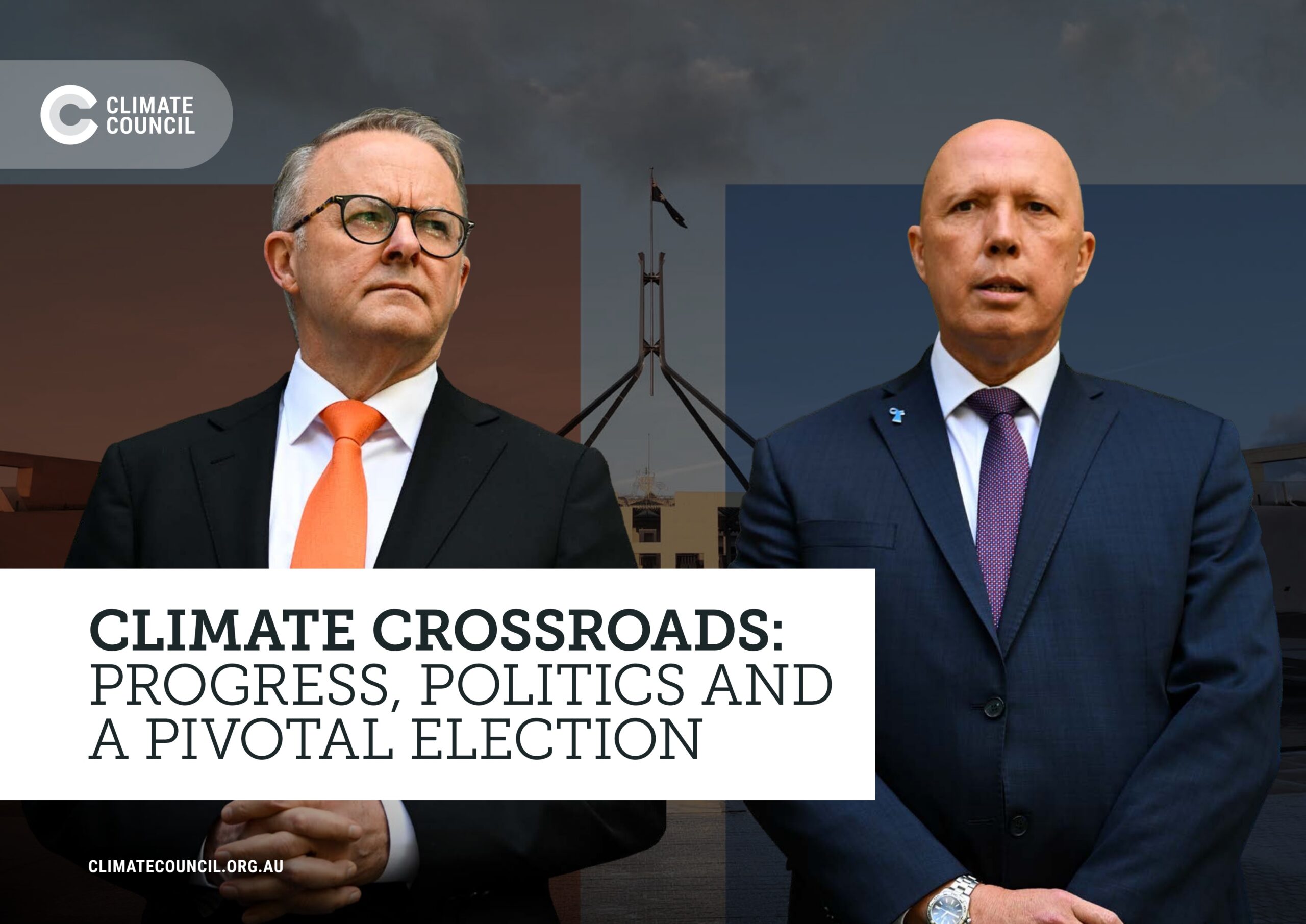
Climate crossroads: Progress, politics and a pivotal election
This report evaluates Australia’s climate progress during the 47th Parliament and assesses major party policies for the upcoming election. It highlights meaningful legislative advancements while critiquing ongoing fossil fuel approvals. The analysis compares Labor, Coalition, and Greens’ commitments against science-based targets necessary for a safer climate future.
Please login or join for free to read more.

OVERVIEW
Key findings
The Climate Council analysis found that the Albanese Labor Government has delivered clear progress during the 47th Parliament, while the Liberal-National Coalition ranks worst on climate change. The government made progress on renewable energy, clean transport, and climate targets, earning a rating of Right Direction. However, its approval of 26 coal, oil, and gas developments undermined this record. The Australian Greens were rated as having the Strongest climate policies. In contrast, the Liberal-National Coalition voted against every law to cut climate pollution in the past three years. Their proposed policies, including a nuclear scheme and gas expansion, would increase climate pollution by at least 6.3 billion tonnes, leading to a rating of Harmful.
Introduction
The 2022 federal election delivered a clear mandate for stronger climate action. Australia’s 47th Parliament was tasked with respecting climate science and advancing policies to transform Australia into a clean energy superpower. While meaningful progress has been made, including legislated emissions reduction targets and accelerated renewable energy investment, the report scrutinises whether these actions are sufficient to meet science-aligned requirements. The Climate Council remains non-partisan, advocating for evidence-based policies that keep Australians safe from worsening climate extremes.
Measuring progress on climate action in the 47th Parliament
Major climate policy reforms mean that Australia’s projected 2030 climate pollution is already expected to be 39 million tonnes lower than the trajectory in 2022, representing a 9% improvement. When combined with revisions to land-based carbon absorption, Australia is now expected to achieve a 42.6% reduction in climate pollution on 2005 levels by 2030. Credible, science-backed policy requires a 75% cut by 2030 and reaching net zero by 2035. The current legislated target of 43% by 2030 and net zero by 2050 is considered a decade too late by scientists to hold global warming at the safest levels possible.
The key climate policy battles of the 47th Parliament
The Climate Change Bill 2022 established a legal framework for action, with crossbenchers securing amendments to clarify that the 2030 target is a floor, not a ceiling. In the energy sector, the government established the Rewiring the Nation program with $20 billion in low-cost financing and the Capacity Investment Scheme to underwrite 32 GW of new renewable generation and storage. Total renewable investment reached record levels of $2.3 billion in the June 2024 quarter. However, the government approved 12 new and expanded coal mines, expected to result in 2.5 billion tonnes of lifetime pollution, and issued nine new offshore gas exploration permits.
Significant progress was made in transport through the New Vehicle Efficiency Standard (NVES), which is expected to cut over 300 million tonnes of climate pollution by 2050. The government also committed $250 million to expand electric vehicle infrastructure and $100 million for active transport. In industry, reforms to the Safeguard Mechanism require the nation’s largest polluters to reduce emissions by approximately 5% annually, though the plan still allows for unlimited carbon credit offsets. The $22.7 billion Future Made in Australia plan was also introduced to grow clean manufacturing and critical minerals industries.
What does the 48th Parliament need to deliver?
The next term of government will determine if Australia secures or squanders a safer future. Labor has committed to maintaining its 43% target and 82% renewable electricity target while implementing the Future Made in Australia plan. The Liberal-National Coalition plans to abandon the 2030 target and introduce a nuclear scheme that would lock in at least two billion more tonnes of pollution from coal, oil, and gas. The Greens and various independents continue to advocate for a 75% reduction target by 2030, an end to new fossil fuel subsidies, and expanded funding for high-frequency public transport and household electrification.
Conclusion
The 47th Parliament established a foundation for a cleaner future, but the transition remains incomplete. Voters face a choice between accelerating the move away from fossil fuels or stalling, which would leave Australians exposed to worsening climate impacts and economic risks. The next parliament must go further and faster to align with scientific requirements, including phasing out fossil fuel exports, which are currently the third largest in the world.
Appendix
The report details 12 coal projects approved during this term, including the Mount Pleasant expansion (876 Mt lifetime impact) and Narrabri coal mine expansion (475 Mt). Five gas projects were approved, including Atlas Stage 3 and Santos-Dorado. Additionally, nine offshore exploration permits were issued to companies including Esso (ExxonMobil), Beach Energy, Woodside, and Chevron across the Otway, Sorell, Northern Carnarvon, and Bonaparte Basins.