

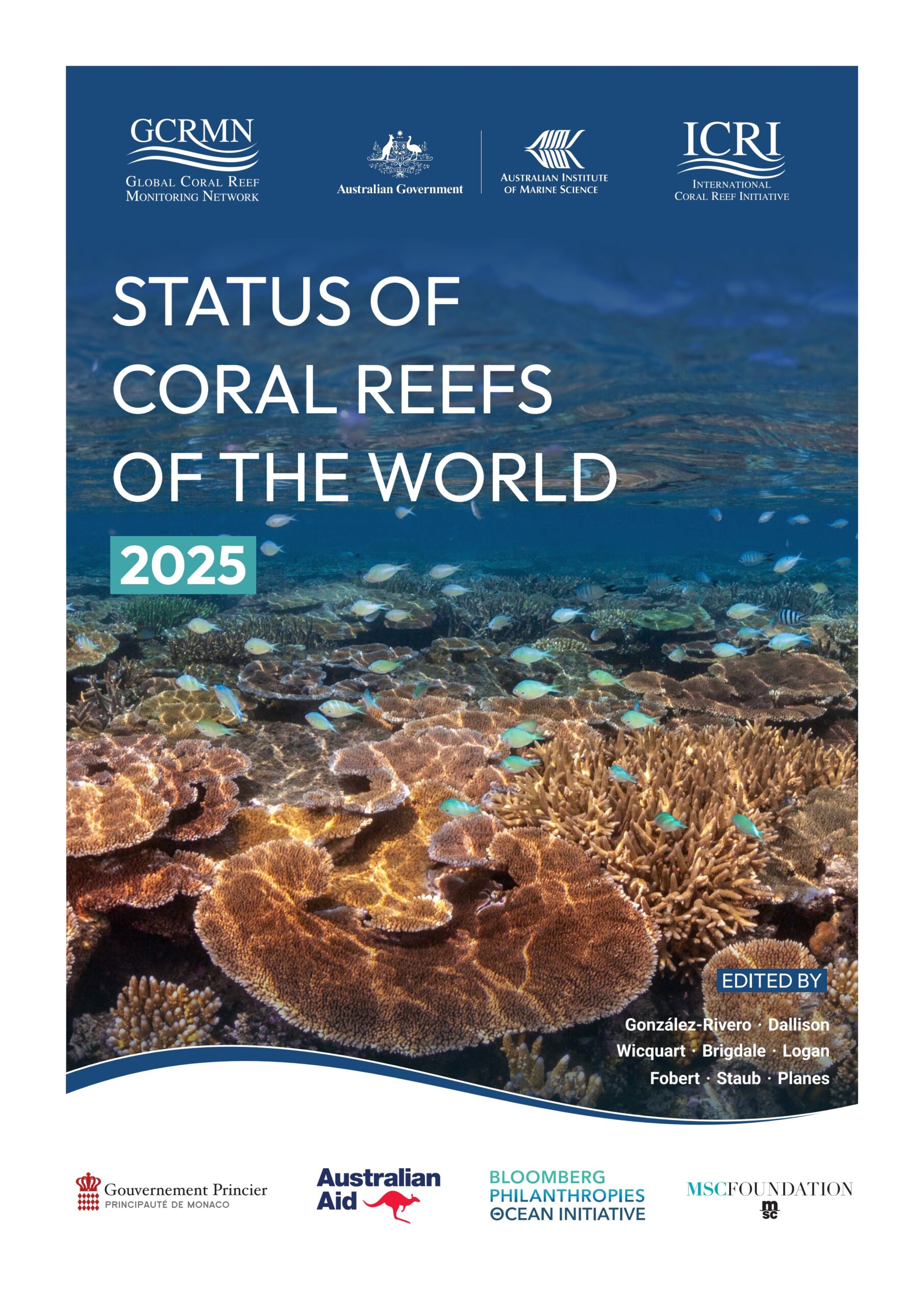
Status of coral reefs of the world: 2025
This seventh GCRMN assessment reveals a 9.5% relative decline in global hard coral cover since 2009, driven by intensifying marine heatwaves. While reefs show recovery potential, shortening disturbance intervals threaten long-term resilience. The report provides a critical evidence base across 123 countries to inform global conservation policy.
Please login or join for free to read more.

OVERVIEW
Introduction
Shallow water coral reefs are amongst the most biologically diverse and socio-economically valuable ecosystems on Earth. Despite occupying less than 0.2% of the ocean floor, they support over 30% of all known marine species and underpin the well-being of close to one billion people. The value of goods and services provided by these ecosystems is estimated at up to USD 9.9 trillion per year. Key contributions include shoreline protection, where complex reef structures dissipate wave energy by up to 97%, and food security, with 50–90% of animal protein in some Pacific diets sourced from reef-associated fisheries. Additionally, coral reef tourism contributes an estimated USD 36 billion to the global economy annually.
Global status of coral reefs
The 2024 global average hard coral cover was estimated at 25.8%. Comparing modern averages from 2020–2024 with the 1980–2009 reference period reveals an overall relative decline of 9.5%. This decline follows a stepwise, ratcheting-down pattern driven by four global bleaching events recorded since 1998, each associated with a relative loss of 6.5–9.9% of global hard coral cover. The period between 2023 and 2024 recorded an 8.9% decline, which represents the largest single-year loss on record. While coral reefs can recover when disturbance frequency eases—demonstrated by a 6% relative recovery following the third global bleaching event—the intervals between major disturbances are shrinking from approximately ten years to just five or six years in many regions.
Marine heatwaves are identified as the primary driver of this decline, with sea surface temperatures over reefs rising by 0.81°C between 1985 and 2025. In parallel, global macroalgal cover has increased steadily by 44.1% since 1980. Although absolute levels remain low at 6.8% globally, the trend is concerning as macroalgal dominance at regional and local scales can hinder reef recovery following mortality events. Nearshore reefs subject to nutrient enrichment and herbivore loss remain particularly at risk of algal phase-shifts.
Regional status of coral reefs
Coral reef trajectories are highly region-specific. Four regions show strong evidence of long-term decline: the ROPME Sea Area (-48.7%), the Caribbean (-43.4%), the Pacific (-18.3%), and Australia (-10.9%). In Australia, median cover ranged between 20% and 34% over the past four decades, with mass bleaching recently superseding cyclones and starfish outbreaks as the dominant cause of loss. The Caribbean has experienced nearly five decades of progressive loss, with macroalgal cover increasing from 7.6% to 20.0% as reef-building acroporids and key herbivores like the Diadema antillarum sea urchin suffered catastrophic mortalities.
Stability or fluctuations without long-term directional change were observed in Brazil, the East Asian Seas, the Eastern Tropical Pacific, and the Red Sea and Gulf of Aden. Remarkable stability was noted in the East Asian Seas, which represent 30.3% of the world’s reef extent. Conversely, South Asia and the Western Indian Ocean demonstrated apparent recoveries of 16.2% and 43.0% respectively compared to their reference states. However, these increases must be interpreted with caution due to significant data sparsity in early periods and the likelihood that reference-period cover already included degraded reefs.
Conclusion
While coral reefs remain under unprecedented pressure, they have not yet crossed a point of no return. Their future condition depends on climate trajectories and the successful reduction of local pressures. Holding global warming as close as possible to the 1.5°C target is the most critical action for reef persistence. Local management practices, such as effective fisheries management and well-resourced protected areas, can increase reef resilience but cannot substitute for global climate mitigation. Six priorities for strengthening global monitoring include increasing funding, extending spatial and temporal coverage, standardising methods, improving data access under FAIR principles, broadening indicators beyond hard coral cover, and integrating socio-economic data to support whole-system interpretation.
Materials and methods
This assessment is based on 21.1 million observations from 87,299 surveys across 36,886 reef sites in 123 countries and territories over five decades. Trends were estimated using Bayesian hierarchical models, with regional estimates weighted by coral reef area to derive global averages. The study used a 5-kilometre buffer around mapped reefs to estimate human population proximity, identifying 104 million inhabitants living near reefs as of 2020. Spatial units were defined using the Marine Ecoregions of the World framework, resulting in 110 ecoregions aggregated into 53 subregions and 10 major GCRMN regions.




