

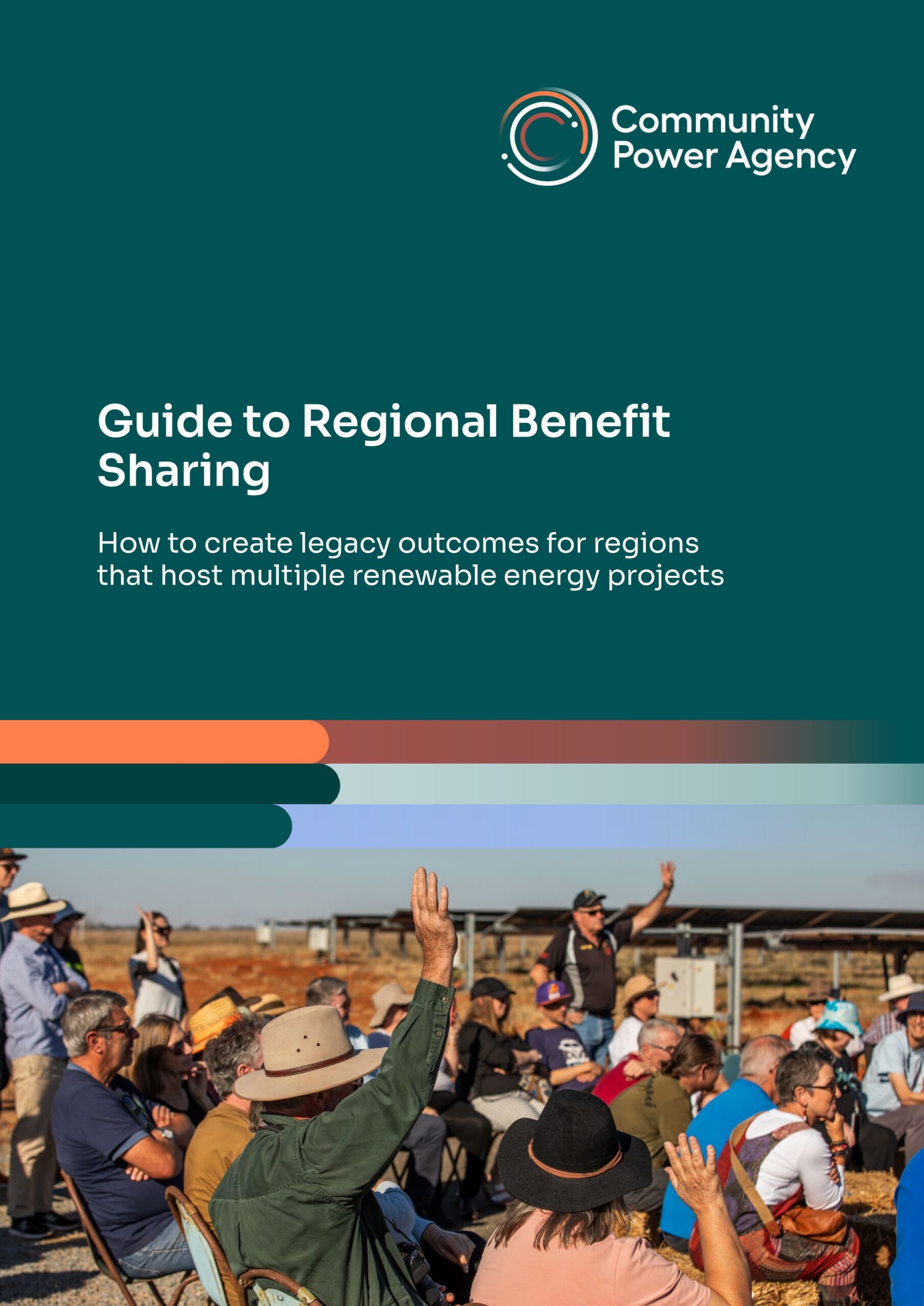
Guide to regional benefit sharing
This report provides a framework for coordinating renewable energy community benefit programmes at a regional level. It outlines design elements, governance structures and engagement strategies. Featuring Australian case studies, the guide highlights how strategic collaboration can minimise engagement fatigue and maximise long-term legacy outcomes for host communities.
Please login or join for free to read more.

OVERVIEW
Executive summary
Regional benefit sharing offers a significant opportunity to harness the rewards of the energy transformation in regional, rural and remote Australia. It is defined as the strategic aggregation of community benefit sharing programmes associated with energy projects located within a common geographic region. This guide provides a framework for regional leaders and stakeholders to design and implement effective programmes that ensure renewable energy benefits are equitable and endure over time. It emphasises the importance of early stakeholder conversations, collaborative co-design and alignment with local and state government policies.
The challenge at hand
As Australia accelerates its investment in clean energy, several regions are hosting multiple renewable energy projects. This transformation can have both positive and negative impacts on the local environment, economy and community. Regional coordination of benefit sharing is essential to avoid duplication across individual project-level programmes, reduce engagement fatigue within communities and maximise legacy outcomes by pooling resources for greater impact. Strategic coordination ensures that renewable energy projects build lasting community trust and strengthen social licence.
Understanding benefit sharing
Community benefit sharing involves sharing the rewards of renewable energy developments with host communities to contribute to the future vitality of the region. It goes beyond providing financial assets to include building long-term relationships and trust. Benefit sharing does not include standard business costs such as local procurement, landowner payments, council rates or regulatory biodiversity plantings. Regional benefit sharing allows communities to share rewards more equitably and stimulates strategic legacy outcomes with longer-lasting impacts.
Getting started
The first step in exploring a regional benefit sharing programme is to open space for conversation and prioritise listening to communities. Every region is unique, with varying levels of social infrastructure, regional networks and previous strategic planning. Initial conversations with key stakeholders, including energy project operators, local councils and First Nations groups, are vital to building trust and gauging interest in a collaborative approach. This process should recognise First Nations sovereignty and support First Nations-led approaches in regional design.
Design elements of regional benefit sharing
Design work involves determining how benefit sharing will be coordinated and which legacy priorities should be funded. Coordination can be achieved by pooling project budgets into a central fund or jointly funding specific initiatives. Design elements include defining the geographic scope, funding sources and guiding principles such as transparency and community participation. Potential functions include granting funds, making investments, holding equity in energy projects and streamlining administration for community grant applications.
Legal and governance structures vary depending on the desired functions. Options include informal partnerships using a Memorandum of Understanding (MOU), using existing entities like councils or not-for-profits, or creating new entities such as companies limited by guarantee, incorporated associations or non-distributing co-operatives. Some regions may consider discretionary or ancillary trusts; notably, Public or Private Ancillary Funds require an initial corpus of at least $500,000. Regardless of the structure, community input into decision-making is crucial to ensure programmes remain fit for purpose.
Leading the design of a regional benefit sharing programme
Collaboration requires at least one lead organisation to initiate discussions, such as community-led collaborations, economic development organisations or local councils. The guide highlights several case studies, including the Wimmera Southern Mallee Regional Energy Collaboration, which established a publicly available Commitments Register to track promises across housing, workforce and community benefits. In the Western Downs, a pilot programme used co-design workshops to identify governance priorities for a regional benefit sharing model.
In Central Western Queensland, the Remote Area Planning and Development Board (RAPAD) developed an Australian-first benefits agreement. This framework targets approximately $183 million in annual cash flows for the community over 25 years. Target payments include $10,000 per megawatt (MW) of installed transmission capacity, $750 per MW per annum for wind generation and $500 per MW per annum for solar generation. Additionally, Banana Shire Council is working with state government partners to design a community legacy fund to support economic transformation.
What we have heard
Stakeholder feedback indicates distinct priorities. Community leaders advocate for place-based, participatory approaches that complement rather than replace local benefits for immediate neighbours. Industry stakeholders support community empowerment and administrative efficiency, generally preferring voluntary contributions to maintain flexibility between local and regional priorities. Government stakeholders emphasise the need for alignment with the pace of development and integration with Renewable Energy Zone (REZ) frameworks and grant programmes.
Risk mitigation
As an emerging concept, regional benefit sharing involves risks that require management strategies. Potential risks include the failure of legacy-funded projects, negative community sentiment regarding a specific project impacting the broader programme, delays in funding distribution and a perceived lack of transparency in decision-making. Organisations must address these risks within their governance structures and terms of reference to maintain community trust.
Conclusion
Regional benefit sharing offers an unprecedented opportunity to harness the benefits of Australia’s energy transformation. By moving beyond individual project-based sharing to coordinated regional programmes, communities can reduce duplication and achieve strategic, lasting legacies. Embracing collaborative leadership and centring community voices ensures that the energy transition delivers meaningful benefits for generations to come.




