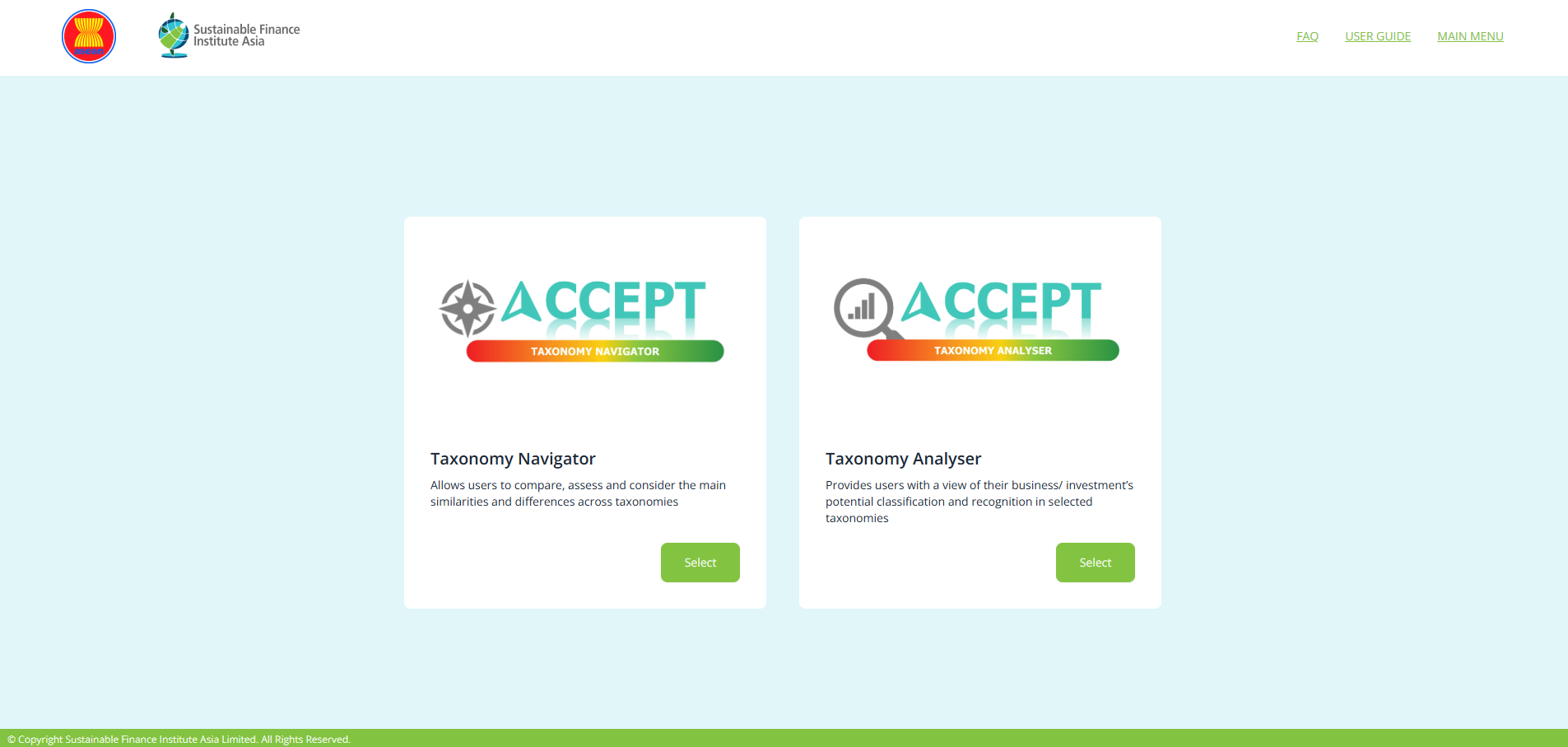
The ACCEPT Taxonomy Navigator is a digital platform that enables users to explore and compare multiple sustainable finance taxonomies across jurisdictions. It is designed to support consistent interpretation of classification criteria and improve understanding of how economic activities align with sustainability frameworks. Finance professionals may use it to navigate differing taxonomy requirements and inform decision-making.
Organisation behind the tool
The tool is developed and maintained by the Sustainable Finance Institute Asia (SFIA). It forms part of the ACCEPT (All-Countries Common Equivalence Platform for Taxonomies) initiative, which aggregates official taxonomies from ASEAN and other jurisdictions to support interoperability and comparability.
What the tool does
- Enables users to explore multiple sustainable finance taxonomies in a single platform.
- Provides a taxonomy navigator to view activities and associated classification criteria.
- Allows comparison of requirements across different national and regional taxonomies.
- Includes taxonomy-specific guidance and sector-level information.
- Supports analysis of how economic activities align with sustainability thresholds and technical screening criteria.
- Regularly updates taxonomy content to reflect revisions and new frameworks.
Target audience
The primary users include financial institutions, regulators, asset managers, and corporates applying sustainable finance taxonomies.
Additional users include rating agencies, second-party opinion providers, policymakers, and researchers seeking to understand taxonomy alignment and comparability.
Relevance to finance professionals
- Risk assessment – Supports evaluation of exposure to transition risks by clarifying which activities meet sustainability criteria across jurisdictions.
- ESG analysis – Provides structured classification frameworks to assess environmental alignment and support sustainability reporting.
- Market/commodity insights – Enables sector-level review of eligible activities (e.g. energy, transport, agriculture) under different taxonomies.
- Investment context – Assists in identifying taxonomy-aligned investments and comparing standards across markets, improving cross-border investment decisions.