

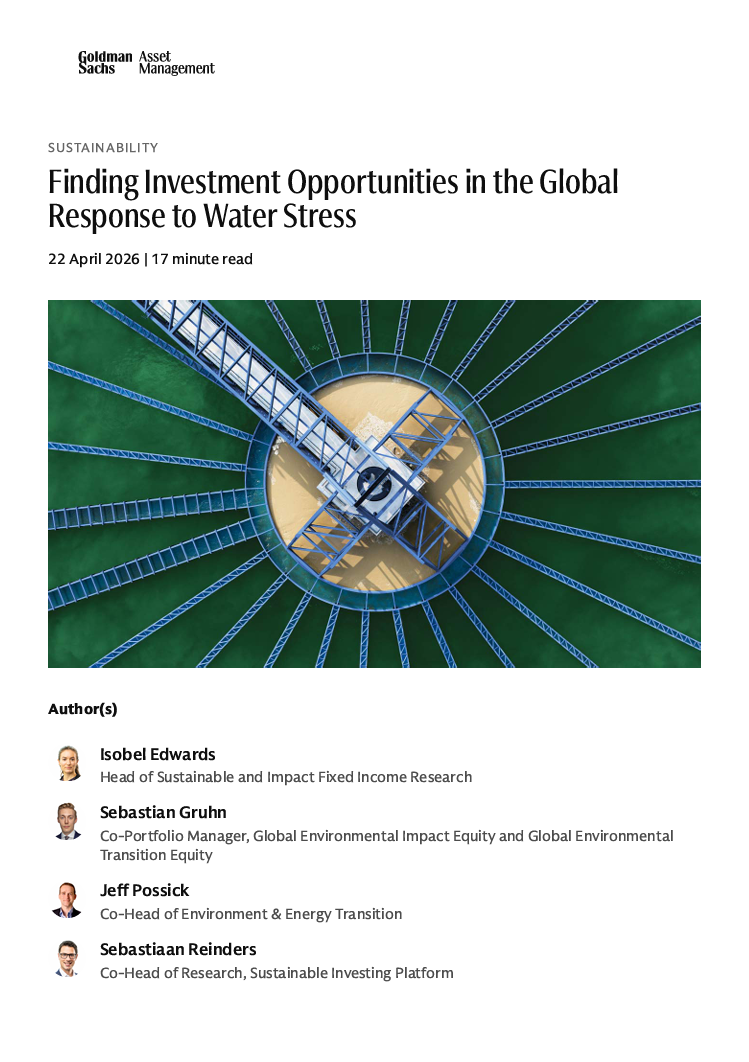
Finding investment opportunities in the global response to water stress
Examines investment opportunities arising from global water stress, focusing on infrastructure renewal, risk management and efficiency gains. Outlines how investors can identify growth across asset classes and technologies addressing water scarcity, supporting resilience, cost reduction and long-term economic trends.
Please login or join for free to read more.

OVERVIEW
Perspectives
This report examines investment opportunities linked to global water stress, highlighting water’s essential role across industries such as agriculture, energy and manufacturing. It frames the investment case around managing downside risks, improving margins, and accessing long-term growth. Rising demand, finite supply, and climate pressures are increasing both risks and opportunities for investors.
Key takeaways
The investment case is driven by structural demand for water solutions and decades of underinvestment in infrastructure. Opportunities arise from rebuilding ageing systems, mitigating operational and regulatory risks, improving efficiency, and capturing growth in water-related technologies. Investors are encouraged to assess opportunities based on risk mitigation, efficiency gains, and exposure to secular growth.
Rebuilding aging infrastructure
Global water infrastructure requires significant expansion, with US$13.2 trillion needed by 2040 and annual investment needing to more than double from around US$380 billion. Governments account for about 85% of spending.
Investment is increasing due to ageing systems, climate impacts, and regulatory pressures. Upgrades can reduce costs, improve reliability and enhance resilience. Opportunities span fixed income, equities and private markets, including green and blue bonds financing water networks, treatment and leak reduction. Around 30% of water is lost through leaks, highlighting efficiency gains and investment potential.
Managing downside risks
Water scarcity creates risks including production disruption, higher costs, and regulatory exposure, particularly in agriculture, energy and manufacturing. Around 19% of global public equity revenues depend heavily on water.
Investors should identify both exposed companies and solution providers. Demand is rising for firms offering leak detection, filtration and infrastructure protection. Private companies across the value chain provide opportunities to improve resilience and reduce water loss, supported by increasing investor focus on water-related risks.
Improving profit margins
Water-sector companies have outperformed broader markets over the past decade (page 8), supported by rising capital expenditure. Firms are investing in technologies such as digital monitoring and water treatment to improve efficiency, reduce waste and lower costs.
Investors should prioritise companies with strong product portfolios, market share growth and critical value chain roles. The sector offers diversification benefits, with relatively stable earnings and lower sensitivity to themes such as artificial intelligence.
Identifying growth opportunities
Innovation is creating opportunities in areas such as smart meters, desalination and water treatment, particularly in private markets. Agriculture, which uses around 70% of global freshwater, presents significant efficiency opportunities.
Technologies such as AI-driven irrigation can reduce water use and costs; one system saved 132 billion gallons in 2024. Investors can access growth through private equity, acquisitions and emerging technologies addressing water scarcity challenges.
Focus on water
Water is presented as a long-term investment theme driven by demand growth, infrastructure gaps and climate pressures. Investors should focus on opportunities that address risk, improve efficiency, or capture growth, supporting diversification and alignment with the global response to water stress.




