

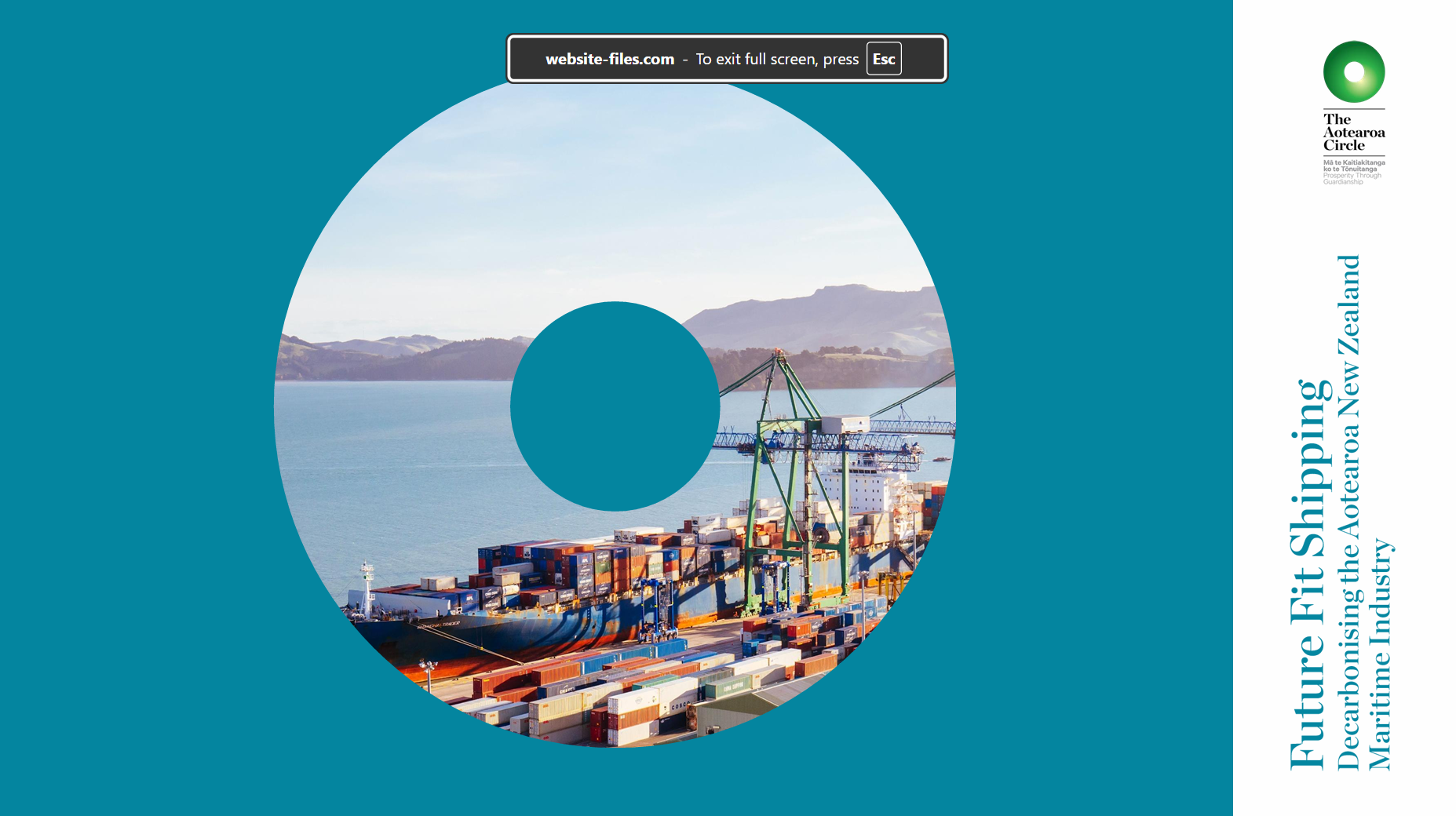
Future fit shipping: Decarbonising the Aotearoa New Zealand maritime industry
Aotearoa New Zealand’s maritime sector faces rising decarbonisation pressures. The report outlines emissions-reduction pathways, alternative fuel options, green corridor opportunities, and economic risks of inaction. It recommends coordinated planning, trans-Tasman collaboration, and enabling regulation to maintain trade competitiveness and support a lower-emissions shipping system.
Please login or join for free to read more.

OVERVIEW
Foreword
The report notes that 99.7% of Aotearoa New Zealand’s trade by volume and 81% by value moves by sea, with annual exports valued at over NZD 74 billion and imports at more than NZD 80 billion. Maintaining resilient maritime links is essential for economic competitiveness, particularly as global markets and regulatory frameworks shift towards low-emissions supply chains. The International Maritime Organization’s (IMO) incoming levy increases the need for timely decarbonisation. New Zealand faces real cost exposure from new emissions pricing mechanisms, including a potential USD 380 per tonne CO₂-equivalent carbon price applied to ships over 5,000 gross tonnes.
Executive summary
International shipping is a hard-to-abate sector and, if treated as a country, would be the sixth-largest global emitter. The report states that New Zealand will largely be a technology taker in the global transition but can still influence decarbonisation along key trading routes. Decarbonising maritime supply chains is complex due to global interdependence and New Zealand’s geographic isolation, yet the transition is achievable through coordinated policy, improved efficiency, and alternative fuels.
Economic modelling indicates that decarbonising at a similar pace to competing trading nations could avoid GDP losses of NZD 17.5–94.1 billion (NPV) by 2050. Failure to act increases risks from IMO levies, market access constraints, Scope 3 emissions scrutiny, and reputational impacts. The report highlights an emerging multi-fuel future, with biofuels likely to drive early emissions displacement, while methanol, ammonia, and LNG develop at varying maturity levels. It also identifies the need for increased port capacity as larger alternative-fuel vessels evolve.
Green corridors—designated low-to-zero emissions shipping routes—are identified as a key mechanism to stimulate alignment among fuel producers, vessel operators, ports, regulators, and cargo owners. Establishing these corridors requires access to suitable vessels, alternative fuel supply capability, port infrastructure, and enabling regulatory settings.
Es | Overview
The report positions green corridors and maritime decarbonisation as both an environmental and economic imperative. New Zealand’s reliance on shipping and the evolving global regulatory environment underscore the urgency of transition.
Es | Purpose of this report
The report aims to outline considerations for establishing green shipping corridors and to identify challenges, opportunities, and potential pathways for decarbonising New Zealand’s maritime supply chains. It draws on market engagement with more than 50 stakeholders, four alternative-fuel roadmaps, and an economic impact assessment modelling avoided costs and trade risks.
Es | Key findings – Charting a lower emission course
Key findings include:
• Decarbonisation can prevent major economic losses and help maintain market access.
• Multiple alternative fuels will be required, increasing transition complexity.
• Ports may need to expand capacity to accommodate larger vessels.
• Green corridors can accelerate uptake of low-emissions fuels and technologies.
• Domestic opportunities exist across freight aggregation, mode shift, and local fuel production.
• Renewable energy supply and a conducive regulatory system are foundational.
• Alternative fuels will increase costs, but container-sector price impacts are estimated at only 1–4% of commodity value.
Es | What do we do about it?
A staged approach is recommended, beginning with routes offering the largest emissions-reduction potential. Collaboration across government agencies and industry is essential. Establishing an initial green corridor involves forming a working group, assessing existing trade flows, undertaking feasibility studies, and developing a corridor roadmap with policy alignment across trading partners.
What do we do about it? Es | Leveraging trans-tasman collaboration
The report recommends joint R&D initiatives, harmonised standards, a bilateral biofuels fund, and feasibility studies supported by agencies such as ARENA, CEFC, and BANZ. Collaboration is necessary due to shared fuel demand and production challenges.
What do we do about it? Es | Broader actions
Broader actions include accelerating the renewable energy transition, assessing future domestic freight needs, developing a national feedstock strategy, engaging in IMO processes, and sharing knowledge with countries progressing green corridors.
Es | Conclusion
Decarbonising maritime transport is complex but achievable. Green corridors offer a practical early step, supporting market access, competitiveness, domestic fuel production opportunities, and long-term energy security for New Zealand.




