Overview
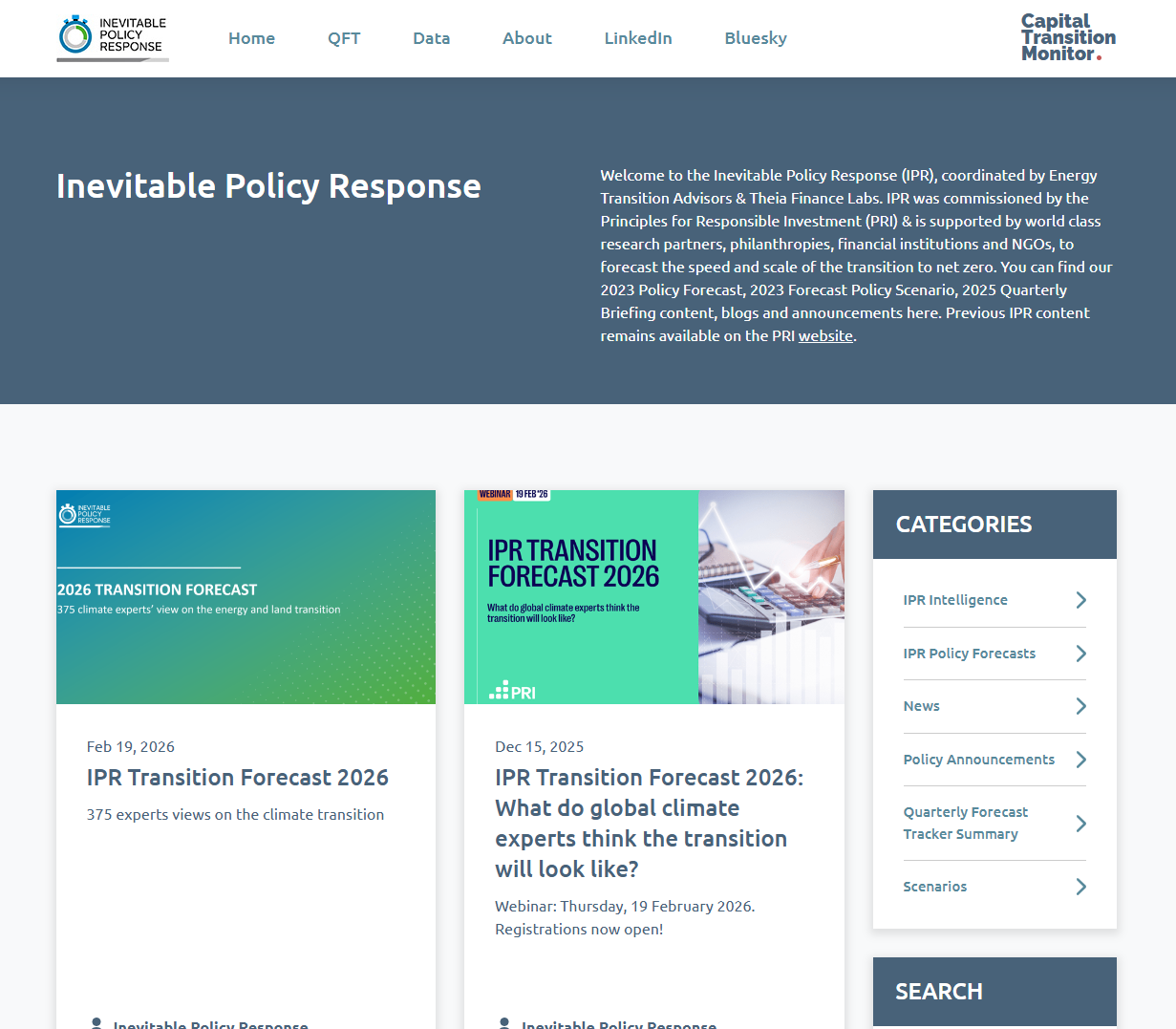
The IPR Transition Monitor is an online climate policy tracking and forecasting platform hosted at ipr.transitionmonitor.com. It provides data on expected government climate actions across countries and sectors. The tool supports analysis of transition risk and policy momentum, and is relevant to finance professionals assessing climate policy impacts on markets and portfolios. It presents quarterly updates and expert-informed forecasts of policy developments to mid-century.
Organisation behind the tool
The platform is maintained by the Inevitable Policy Response (IPR) consortium. IPR was commissioned by the Principles for Responsible Investment (PRI) and is coordinated by Energy Transition Advisers and Theia Finance Labs. It draws on research partners including Deloitte, Carbon Tracker Initiative, Climate Bonds Initiative and Planet Tracker. The consortium produces climate policy forecasts and analytical content to inform investment decision-making.
What the tool does
• Tracks cumulative climate policy announcements and legislation by country and sector.
• Presents Quarterly Forecast Trackers showing directional shifts in policy momentum.
• Hosts policy forecast scenarios informed by surveys of climate and policy experts.
• Displays data tables and charts on policy developments and their expected impact on transition pathways.
• Allows users to review historical and current policy forecasts over multiple years.
Target audience
Primary users are institutional investors, asset managers and analysts focused on climate transition risk. Other audiences include climate researchers, policymakers and risk professionals analysing government policy trends and economic transition scenarios.
Relevance to finance professionals
Risk assessment
• Assesses climate policy momentum that could affect sectoral regulation and economic transition risk.
• Helps contextualise policy-driven risks in energy, land use and industrial sectors through forecasts.
ESG analysis
• Offers data on expected policy developments relevant to environmental and governance risk factors.
• Supports integration of forward-looking climate policy indicators into ESG frameworks.
Market/commodity insights
• Provides insight into likely shifts in energy, mobility and land-use industries under evolving policy landscapes.
• Highlights regional and sectoral policy divergences that could influence commodity markets.
Investment context
• Supplies scenario forecasts that inform strategic asset allocation under different climate policy pathways.
• Aids in evaluating portfolio alignment with expected policy trajectories and long-term transition outcomes.