

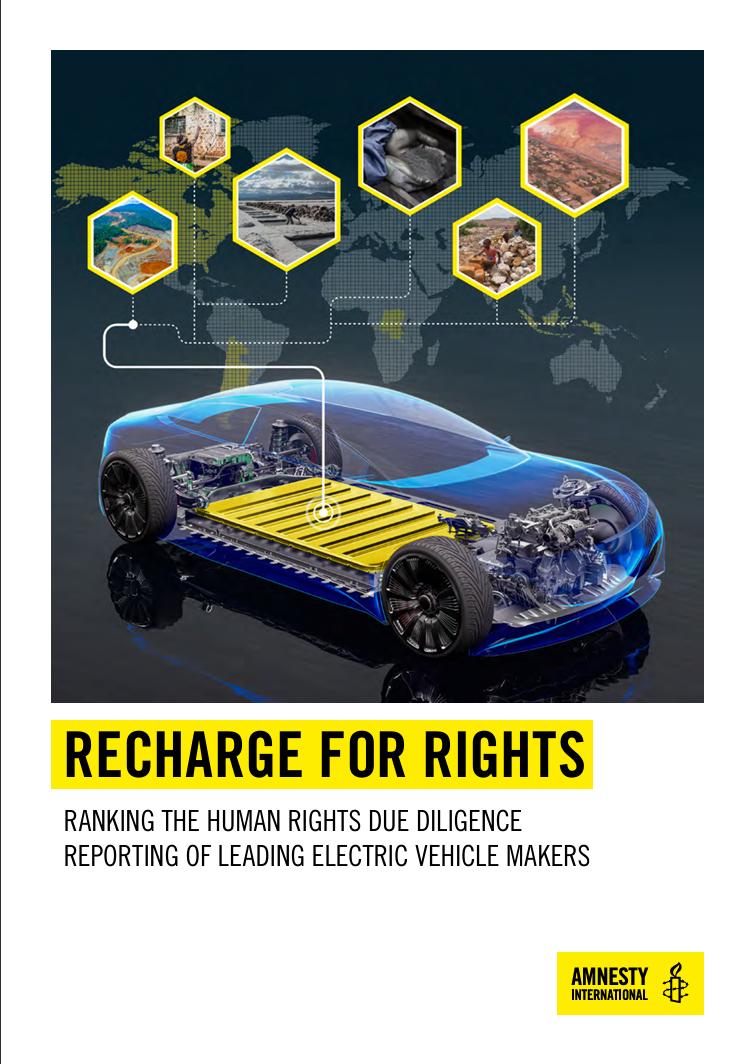
Recharge for rights: Ranking the human rights due diligence reporting of leading electric vehicle makers
Amnesty International assesses 13 leading EV makers’ public reporting on human rights due diligence in battery mineral supply chains. It finds uneven progress since 2017, but no company demonstrates adequate alignment with international standards; Mercedes-Benz and Tesla lead, while BYD ranks last.
Please login or join for free to read more.

OVERVIEW
Methodology
The report assesses 13 leading EV manufacturers using publicly available disclosures and company responses as of August 2024. It evaluates human rights due diligence across six categories aligned with international standards, focusing on cobalt, copper, lithium and nickel supply chains. Limitations include reliance on self-reported data rather than verified outcomes.
Background
The transition to electric vehicles is critical for decarbonisation, potentially reducing emissions significantly, but creates rising demand for battery minerals. This expansion increases exposure to human rights risks, including labour abuses and impacts on Indigenous communities, particularly in mining regions such as the Democratic Republic of the Congo and the Philippines.
Human rights due diligence – Legal framework
The assessment framework is based on the UN Guiding Principles on Business and Human Rights and OECD due diligence guidance. Companies are expected to identify, prevent, mitigate and account for adverse human rights impacts across supply chains, including through stakeholder engagement, transparency and remediation processes.
Company scorecards
Overall, progress has been made since 2017, with many firms adopting human rights policies and conducting risk assessments. However, none of the 13 companies achieved adequate due diligence, with no firm reaching the highest score category. Scores ranged from 51/90 (Mercedes-Benz) and 49 (Tesla) to 11 (BYD).
Across categories, gaps are evident. While most companies have human rights policies, few integrate gender-responsive approaches or fully address Indigenous rights. Only four companies demonstrate moderate identification of risks across all minerals, and several focus narrowly on cobalt in the DRC.
Mitigation efforts are limited, with eight companies providing minimal information on how they address risks. Monitoring and reporting are inconsistent, with six companies disclosing minimal information on due diligence outcomes.
Remediation is particularly weak: 11 companies provide little evidence of effective grievance mechanisms or remedy processes, and disclosure on complaints and outcomes is limited.
Top performers such as Mercedes-Benz and Tesla show relatively stronger disclosure and supply chain mapping, while BYD, Hyundai and Mitsubishi Motors demonstrate minimal alignment and limited transparency.
Conclusion
Human rights abuses linked to battery mineral extraction remain widespread, and industry responses are insufficient. Although some progress has been made, most companies are not demonstrating alignment with international standards or implementing their stated policies. Weak due diligence exposes firms to legal, financial and reputational risks while perpetuating harm to affected communities.
Recommendations
Governments should mandate human rights and environmental due diligence legislation, enforce compliance and ensure access to remedy. Mineral-producing states should require impact assessments, enforce labour protections and uphold Indigenous consent.
Companies should urgently strengthen due diligence by mapping supply chains, identifying risks across all minerals, improving transparency, and disclosing mitigation actions. They should also enhance stakeholder engagement, integrate gender and Indigenous rights considerations, and ensure effective grievance mechanisms and remediation processes.




