

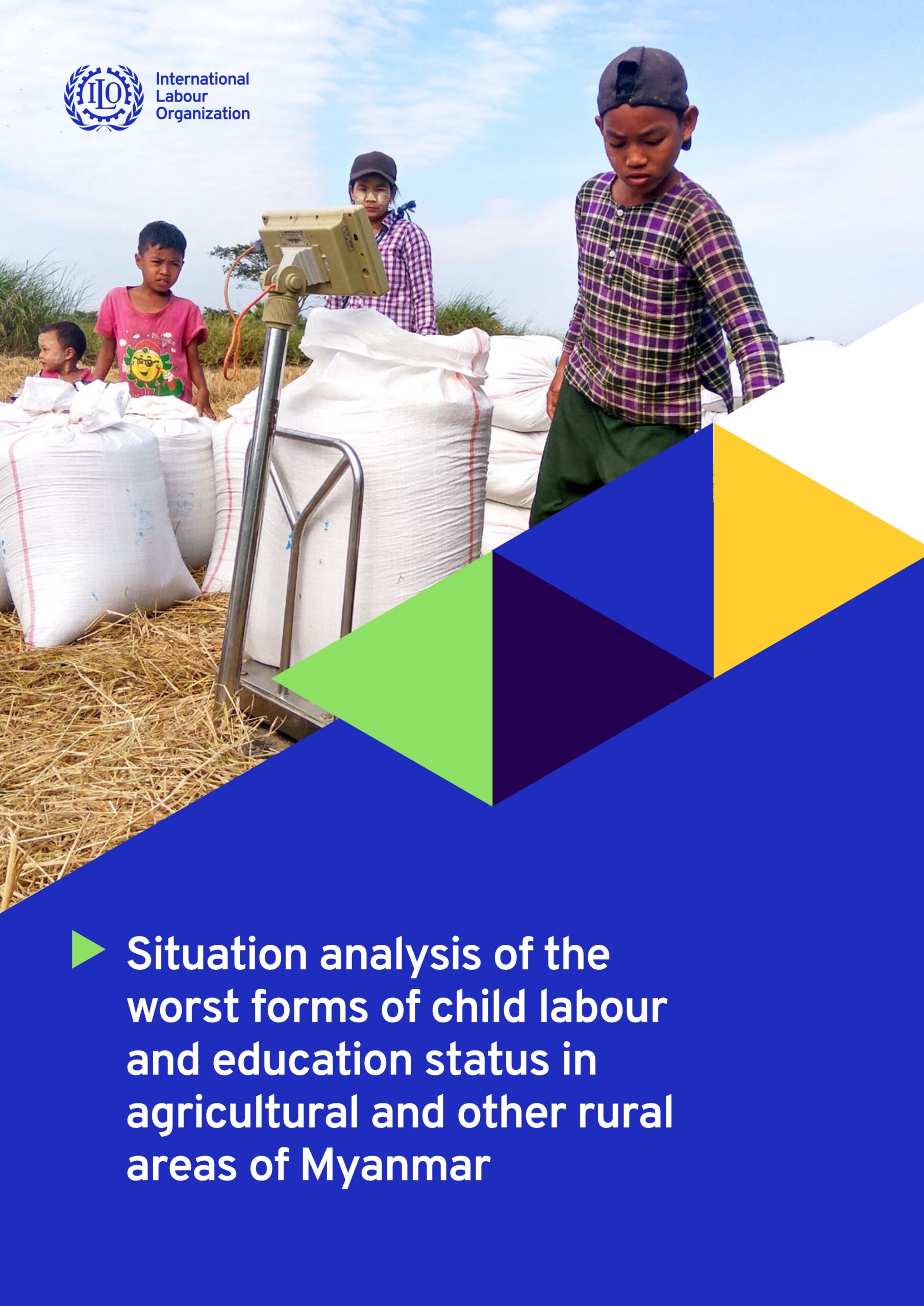
Situation analysis of the worst forms of child labour and education status in agricultural and other rural areas of Myanmar
This report examines child labour and education in rural Myanmar. It highlights how poverty, conflict, and natural disasters, including a 2025 earthquake, drive child labour. It provides strategic recommendations for the ARISE project to improve education access, strengthen livelihoods, and eliminate hazardous work for children.
Please login or join for free to read more.

OVERVIEW
Foreword
Child labour remains one of the most pressing challenges affecting children across Myanmar, particularly in agricultural and rural communities where poverty, livelihood insecurity, and limited access to education are prevalent. These issues have been further exacerbated by conflict, displacement, and the socio-economic impacts of natural disasters. The Achieving Reduction of Child Labour in Support of Education (ARISE) project, implemented by the International Labour Organisation (ILO) with funding from the Government of Japan, seeks to address these challenges through evidence-based interventions. This situational analysis focuses on project areas in Mon State, Southern Shan State, Mandalay Region, and Sagaing Region.
Executive summary
The situation in Myanmar has worsened in recent years due to the consequences of the COVID-19 pandemic, political instability, and natural disasters. Phase I of the ARISE project ran from March 2020 to December 2024, followed by Phase II, which commenced in September 2025 and is scheduled to conclude in August 2026. This qualitative study examined 17 villages across five townships: Chaung-U, Kyaukse, Nyaungshwe, Taunggyi, and Ye. Data collection was performed by six trained researchers between 11 and 25 January 2026, involving 24 key informant interviews and 68 focus group discussions with 435 participants.
3. Literature review
According to the 2015 Myanmar Labour Force Survey, more than 1 million children aged 5–17 years were engaged in child labour. Approximately 57 per cent were in the agriculture sector, and more than 25 per cent were trapped in hazardous conditions. There is a clear positive correlation between age and labour; while only 1.7 per cent of children aged 5–11 were working in 2015, the rate increased to 75.6 per cent for those aged 15–17. School attendance declined as children aged, falling from 88.9 per cent for the youngest group to 47.7 per cent for adolescents aged 15–17. Working children in this older demographic averaged 60 hours per week.
In March 2025, a 7.7 magnitude earthquake in central Myanmar caused more than 3,500 deaths and 5,000 injuries. This disaster disrupted critical services for roughly 2 million people who urgently needed help. Before the earthquake, around 20 million people were in need of aid, and the country’s poverty rate in 2023 had doubled from 25 per cent in 2017.
5. Findings
Agriculture is the principal source of livelihood in the study areas, involving crops like betel nut, rubber, rice, and various seasonal vegetables. Households face multiple challenges, including declining yields, price volatility, and high levels of indebtedness. In Kyaukse and Taunggyi, landless and displaced households earn between 150,000 and 200,000 kyats per month from casual wage labour. Monthly income in Ye was reported up to 700,000 kyat. Debt interest rates are significant, reaching up to 10 per cent per month in some regions.
Child labour is present in both agriculture and non-agriculture sectors, with adolescents aged 12–17 being the most affected group. In Nyaungshwe, an estimated 20 per cent of children (30 out of 170 in one village) were engaged in labour. In Kyaukse, children constituted up to an estimated half of the total workforce during planting and harvesting seasons. Boys generally perform physically demanding tasks like masonry, carpentry, and operating machinery, while girls are often employed in weaving, garment factories, and domestic work. Typical daily wages range from 5,000 to 10,000 kyats, with working hours often spanning from 8 a.m. to 4 p.m.
Hazardous tasks include spraying pesticides without protective equipment, heavy lifting, and operating dangerous machinery. In Ye, children climb betel nut trees that are 25–50 feet high, which carries a significant risk of injury from falls. The study also documented worst forms of child labour, including child soldiering in Kyaukse and Taunggyi, drug trafficking, and commercial sexual exploitation.
Access to education is constrained by physical and security risks. Damage from the 2025 earthquake in Kyaukse forced some children into temporary, overcrowded learning spaces. In Chaung-U, schools have been replaced by community learning centres, some requiring underground classrooms and bomb shelters for protection against artillery shelling. Indirect costs, such as uniforms and private tutoring fees, drive many families to withdraw their children from school to help manage family debt.
7. Recommendations
The report provides strategic recommendations to improve education access, including strengthening teacher recruitment and addressing indirect cost barriers such as transport and learning materials. It suggests improving the effectiveness of vocational training pathways to align with local labour market demands. Specific local recommendations include providing psychosocial support to children in conflict-affected areas and supporting resilient school infrastructure like bomb shelters.
To address economic vulnerability, the report suggests integrating child labour prevention into rural development policies and promoting livelihood diversification through income-generating activities such as avocado grafting or tailoring. It also emphasises the need to facilitate access to low-interest microfinance to reduce the debt cycles that pressure families to rely on child labour. Finally, it calls for strengthened enforcement of minimum age legislation and the adoption of a formal list of hazardous types of work.




