

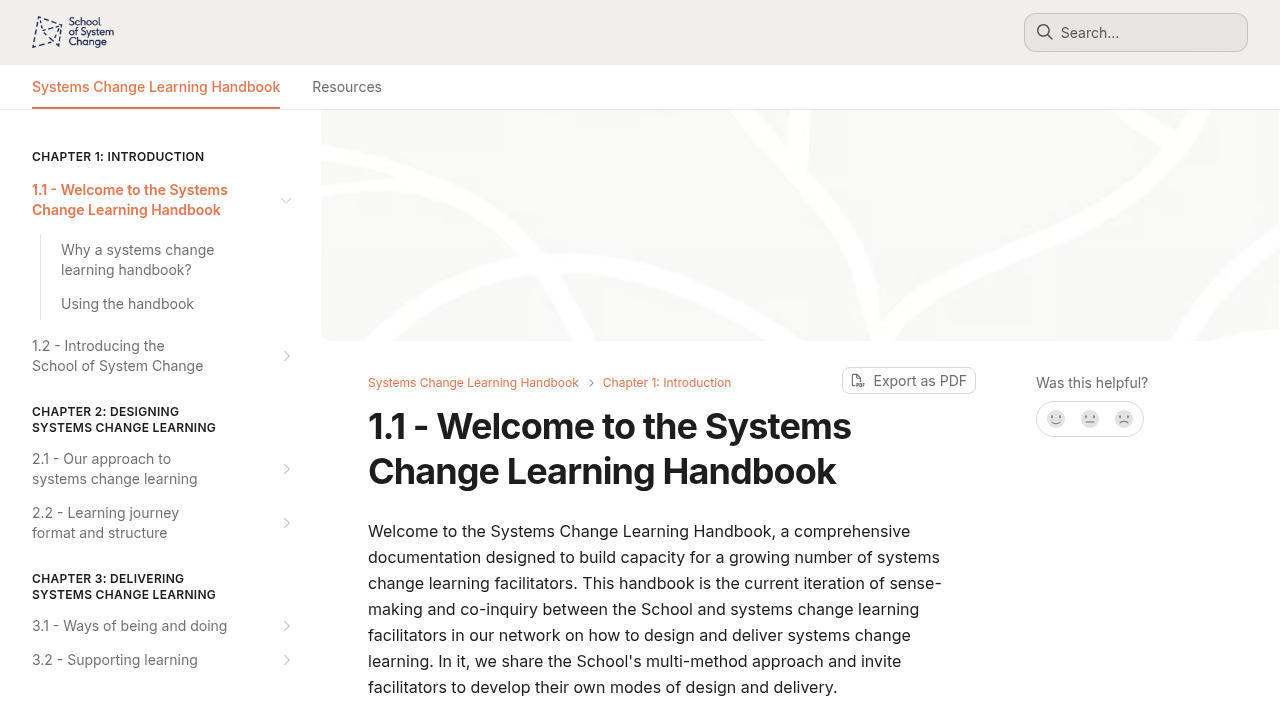
Systems Change Learning Handbook
The Systems Change Learning Handbook is a digital resource by the School of System Change. it offers frameworks, tools, and methodologies to help professionals understand and navigate complex systemic challenges, including environmental and economic transitions.
Please login or join for free to read more.

OVERVIEW
The Systems Change Learning Handbook is an online resource designed to help practitioners navigate the complexities of systemic transformation. It provides a structured framework for understanding how to influence and navigate complex systems, offering a variety of methodologies and practical tools. For finance professionals, this resource is relevant as it provides the theoretical and practical scaffolding needed to address systemic risks, such as climate change and biodiversity loss, which cannot be managed through traditional siloed approaches.
Organisation behind the tool
The handbook is developed and maintained by the School of System Change, an organisation dedicated to building a global community of practitioners capable of addressing complex systemic challenges through diverse learning programmes and collaborative inquiry projects.
What the tool does
The tool functions as a digital knowledge hub with the following features:
- Introduction to foundational concepts and definitions of systems change.
- Guidance on navigating different systemic approaches, from mapping to strategy.
- Practical modules on systems thinking, complexity, and collective action.
- Case studies and inquiry-based learning materials for real-world application.
- Frameworks for organising and facilitating systemic interventions.
Target audience
The primary audience includes systems change practitioners, strategists, and leaders across various sectors. It is also suitable for researchers, policymakers, and professionals in the private sector seeking to integrate systemic thinking into their organisational strategies.
Relevance to finance professionals
The handbook can be applied in finance in the following areas:
- Risk assessment – understanding the interconnected nature of systemic risks (e.g. financial stability and environmental health) to better predict cascade effects.
- ESG analysis – moving beyond individual company metrics to assess how investments contribute to or hinder broader systemic transitions.
- Investment context – identifying long-term structural shifts in energy, agriculture, and infrastructure that may impact asset valuation and portfolio resilience.
- Stakeholder engagement – applying systems mapping to identify key leverage points for active ownership and collaborative engagement.




