

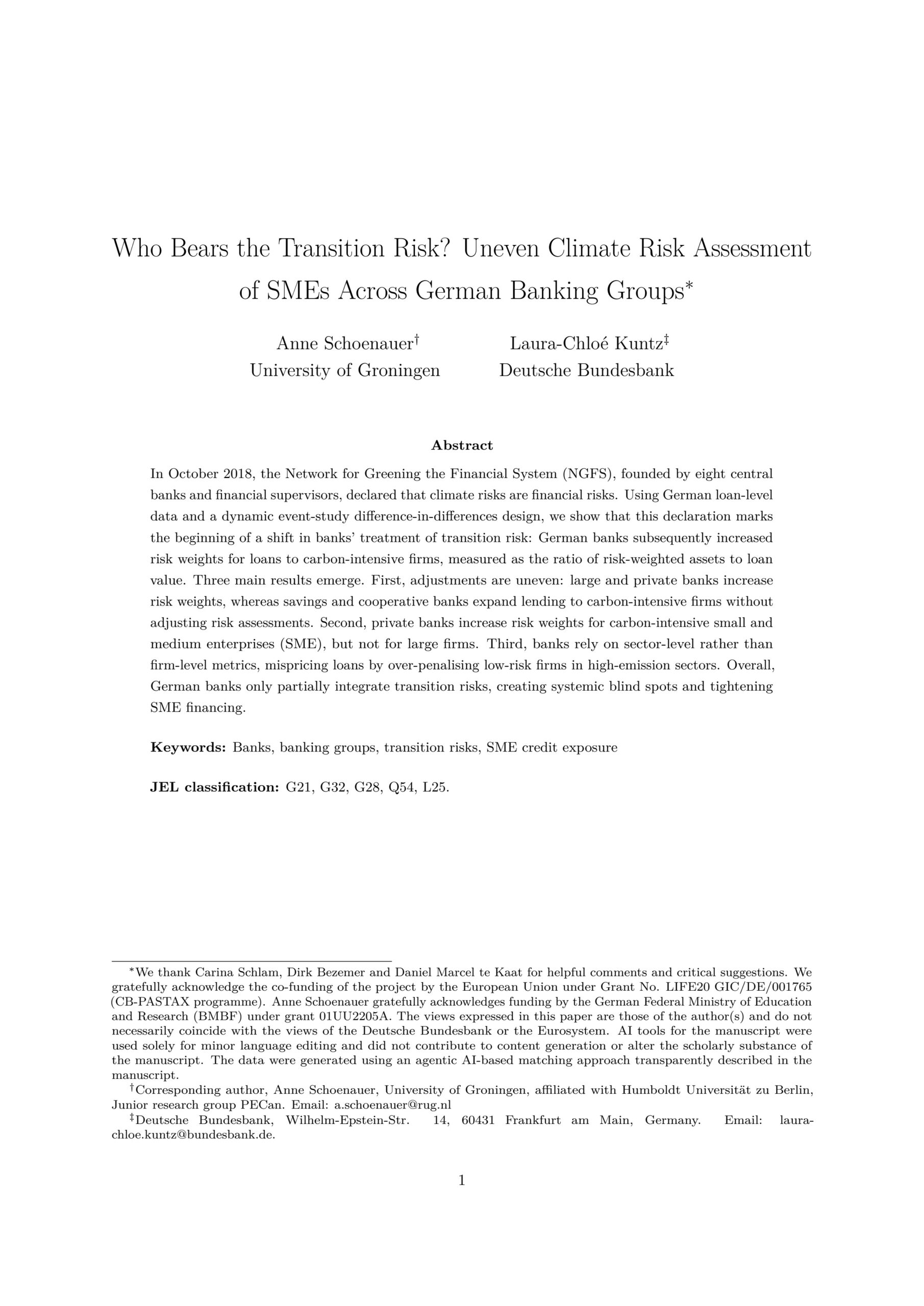
Who bears the transition risk? Uneven climate risk assessment of SMEs across German banking groups
This report examines how German banks assess climate transition risks, specifically for SMEs. It finds that private banks significantly increased risk weights for carbon-intensive firms after 2018, while cooperative and savings banks did not. The reliance on sector-level metrics suggests potential loan mispricing and systemic risks within regional banking groups.
Please login or join for free to read more.

OVERVIEW
Introduction
This research paper examines how private, savings and cooperative banks in Germany incorporate climate transition risks into their credit exposures. The analysis focuses specifically on lending to small and medium-sized enterprises (SMEs), which constitute more than 99% of German firms and account for approximately 40% of business sector emissions. The transition to a low-emission economy creates both opportunities and significant costs, as policies such as carbon pricing or technology bans can render existing business models unprofitable and pose risks to financial stability.
The study uses the October 2018 declaration by the Network for Greening the Financial System (NGFS) — which framed climate risks as financial risks — as a pivotal event to examine shifts in banks’ risk assessments. Using granular loan-level data, the authors demonstrate that this declaration marked the beginning of a shift in how German banks treat transition risks, particularly regarding risk weights for loans to carbon-intensive firms.
Data
The study utilizes five primary data sources, centered on granular German credit-level data from the Deutsche Bundesbank’s “Mio Evidence” register, which covers credits exceeding €1.0 million from 2016 to 2022. This is complemented by the MamFi database for categorising banks into different banking groups, the JANIS company balance sheet database and the BISTA bank balance sheet database. Climate-relevant information is derived from the Climate Policy Relevant Sectors (CPRS) classification and the tilt database, which provides product-level transition risk metrics for over 80,000 German firms.
Estimation strategy
The researchers employ a dynamic event-study difference-in-differences (DiD) design using a double-robust estimator. This approach allows for treatment-effect heterogeneity across groups and time. The model identifies the Average Treatment Effect on the Treated (ATT) by comparing carbon-intensive firms (the treated group) with less-exposed firms (the control group) before and after the 2018 NGFS progress report.
Results
Following the 2018 NGFS declaration, German banks increased risk weights for exposures to carbon-intensive firms by an average of 2.77 percentage points (pp). Under Basel III total capital requirements, this implies an additional capital requirement of approximately €0.29 per €100 exposure. However, this adjustment is driven entirely by private banks, while cooperative and savings banks show no measurable response. For carbon-intensive firms, private banks increased risk weights by 3.5 pp after October 2018, whereas savings and cooperative banks actually expanded lending to these firms without adjusting their risk assessments.
Within the private banking sector, SMEs experienced a significant 4.5 pp increase in risk weights, while the 1.3 pp increase for large firms was not statistically significant. This suggests that carbon-intensive SMEs are systematically perceived as riskier after the NGFS announcement, potentially due to their limited capacity to absorb transition shocks compared to larger firms. Furthermore, the findings reveal that banks rely heavily on sector-level rather than firm-level metrics. When testing product-level metrics, the authors found no evidence that banks incorporate granular firm-specific information into risk weights, leading to potential mispricing where low-risk firms in high-emission sectors are unfairly penalised.
Moderating effects
Bank-specific characteristics significantly moderate the management of transition risks. Banks with lower capital ratios exhibited the largest adjustments, with an ATT of 4.1 pp, possibly to ensure adequate capitalisation for these exposures. Additionally, banks with higher total assets showed stronger transition risk management (3.1 pp ATT) compared to smaller banks. Banks facing higher overall transition risk exposure across their entire portfolios also responded more decisively, showing an ATT of 3.5 pp compared to 1.5 pp for less-exposed institutions.
Conclusion
The report concludes that transition risks are not integrated uniformly across the German banking sector, creating systemic blind spots and tightening financing for SMEs. While private banks are actively incorporating transition risks, the lack of adjustment in savings and cooperative banks may pose financial stability risks if climate-related risks materialise abruptly. The reliance on sector-based metrics highlights the need for more sophisticated and granular risk-management frameworks to prevent the mispricing of loans and to support an effective green transition.




