

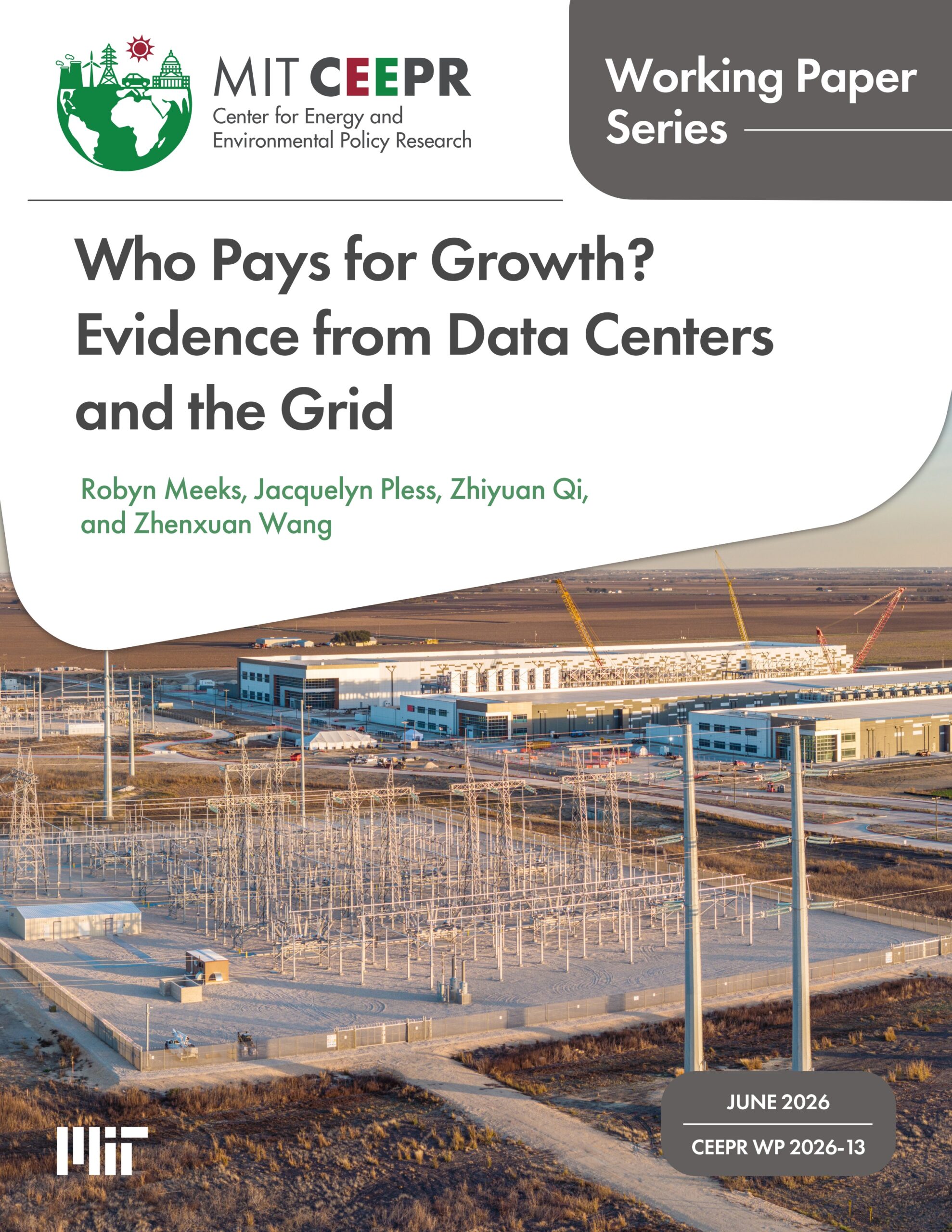
Who pays for growth? Evidence from data centers and the grid
This research examines the impact of data centre expansion on US electricity prices. Findings indicate that entry between 2010 and 2024 increased average retail rates by 2.7%. These costs are concentrated among investor-owned utilities and pronounced in deregulated markets or regions with limited spare capacity.
Please login or join for free to read more.

OVERVIEW
Introduction
Artificial Intelligence (AI) is unleashing one of the largest infrastructure booms in modern history. Behind advances in AI models lies an enormous physical footprint: hyperscale data centres consuming vast quantities of electricity. Global investment in data centres nearly doubled between 2022 and 2024, reaching roughly half a trillion dollars. Projections indicate that electricity use from data centres in the United States alone could more than double by 2030. This research investigates who pays for the infrastructure needed to support this growth, examining how data centre entry affects retail electricity rates across residential, commercial, and industrial customers.
Background
Data centres are exceptionally energy-intensive due to their continuous operation, computing equipment, and cooling needs. US data centre energy use more than doubled between 2017 and 2023, reaching approximately 176 TWh, or 4.4% of total US electricity consumption. Projections suggest this could increase to between 6.7% and 12.0% by 2028. This growth necessitates investment in new generation capacity, as well as transmission and distribution infrastructure. The impact on retail electricity prices is theoretically ambiguous, as large new loads may increase system costs but could also lower average costs by expanding the customer base over which fixed investments are recovered, especially if they improve system utilisation.
Main results
Data centre entry between 2010 and 2024 increases average retail electricity prices by 2.7%. These effects differ across customer classes: residential rates increase by 2.1%, commercial rates by 2.8%, and industrial rates by 4.2%. The burden is not distributed uniformly across institutions. Price increases are concentrated among investor-owned utilities (IOUs), where average retail prices rise by 5.6%. For IOUs, residential prices rise by 5.2%, commercial prices by 4.6%, and industrial prices by 8%. In contrast, price effects are much smaller among publicly-owned utilities and absent among cooperatives.
The regulatory environment also shapes outcomes. Average retail prices rise by 3.8% in deregulated states, compared to a smaller and statistically insignificant 1.5% increase in regulated states. In bill terms, the residential effect corresponds to approximately $3 per month for the average household, rising to about $7 per month for IOU customers. These estimates reflect realised average pass-through over the 2010–2024 study period rather than an upper bound on potential future consequences.
Mechanisms
Data centre entry induces significant infrastructure and operational responses among IOUs. In deregulated states, electric construction work in progress (CWIP) increases immediately, often a year before activation. Transmission operations and maintenance (O&M) also rise several years prior to entry. In regulated states, utilities appear to accommodate growth through improved system utilisation and fixed-cost spreading. Vertically integrated utilities in regulated states show improved load factors a few years after entry, helping explain muted contemporaneous price effects despite infrastructure responses.
Regulatory cost recovery further explains these patterns. Data centre entry is associated with larger authorised rate bases in both regulated and deregulated states. However, in deregulated states, there is an increased probability of filing rate cases, general rate cases, and rider proceedings, while case duration declines. This suggests more frequent and faster regulatory engagement. System constraints also play a role; price effects are larger in low-reserve-margin regions, particularly in deregulated states where systems have limited spare capacity and are more likely to require expensive generation procurement or reliability expenditures.
Distributional implications across places
Price effects vary across areas with different pre-existing economic conditions. Although effects are similar on average, they are generally larger in areas that already had higher electricity prices before data centre entry. Furthermore, price effects are larger in lower-GDP areas for average retail, residential, and industrial prices. Households in lower-GDP areas experience larger price increases following data centre entry than households in higher-GDP areas. Commercial prices, by contrast, increase more in higher-GDP areas. These patterns suggest that the costs of accommodating growth are not distributed uniformly across places.
Conclusion
The rapid expansion of the digital economy requires substantial complementary investment in electricity infrastructure. The research demonstrates that data centre growth increases retail electricity prices on average, but the incidence depends heavily on the institutions that finance, regulate, and allocate costs. Retail pass-through is larger when new load creates system cost pressure not offset by utilisation gains, particularly within investor-owned utilities and deregulated markets. As demand continues to expand, the design of tariffs and cost-causation mechanisms will remain critical for determining how costs are distributed across ratepayers and shareholders.




