
Library | Resource Types
Research
We summarise credible research and reports on sustainable finance and ESG issues. Our summaries, along with our AI ChatBot saves members time reading large reports, to focus on knowledge building and action.
Refine
1838 results
REFINE
SHOW: 16


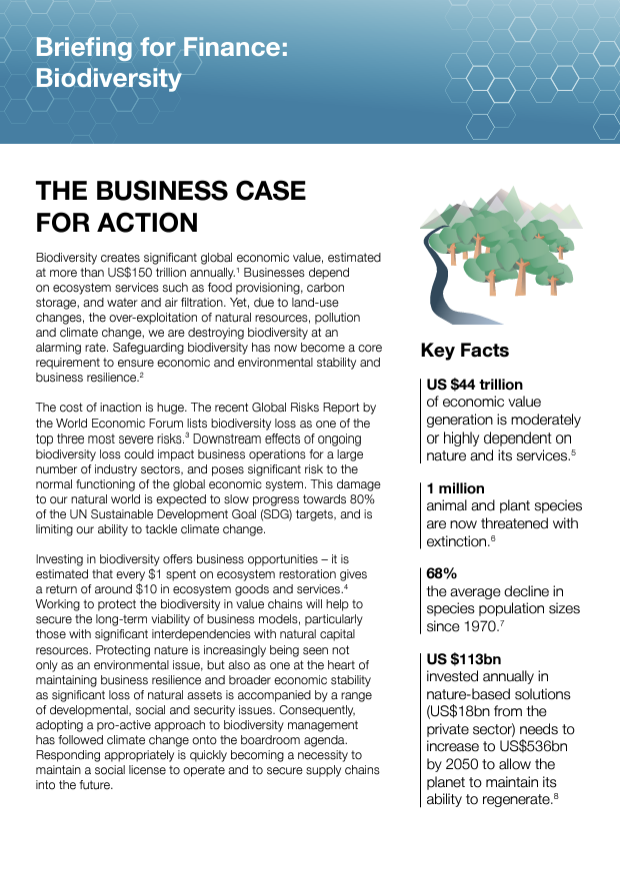
Briefing for finance: Biodiversity
This briefing highlights how businesses' impact nature and the significant economic and environmental consequences of biodiversity loss. It explores the risks of biodiversity loss and opportunities of investing in nature-based solutions, and offers recommendations for finance professionals to mitigate potential negative impacts and embed biodiversity considerations into decision-making processes.

Do investors respond to mechanical changes in ESG ratings?
This study investigates whether investors react to changes in ESG ratings that are not linked to firms' actual ESG activities. Using the 2015 Refinitiv coverage expansion as a quasi-experimental setting, it finds that mechanical rating increases influence ESG fund selections, especially among resource-constrained active funds, leading to portfolio allocations not truly reflective of firms' ESG performance.

Exploring the cooperative economy report 2023
The 2023 World Cooperative Monitor Report provides rankings of the top 300 global cooperatives by turnover and GDP per capita. It highlights the economic impact and member benefits of cooperatives, offering insights into their performance, sustainability, and contribution to local communities and development goals.

Mutuals industry review 2023: Challenges for a purposeful future
This report shows that the mutuals industry increased net assets by 4.2% to AUD$11.7 billion, largely driven by increased interest rates and continued loan growth. The report also highlights key insights into the industry's future, including pathways to a sustainable and customer-centric future, managing the cyber threat, closing the gap on sustainability reporting, AI risks and opportunities, and CPS 230 Operational Risk Management.

Indigenous rights and financial institutions: Free, prior and informed consent, just transition and emerging practice
This report examines the importance of Indigenous Peoples’ rights in finance, focusing on Free, Prior and Informed Consent (FPIC). It discusses challenges in implementing FPIC, such as differing views on indigeneity, determining adequate FPIC, poor information, and power imbalances. It concludes with the potential for mutually beneficial partnerships.
Artificial intelligence and human rights investor toolkit
This toolkit aims to provide investors with guidance on how to navigate the intersecting terrain of AI and human rights. It covers the various aspects of AI implementation that have potentially significant implications for human rights, and how investors can engage with companies on these issues. Its focus is on emerging risks and opportunities for investors in the context of rapidly evolving technologies and the ethical challenges they pose.

Biodiversity finance as a technology of power: Discourses of innovation and regulation in an Australian case study
This research paper merges innovation and regulation, commodifying nature through tradeable biodiversity units. This study explores how financialisation shapes conservation policies, highlighting tensions between market-driven solutions and regulatory frameworks, and the complex power dynamics involved in biodiversity finance.

Investing in stakeholder engagement for improved digital technologies
This report explores the importance of stakeholder engagement for tech sector investors. It shows how engaging with affected stakeholders helps identify, assess, and mitigate human rights risks. It provides recommendations for investors to fund more rights-respecting companies.
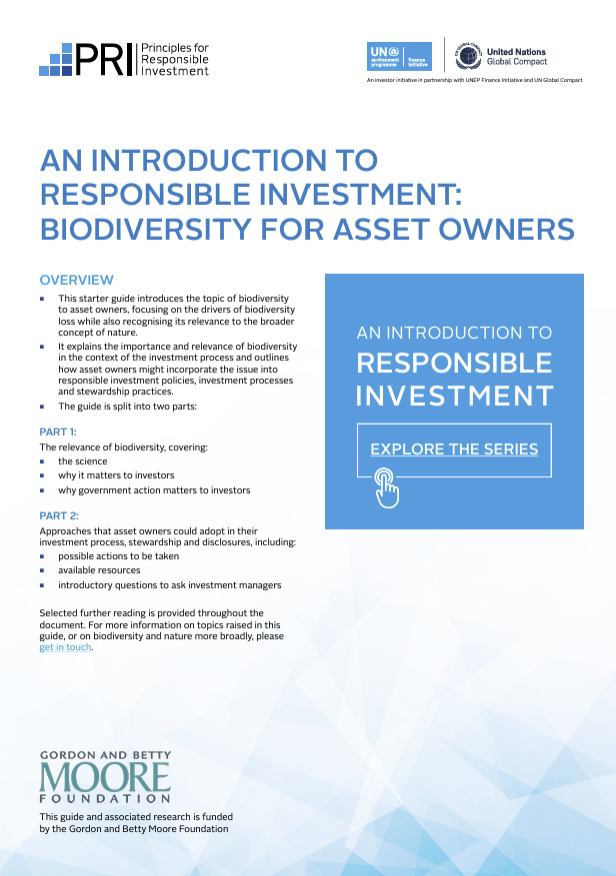
An introduction to responsible investment: Biodiversity for asset owners
This introductory guide for asset owners explores the financial risks and opportunities associated with biodiversity loss. It explains the relevance of biodiversity to investment processes and outlines how asset owners can incorporate biodiversity considerations into their responsible investment policies, stewardship practices, and disclosures.

Human rights and climate change: A guide for institutional investors
This guide examines the relationship between climate change and human rights. It highlights the responsibilities of institutional investors to recognise and act on climate-related human rights risks. It also identifies crucial areas of risk for investors and provides an action plan to support investors to integrate the management of climate-related human rights risks into their existing frameworks.

The intersection of Responsible AI and ESG: A framework for investors
This report provides actionable insights for investors exploring the integration of Responsible AI (RAI) in their investment decisions. It offers a framework to assess the environmental, social, and governance (ESG) implications of Artificial Intelligence (AI) usage by companies. The report includes case studies of globally listed companies and a set of templates to support investors in implementing the framework.

Anticipatory finance: An introductory guide
This introductory guide explores anticipatory finance, a funding mechanism released before predicted disasters to reduce humanitarian impact. It explains anticipatory action (AA), details potential finance sources (e.g. donor funds, government budgets, insurance), and presents real-world examples, challenges, and recommendations for implementation.

Financial crimes and land conversion: Uncovering risk for financial institutions
This report outlines the risks financial institutions face due to land conversion and related financial crimes. It emphasises the convergence of land conversion with crimes like money laundering and corruption, highlighting the need for robust due diligence and risk assessment. It introduces an Environmental Crimes Financial Toolkit to aid institutions in mitigating these risks.

Respecting Indigenous rights: An actionable due diligence toolkit for institutional investors
This toolkit offers practical guidance for investors to respect Indigenous rights. It covers understanding and incorporating these rights into investment policies, assessing and addressing impacts, and ensuring Free, Prior, and Informed Consent. This toolkit aims to mitigate risks and uphold international human rights standards.

Impact at scale
This report by Social Ventures Australia explores the topic of impact at scale within the Australian social sector. It sets out key features of impact at scale, with Australian case studies highlighting different approaches in working towards this goal. The report aims to bring together a uniquely Australian set of perspectives on the topic, which is broadly missing in current literature.

Is CSRD working for financial institutions? A look into how CSRD is being rolled out across the financial sector
The Corporate Sustainability Reporting Directive (CSRD), an ambitious EU regulation, demands increased transparency from financial institutions (FIs). Challenges include lack of sector-specific guidance and data collection difficulties. Despite the focus on reporting, FIs must use CSRD strategically to align financing with sustainability goals and ensure long-term compliance.


