
Library | ESG issues
Corporate Strategy
Corporate strategy involves the comprehensive plan a company employs to achieve its long-term objectives, encompassing decisions on resource allocation, market participation, and competitive positioning. Integrating sustainability into corporate strategy enables organisations to create long-term stakeholder value. This approach offers advantages such as enhancing brand value, meeting consumer demands, increasing efficiency, attracting top talent, and opening new market opportunities.

Refine
593 results
REFINE
SHOW: 16


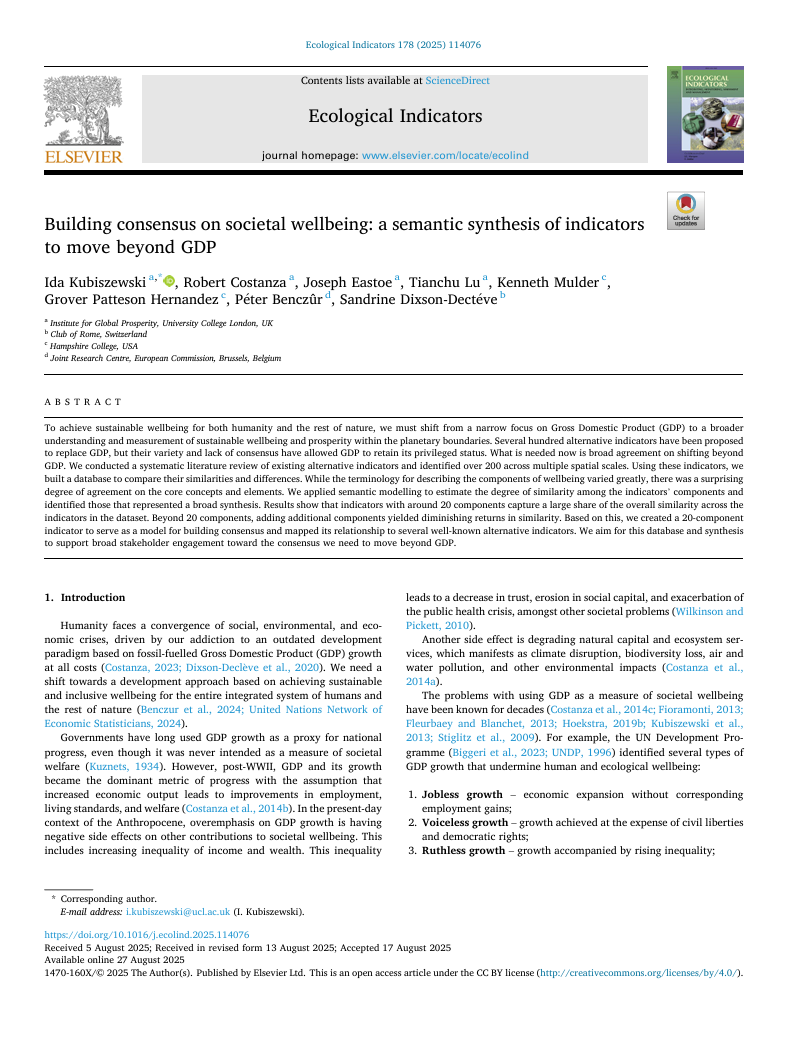
Building consensus on societal wellbeing: A semantic synthesis of indicators to move beyond GDP
Analyses 213 wellbeing indicators using semantic modelling to identify conceptual overlap and optimal design beyond GDP. Finds strong thematic convergence and diminishing returns beyond roughly 20 components. Proposes a synthesised 20-component indicator to support international consensus on measuring sustainable and inclusive wellbeing.
Total Impact Portfolio: Constructing an investment portfolio with an impact lens
This guide outlines constructing a Total Impact Portfolio (TIP), integrating risk, return and impact across all asset classes. It explains double materiality, portfolio design steps, responsible investment strategies, measurement frameworks and barriers. Case studies illustrate Australian and international asset owners embedding impact within governance, allocation and performance management.
Restoring human progress: Winning citizens’ support for actions on climate and nature
This report argues that despite widespread concern about climate and nature, durable policy support depends on restoring belief in human progress. Drawing on surveys and literature, it proposes three principles: deliver meaningful sectoral gains, play to national strengths, and make progress visible to build optimism, agency and sustained public backing.
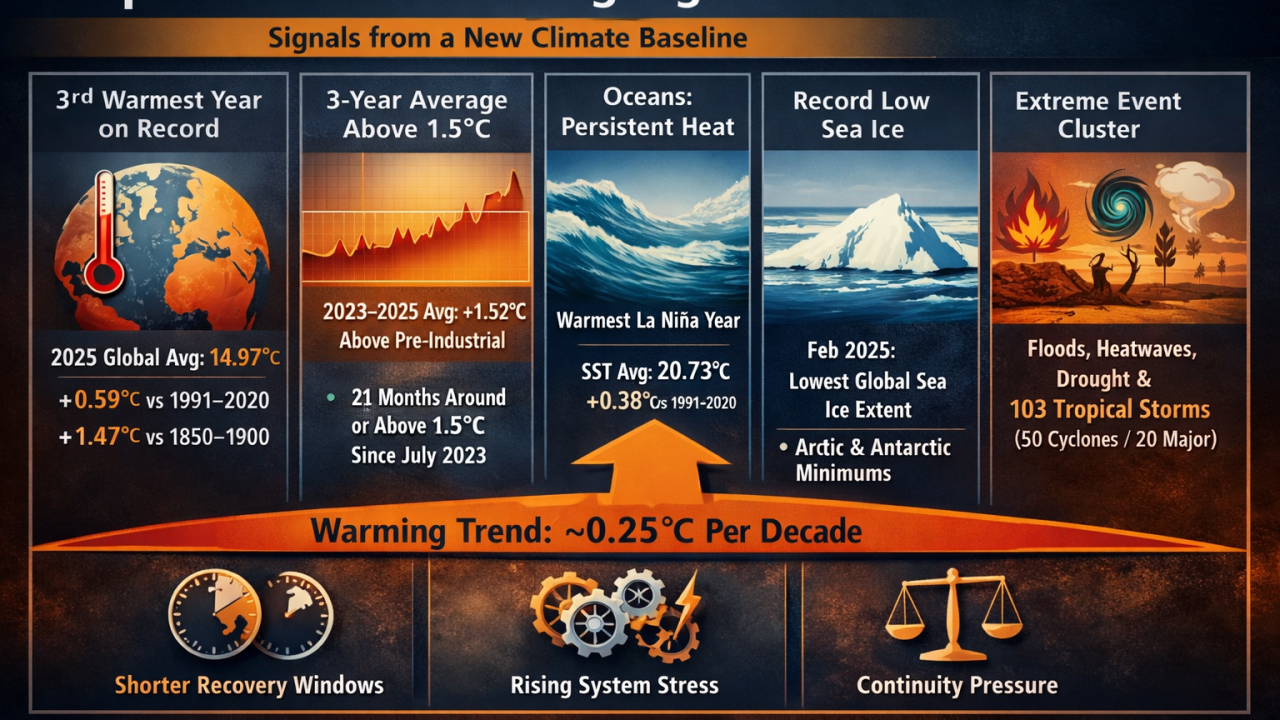
PerilScope: Strategic Deep Dive Copernicus Global Climate Highlights 2025 — From Records to Operating Conditions in the 3°C World SRP® Frame
The article interprets Copernicus’s Global Climate Highlights 2025 as a shift from episodic extremes to a structurally warmer, more volatile baseline. It argues that persistent temperature exceedances, ocean heat, cryosphere decline, and overlapping hazards demand a move from climate risk awareness to disciplined adaptation and continuity planning.
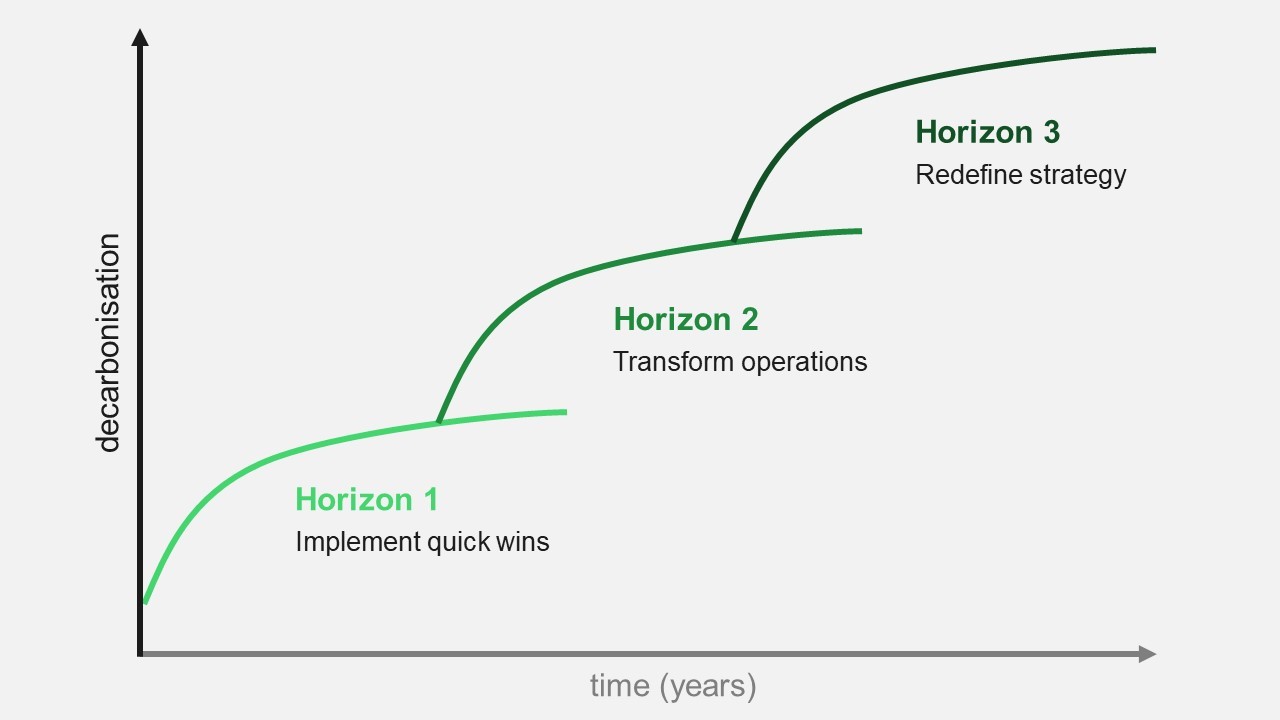
The Three Horizons of Decarbonisation
This article presents the Three Horizons of Decarbonisation framework, helping companies distinguish between short-term efficiency measures, operational transformation, and fundamental business model shifts. It explains how clear horizon identification improves capital allocation, stakeholder engagement, and the likelihood that net zero plans translate into meaningful action.

Global cybersecurity outlook 2026: Insight report
Global Cybersecurity Outlook 2026 examines AI-driven threats, geopolitical volatility and supply chain vulnerabilities shaping cyber risk. Drawing on a global survey, it highlights rising AI-related risks, escalating cyber-enabled fraud, regulatory fragmentation and persistent skills shortages, emphasising resilience, ecosystem collaboration and economic impacts as strategic priorities.
Invisible barriers: How gender norms impact financial inclusion A framework for classifying norms and developing strategies to address them
This CGAP Focus Note presents a framework classifying gender norms by strength and prevalence to address barriers to women’s financial inclusion. Drawing on diagnostics in Rwanda, Tanzania and Uganda, it outlines four intervention strategies for development and market actors to transform financial systems and advance women’s economic empowerment.
Systems-informed stewardship: Reimagining investment stewardship for a sustainable future series
This series sets out a systems-informed framework for reimagining investment stewardship. It examines stewardship as an interconnected system shaped by policies, practices, resource flows, relationships, power dynamics and mental models, and proposes practical shifts to embed responsibility, design for complexity, and manage for long-term sustainability outcomes.

Systems-informed stewardship part III: Reimagining stewardship for a sustainable future
This article presents systems-informed stewardship as a new approach to advancing sustainability across the finance sector. It outlines two interdependent lenses and three practical shifts, embedding responsibility, designing for complexity, and managing adaptively to improve stewardship effectiveness.
The production gap series
This benchmark series examines the gap between governments’ planned fossil fuel production and pathways consistent with international climate goals. It assesses alignment with temperature limits by reviewing national production plans and policy signals, providing a consistent framework to track progress and comparability across editions.
Frozen gas, boiling planet: How bank and investor support for LNG is fueling a climate disaster
The report analyses bank and investor financing of LNG expansion, finding US$213 billion in bank support and US$252 billion in investor exposure since 2021. It concludes this financing drives overcapacity, climate risk and misalignment with 1.5 °C pathways.
Energy and AI
The IEA’s Energy and AI report examines AI’s rising electricity demand and its capacity to improve energy efficiency, security and innovation. It assesses data centres, grids and end-uses, highlighting skills, infrastructure and policy needs to manage costs, emissions and resilience globally.
Net zero: A practical guide for cooling businesses
This guideline provides practical guidance for cooling manufacturers to achieve Net Zero by 2050, outlining emissions hotspots, regulatory drivers and decarbonisation levers across Scopes 1–3, with emphasis on efficiency, low-GWP refrigerants, value-chain collaboration and science-based targets.

We can’t ignore the largest source of methane
This article argues the global food system is the largest source of human-caused methane and deserves far more policy and funding attention. It maps key emission “hot spots”—ruminant livestock, food waste in landfills, biomass burning, and flooded rice fields—and outlines practical mitigation options from dietary shifts to landfill capture and improved rice management.

Systems-informed stewardship part II: Bringing a systems perspective to stewardship
This article applies a systems lens to stewardship, arguing that fragmented intermediation and entrenched short-term time horizons undermine sustainability outcomes. It calls for recognising these structural barriers as a critical step toward more effective, systems-informed stewardship.

Energy Transition Advisers (ETA)
ET Advisors is a sustainability and climate advisory firm supporting investors, corporates and financial institutions. It provides research-led advice on climate transition, ESG strategy, sustainable finance and long-term value creation, helping organisations manage risk and align with global sustainability and net zero goals.


