
Library | ESG issues
Governance
The governance pillar in ESG (environmental, social, and governance) refers to the systems, policies, and practices that ensure an organisation is managed responsibly and ethically. It includes issues such as board structure, reporting & disclosures, shareholders & voting, and risk management. Strong governance reduces risks, enhances trust, and supports long-term business sustainability.
Refine
1872 results
REFINE
SHOW: 16



Great expectations: Is engagement living up to its promise?
This report examines whether engagement activities deliver impactful sustainability outcomes, comparing systemic and company-specific engagement. It encourages investors to align engagement goals with investment views, distinguishes escalation mechanisms for equity and debt investors, and emphasises financial materiality for achievable, value-enhancing outcomes. Investors are reminded of their fiduciary responsibility to clients and stakeholders.
World Economic Forum's global risks report series
The Global Risks Report is a long-running report series published by the World Economic Forum that examines emerging global risks across environmental, social, economic, geopolitical and technological domains. It provides a forward-looking assessment to support risk awareness, strategic planning and decision-making by finance professionals and policymakers.
Accounting for impact: Financial and sustainability reporting of relocating graves in South Africa
This report delves into reporting sustainability impacts alongside financial data, using the case of relocating graves due to mining in South Africa. It highlights the necessity of clearer disclosure guidelines, improved stakeholder engagement, cultural heritage preservation, and recognising societal implications beyond financial metrics. Companies must navigate complexities and prioritise transparency.

Empowering key development finance institutions in Asia to accelerate the decarbonization of the energy sector
The report outlines Asia's challenges to decarbonising energy while driving economic development. It suggests there is significant room for improvement among regional banks and to achieve their commitments to the Paris Agreement, firms need to implement more stringent sustainable finance policies.

Considering social factors in pension scheme investments: Guide from the Taskforce on Social Factors
This final report identifies social risks and opportunities that can be addressed by trustees, industry, and policymakers. The guide outlines frameworks of good practice and materiality assessment, with data sources to support the assessment and provides practical assistance to enable consideration of social factors within their investments.

Greenpeace
Greenpeace International is an environmental NGO advocating for global environmental protection and sustainability. With a focus on climate change, deforestation, overfishing, and other ecological issues, it engages in activism, research, and lobbying to drive positive change. Greenpeace campaigns for renewable energy, biodiversity preservation, and the mitigation of environmental damage worldwide.
Artificial intelligence risk management framework (AI RMF 1.0)
This framework is a guide to promote safe, secure and transparent use of AI systems. The Framework provides four key functions – govern, map, measure and manage - with further categories and subcategories for risk management in AI systems.

New Zealand Green Investment Finance (NZGIF)
The New Zealand Green Investment Finance (NZGIF) is dedicated to driving sustainable investment across New Zealand. With a focus on green initiatives, NZGIF collaborates with businesses, government, and communities to promote environmental stewardship and economic growth. Their strategy emphasises innovation, values integrity, and embraces a holistic approach to green investment.

Nature positive economies: Progress, lessons and next frontiers
The report titled explores a six-year global partnership aimed at embedding natural capital into economic decision-making. It highlights key lessons, including the need for systemic change, collaboration across sectors, and nature-based solutions to build resilient, sustainable economies. The report provides case studies and frameworks to guide future efforts towards nature-positive economies.

Green Economy Coalition (GEC)
The Green Economy Coalition is a global network advancing sustainability and economic prosperity. Focused on promoting green economic policies and practices, they engage diverse stakeholders to foster a transition to sustainable development.
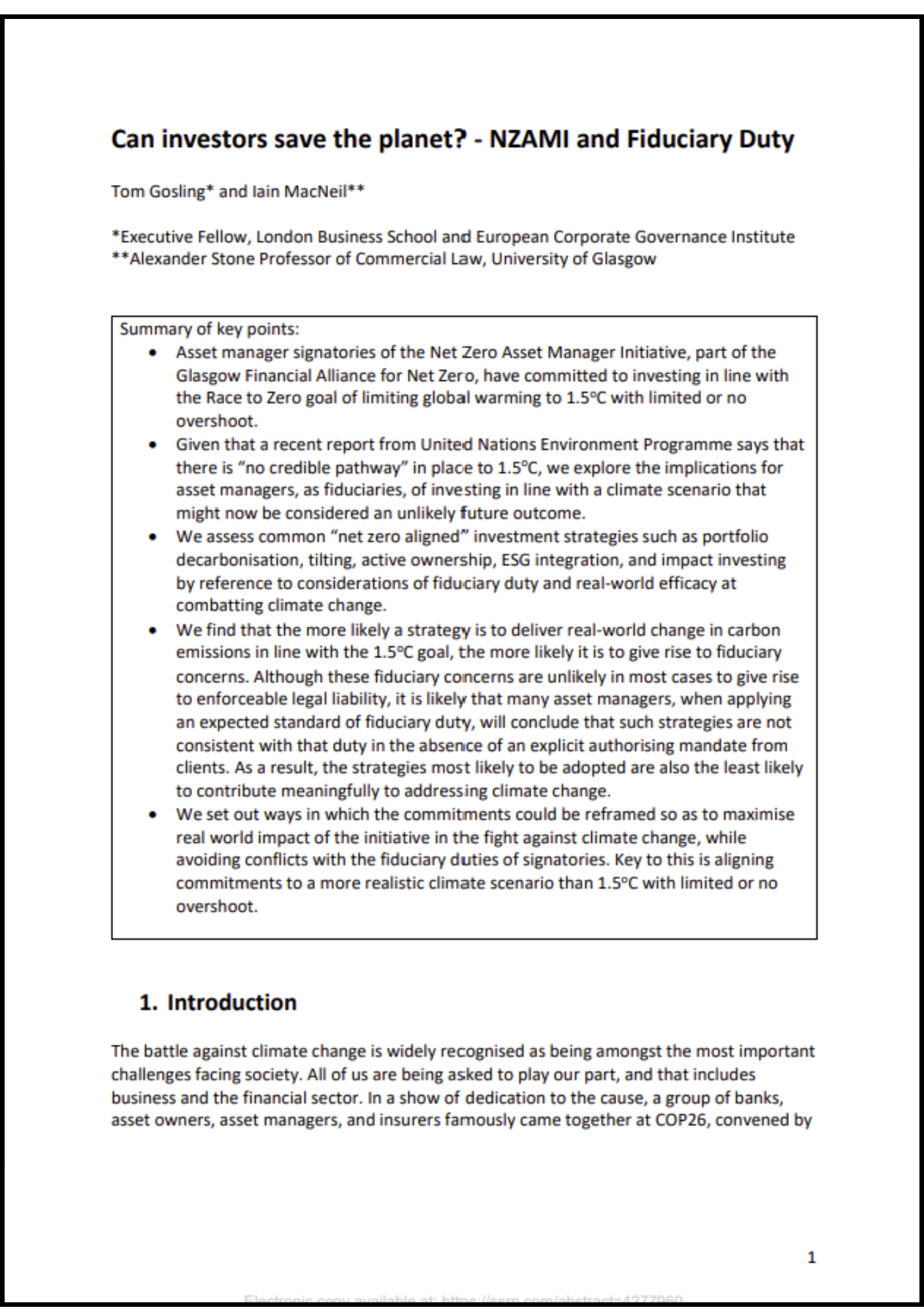
Can investors save the planet? - NZAMI and fiduciary duty
The report evaluates asset managers' strategies aligning with the Race to Zero goal of limiting global warming while considering the possibility of a different climate scenario. It finds impactful environmental approaches might pose fiduciary challenges. Authors propose revising commitments to enhance climate impact while upholding fiduciary duties.

Broadening the spectrum of investing: Opportunities and demand for investing in LGBTQ+ equity and inclusion
The report emphasises increasing demand for LGBTQ+ equity and inclusion investments in the US, particularly among investors born after 1980. Nearly half of US investors seek such opportunities, but there's a shortage of investment options catering to this demand. Asset managers could profit by developing products targeting LGBTQ+ equity and inclusion.

Dhawura Ngilan - Business and investor initiative: A guide for businesses and investors
This report provides guidance for businesses and investors to respect Aboriginal and Torres Strait Islander heritage rights and implement environmental, social, and corporate governance principles. The Dhawura Ngilan (Remembering Country) vision is outlined and detailed recommendations for ethical investment practices are provided.

Terri Janke and Company
Terri Janke and Company is a leading Indigenous-owned law firm based in Australia. Specialising in Indigenous cultural and intellectual property rights, they offer expert legal services to businesses and organisations. With a focus on cultural diversity and sustainability, they provide tailored solutions to meet clients' legal needs effectively and ethically.

State of Indigenous business: Driving growth across the Indigenous business sector
The report provides insights into the Indigenous business landscape in Australia. The report outlines the potential economic growth for Indigenous businesses estimated at $8 billion, which could create 19,000 jobs for Indigenous Australians. The report discusses the current challenges facing Indigenous businesses and offers policy recommendations to stimulate growth and improved connection between procurers and Indigenous businesses.

The rising tide of greenwashing: Navigating ‘greenwashing’ risks in climate change targets and sustainability credentials
The report highlights the risks and challenges associated with businesses misrepresenting their sustainability credentials or strategies. The document elaborates on the subject with the help of multiple examples and practical guidelines to reduce legal and reputational exposure to businesses and corporations.


