
Library | ESG issues
Targets & Accountability
Targets and accountability are essential for ensuring organisations and governments follow through on commitments to sustainability, climate action, and social responsibility. Setting measurable and transparent targets such as net-zero goals, emissions reductions, diversity benchmarks, and human rights protections allows for tracking progress and holding entities accountable. Clear, data-driven targets strengthen stakeholder trust and help align financial and business strategies with long-term sustainability objectives.
Refine
282 results
REFINE
SHOW: 16


The high-integrity sustainable aviation fuels handbook
The handbook provides introduction to sustainable aviation fuels (SAF) and guidance for the development and deployment SAF. It emphasises the need for robust sustainability criteria, transparent accounting systems and a life-cycle assessment approach to ensure significant emissions reductions compared to conventional jet fuel. It also offers policy recommendations to support the growth of SAF in the aviation industry.

State of nature-related disclosures: Assessing TNFD alignment of nature-related disclosures by firms in high-risk sectors
The report evaluates the alignment of firms' nature-related disclosures with the TNFD framework. It covers eight priority sectors, highlighting disclosure gaps and providing recommendations for improvement to ensure comprehensive, high-quality nature-related reporting.

Making net-zero aviation possible: An industry-backed, 1.5°C-aligned transition strategy
The report outlines a 1.5°C-aligned transition strategy for decarbonising the aviation sector by 2050. It provides tools and milestones, to guide public and private sector decision-makers in achieving net-zero greenhouse gas emissions through sustainable aviation fuels, novel propulsion technologies, and efficiency improvements. The strategy emphasises collaboration across the aviation value chain to meet the ambitious climate targets.

Net Zero Investment Framework 2.0
The Net Zero Investment Framework (NZIF) 2.0, updated in June 2024, provides guidelines for investors to align their portfolios with the Paris Agreement goals. It includes detailed methodologies for various asset classes, governance, strategic asset allocation, and policy advocacy, focusing on achieving real economy emissions reductions through independent fiduciary decisions.

How corporate climate change mitigation actions affect the cost of capital
This study explores how corporate climate change mitigation actions influence the cost of capital for Japanese firms from 2017-2021. It finds that higher carbon intensity increases the cost of equity, debt, and overall capital. Climate-related disclosures lower the cost of equity and overall capital, despite raising debt costs.

Nature-positive strategy: Practical guidance for corporates
This practical guidance report provides a principles-based approach that equips corporates with an understanding of the value of nature, identifies key frameworks, and encourages a call to action. It suggests implementing “no regrets” actions for risk mitigation while progressing work on key frameworks. It further recognises that taking actions now will create business value.
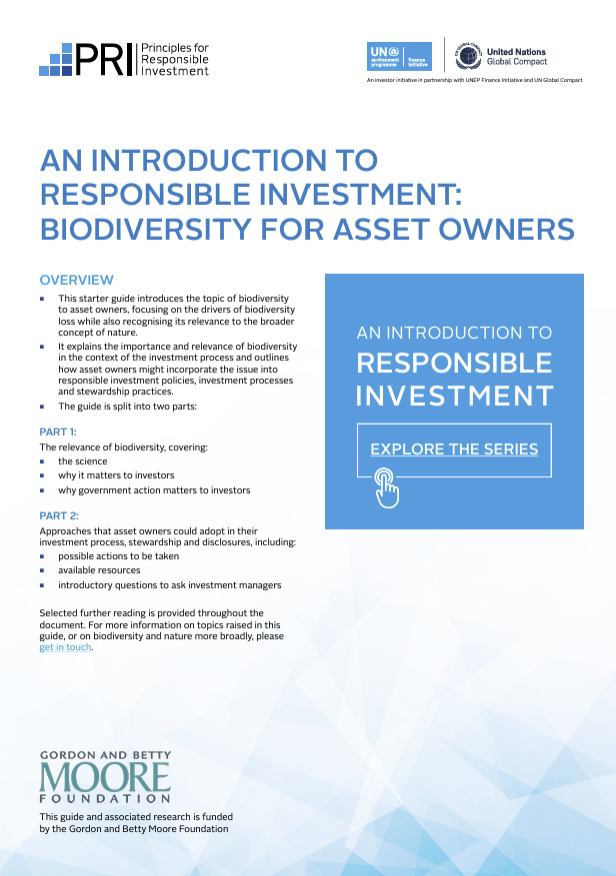
An introduction to responsible investment: Biodiversity for asset owners
This introductory guide for asset owners explores the financial risks and opportunities associated with biodiversity loss. It explains the relevance of biodiversity to investment processes and outlines how asset owners can incorporate biodiversity considerations into their responsible investment policies, stewardship practices, and disclosures.

ShareAction's voting matters series
Voting Matters are benchmark-series reports by ShareAction evaluating the proxy voting behaviour of asset managers on environmental and social issues. This report analyses the voting patterns of major asset managers to determine their commitment to responsible investment practices.

Banking on climate chaos: Fossil fuel finance series
The "Banking on Climate Chaos" benchmark report examines global banks' financing of fossil fuel companies, highlighting trends and policy shifts impacting climate goals. This series offers critical insights into financial institutions' roles in supporting fossil fuel expansion and their climate commitments.
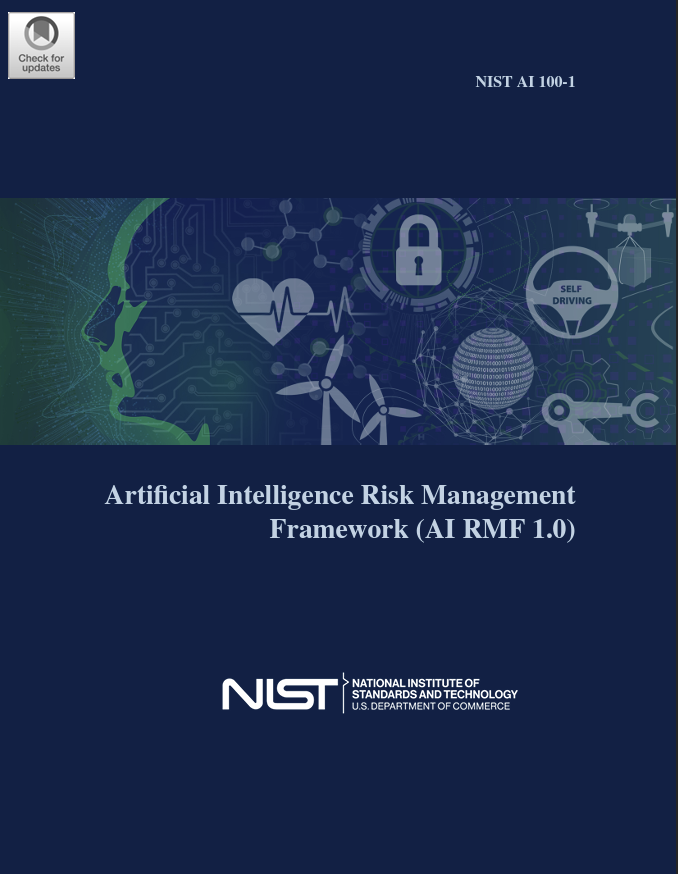
Artificial intelligence risk management framework (AI RMF 1.0)
This framework is a guide to promote safe, secure and transparent use of AI systems. The Framework provides four key functions – govern, map, measure and manage - with further categories and subcategories for risk management in AI systems.

Do high-ability managers choose ESG projects that create shareholder value? Evidence from employee opinions
Are ESG projects compatible with shareholder value? Managers face a challenge when they decide which ESG projects to select with limited clarity on allowed investments. The paper uses MSCI ESG ratings and Glassdoor employee ratings to demonstrate that high-calibre managers put their resources towards ESG projects and thereby enhance shareholder value.

Change finance, not the climate
This is a comprehensive and practical handbook by Transnational Institute and Institute for Policy Studies. This report outlines how to democratically marshal financial resources for a Global Green New Deal and to green the financial institutions by focusing on central banking, private banks, and financial markets towards tackling climate chaos.

Do investors care about impact?
Investors care about sustainable investments, but not enough to pay substantially more for more impact. A framed field experiment revealed investors’ preference was an emotional rather than a calculative valuation of impact. This preference is driving the market, as managers provide little quantitative evidence of sustainability impact, according to the report.

Safe and just Earth system boundaries
This report sets safe and just Earth system boundaries (ESBs) for domains including climate, nitrogen, and phosphorus, and identifies sub-global ESBs for avoiding Earth system destabilization. Achieving these ESBs requires a systemic transformation across sectors and addressing drivers of Earth system change for a safe and just future.

Five insights for avoiding global collapse: What a 50-year-old model of the world taught me about a way forward for us today
This book analyses a 50-year-old model of the world to provide five insights for avoiding global collapse. The book examines societal pressures, the role of technology, governance structures, and finance that contribute to earth's ecosystem health and sustenance.

Growth-positive zero-emission pathways to 2050
This paper presents pathways to achieving growth positive zero-emission targets by 2050. The report concludes that significant action is required globally to achieve the low-carbon transition required to limit temperature increases to 1.5 °C, including the refashioning of multiple fundamental socio-economic systems and the international co-operation of decision-makers.


