
Library | Finance relevance
Impact investors
Refine
750 results
REFINE
SHOW: 16


Understanding inequality as a macro-financial risk to markets and diversified portfolios
This research identifies economic inequality as a systemic macro-financial risk to markets. It examines how wealth concentration and market power destabilise economies, fuel social instability, and hinder progress on global challenges. The report advocates for new financial analysis tools and disclosure frameworks to integrate social-related risks into investment strategies.
Just transition metrics benchmark
Just Transition Metrics is a benchmark series developed by Shift in collaboration with multiple organisations. It provides a foundational, sector-agnostic set of quantitative metrics designed to assess the 'justness' of companies' climate-related transition plans, covering workforce, communities, and value chain impacts.
GIIN state of the market series
The GIIN's State of the Market is an annual benchmark series tracking the scale, activity, financial performance, and allocation patterns of the global impact investing market through a comprehensive survey of impact investors across asset classes, geographies, and sectors.

Rate the raters series
Rate the Raters is a benchmark series by the ERM Sustainability Institute tracking corporate perceptions of ESG rating agencies. It examines quality, usefulness, trust, and engagement with ESG raters across regions and industries, offering a longitudinal view of the evolving ESG ratings landscape for companies and investors.
Transition Acceleration Framework (TAF)
TAF is a forward-looking analytical framework by Rhodium Group that evaluates where climate investment and policy will accelerate decarbonisation.

Plastic footprint guidelines
The Plastic Footprint Network's guidance document presents a science-based methodology for assessing corporate plastic footprints. Developed by over 100 professionals from 35 organisations, the framework comprises 11 modules covering macroplastics and microplastics, providing practitioners with a step-by-step process for measuring plastic leakage and reporting results.
Guidance on integrating deforestation into net zero strategies
This IIGCC guidance supports institutional investors in integrating deforestation, land conversion, and associated human rights risks into net zero strategies. Aligned with the Net Zero Investment Framework 2.0, it provides practical, asset class-specific action points across listed equity, sovereign bonds, real estate, and private equity and debt.
EDHEC Climate Institute Resource Hub
EDHEC Climate Institute is a climate finance research resource that provides research, analytical tools and data on climate-related financial risks, transition pathways and climate policy. It supports finance professionals with evidence-based insights for investment analysis, risk assessment and decision-making on climate-related issues.
Project Preparation Support Database (PPSD)
Searchable database of project preparation facilities and climate-focused incubators helping developers and investors access support for bankable climate projects.
Widening the lens: Scaling climate adaptation and resilience through sustainable finance
This report examines climate adaptation and resilience in sustainable finance, highlighting a significant financing gap in emerging markets and limited formal allocation in labelled debt markets. It argues for a broader lens that recognises resilience outcomes already embedded in policy-driven investments, using Ecuador's sovereign housing framework as a case study.
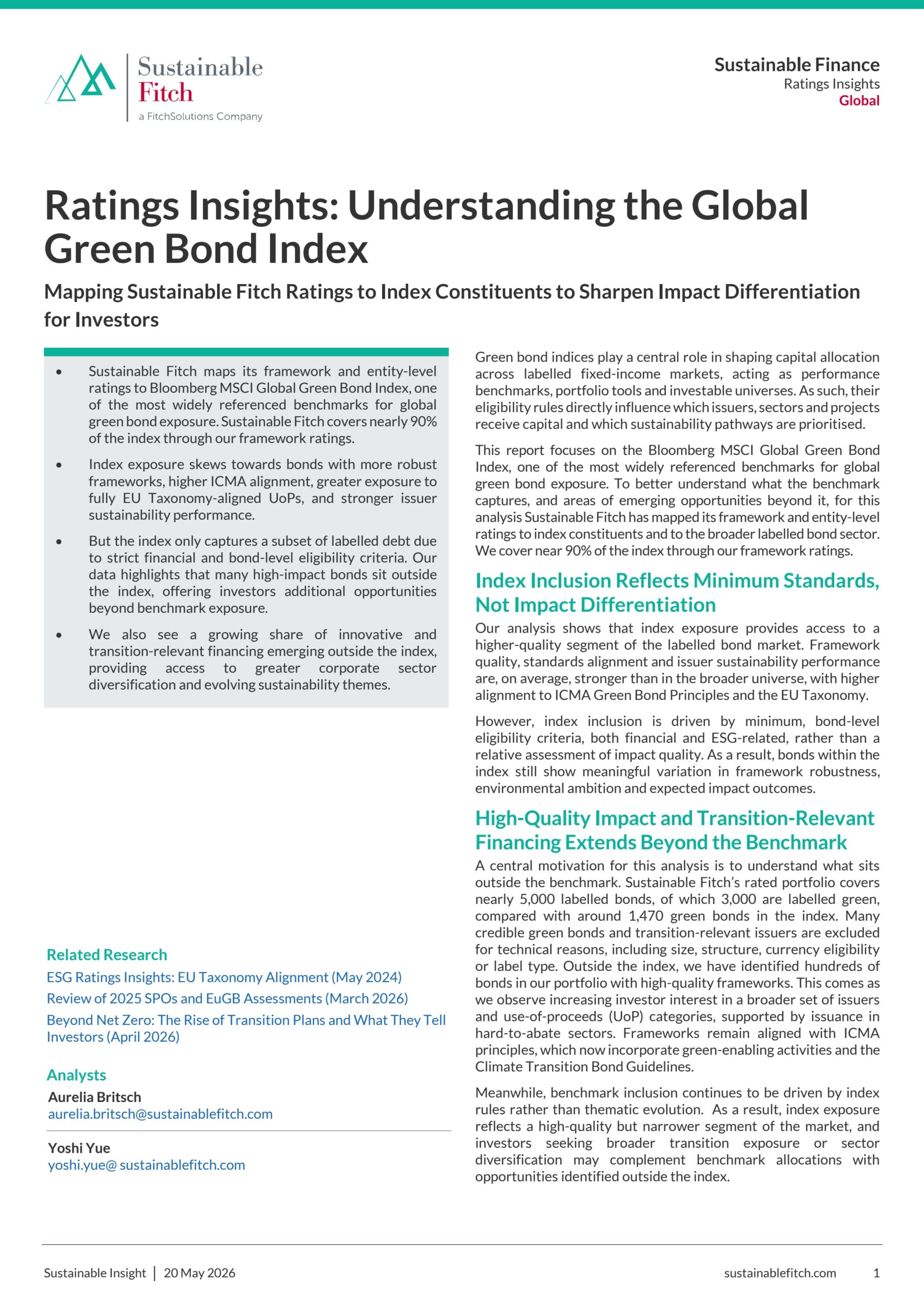
Ratings insights: Understanding the global green bond index
Sustainable Fitch maps its framework and entity-level ratings to the Bloomberg MSCI Global Green Bond Index, covering 88% of index bonds. While index constituents show stronger framework quality and ICMA alignment than the broader market, many high-quality and transition-relevant bonds sit outside the benchmark due to financial eligibility constraints.
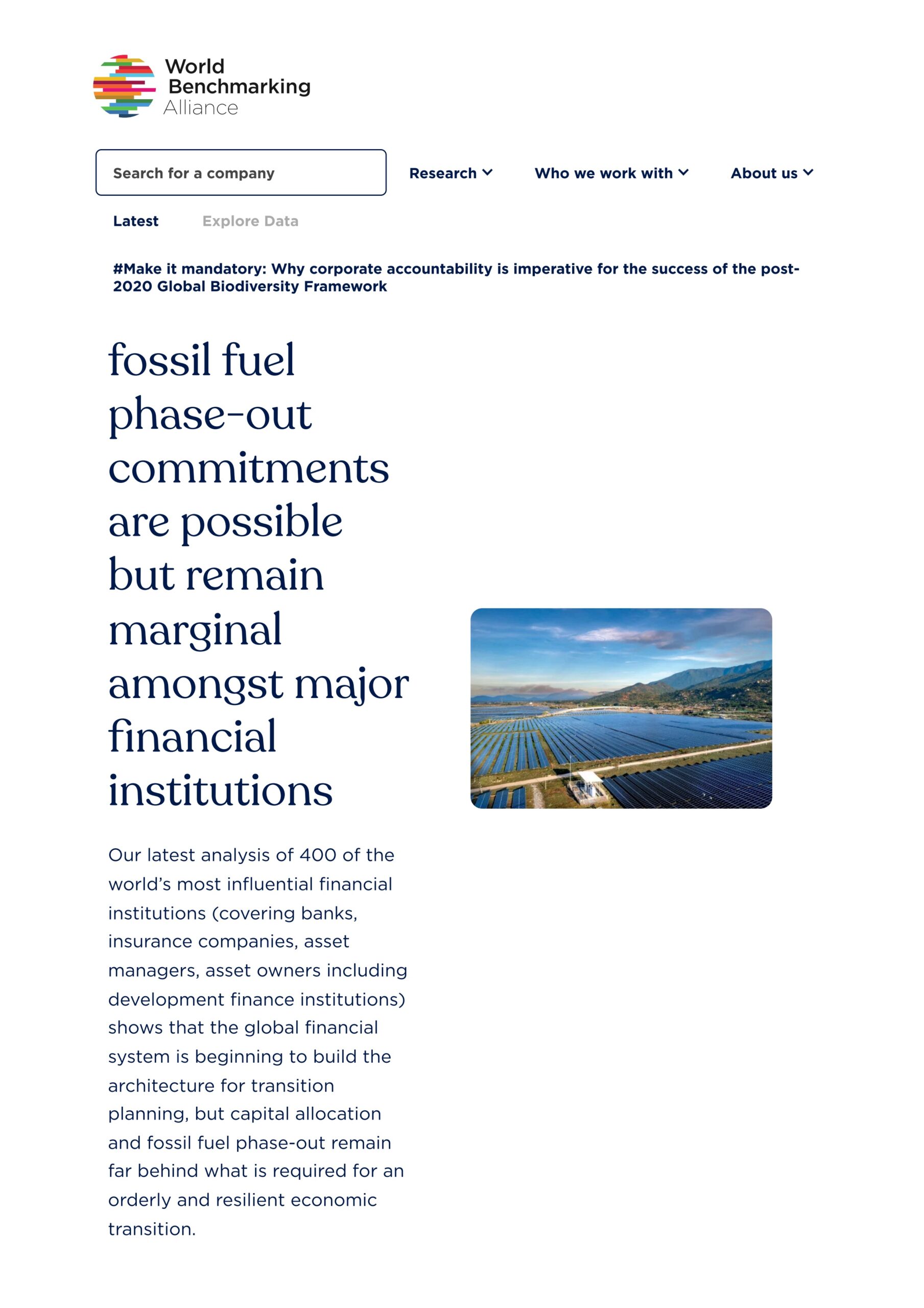
Credible climate financing and fossil fuel phase-out commitments are possible but remain marginal amongst major financial institutions
WBA's analysis of 400 major financial institutions finds that transition planning is emerging but capital allocation to low-carbon solutions and fossil fuel phase-out commitments remain marginal. Only two institutions demonstrate robust fossil-fuel restrictions, and low-carbon activities account for an average of just 2.7% of total financed activities globally.
DAX-AEX Futureproof Index Report
The DAX-AEX Futureproof Index Report is a benchmark series that ranks DAX and AEX-listed companies using an Integrated Value framework combining financial, social, and ecological value. It produces a Futureproofing Ratio to assess long-term corporate value creation and transition risk across sectors and economies.
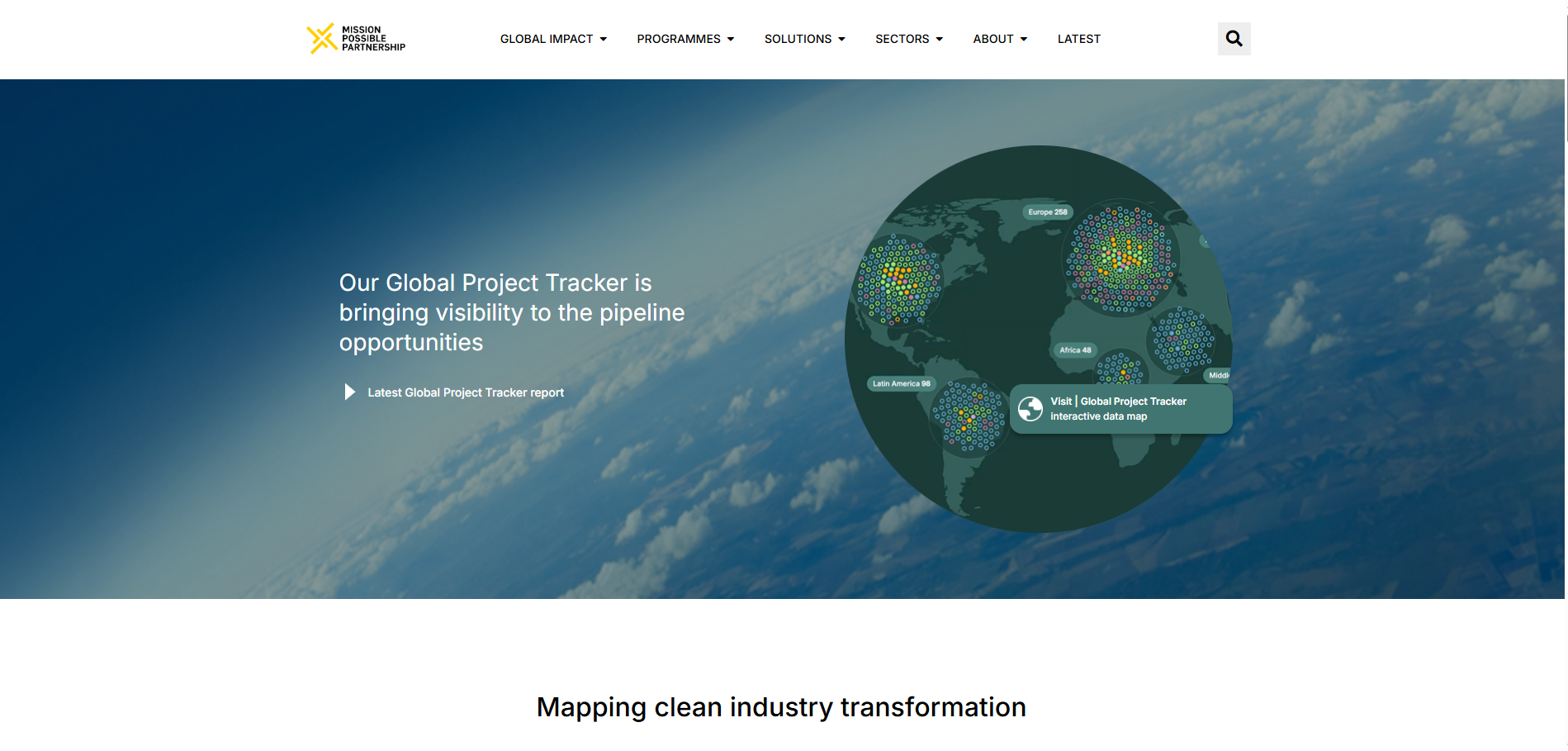
Global Project Tracker
MPP's Global Project Tracker maps the global pipeline of commercial-scale, net-zero-aligned clean industrial plants across materials, chemicals and fuels sectors.
Valuing Impact Dataset
Valuing Impact provides a dataset, insights, methods and case studies to support impact valuation and measurement across organisations.

Retreat or respect? Diverging corporate paths on human rights in a time of turbulence
This BHRC report examines how top US companies are responding to mounting pressure on human rights standards. It identifies three corporate pathways: active deregulatory lobbying by Big Oil and Big Tech, quiet retreat from human rights commitments, and continued adherence. Survey data from April 2026 reveals significant reductions in human rights staffing and budgets.


