
Library | Finance relevance
Investment managers / asset managers
Refine
1407 results
REFINE
SHOW: 16


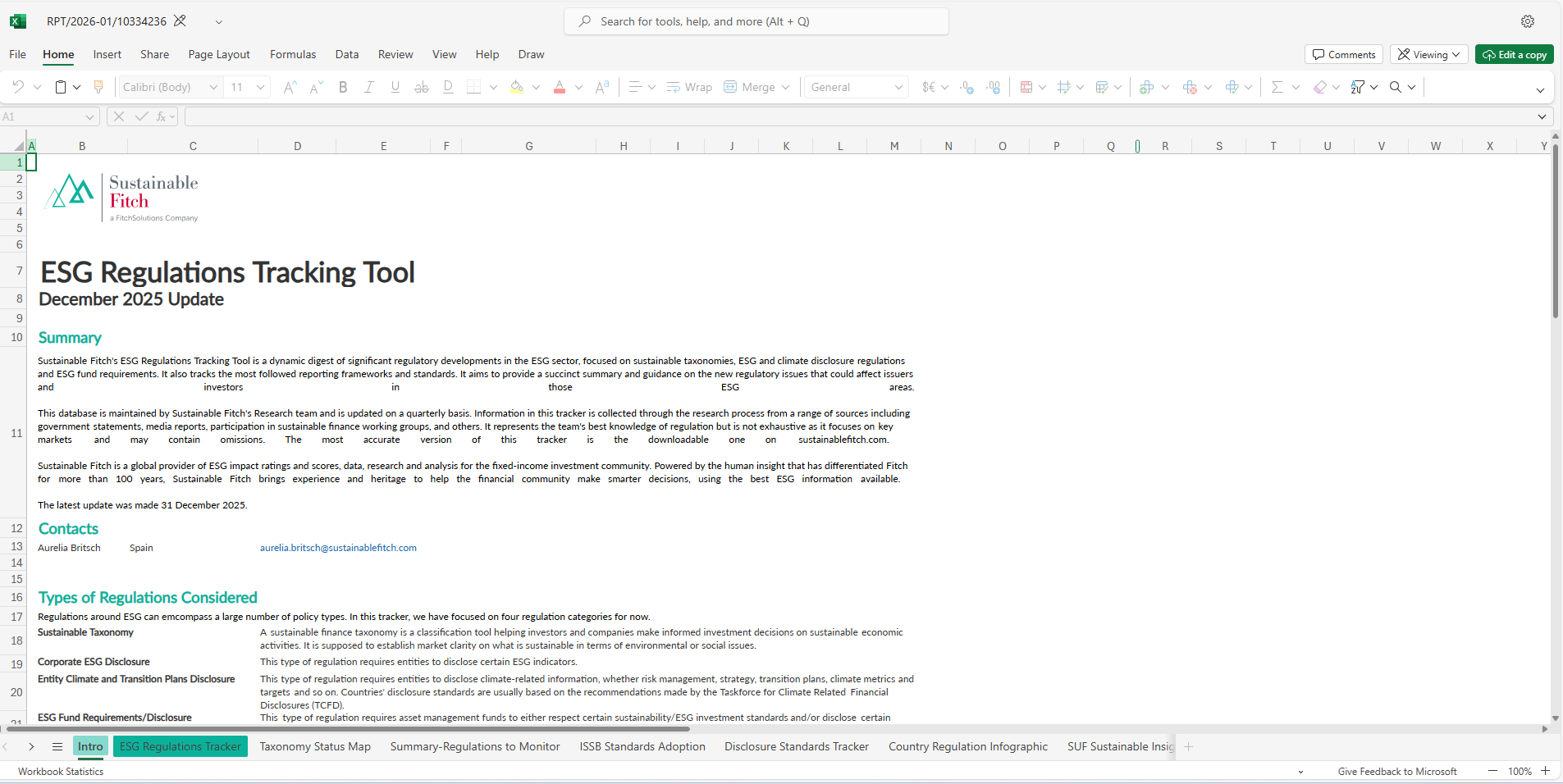
ESG regulations tracking tool
Fitch’s ESG Regulations Tracking Tool monitors global ESG-related regulatory developments affecting corporates. It provides structured, regularly updated insights on policy changes, jurisdictional trends and compliance requirements, supporting finance professionals in assessing regulatory risk, aligning strategies and understanding evolving ESG obligations across multiple markets and sectors.

Sustainable Finance Roundup March 2026: Markets, Climate Risk, and the Transition in Practice
This month’s sustainability roundup captures a shift from framework development to real-world application, where climate and nature risks are increasingly embedded across financial systems, legal accountability, and decision-making. It highlights how intensifying physical climate signals, evolving disclosures, and maturing litigation are converging with insights on sovereign risk, energy systems, and corporate strategy. Together, these developments show how sustainability is moving beyond principle—being tested, priced, and enforced across markets, regulation, and the real economy.

Private doubts, collective conformity: the Power and fragility of climate narratives
This article examines why current climate frameworks persist despite widespread professional skepticism, highlighting institutional incentives and “preference falsification” as key drivers. It calls for more open, cross-sector dialogue focused on diagnosing real problems and unlocking practical, system-level solutions.
Investor climate action plans series
This series provides guidance for investors on developing and assessing climate action plans using the ICAPs Expectations Ladder. It outlines approaches across investment, corporate engagement, policy advocacy, disclosure and governance to support alignment with net zero pathways and improve management of climate-related risks and opportunities.
Seafood traceability engagement series
This series examines how investor engagement can drive improved traceability in global seafood supply chains. It focuses on assessing company progress, encouraging adoption of traceability systems, and supporting investors in identifying and managing environmental and social risks within complex seafood value chains.
Responsible exit principles for oil and gas companies
Sets out voluntary principles for responsible oil and gas asset exits, focusing on decommissioning, buyer due diligence, transparency and stakeholder engagement to reduce climate, financial, legal and social risks from asset transfers and support an orderly transition.

You Built This
This article argues that modern investment strategies fuel economic extraction while often underperforming simpler alternatives. It calls on investors to realign portfolios with productive, community-oriented investments that generate real economic and social value.
Untapped potential: Asset owners and climate policy influence
Assesses major asset owners’ influence on climate policy, finding limited stewardship and advocacy despite significant potential. Most score poorly on climate lobbying oversight and transparency, with few aligning engagement to net zero goals. Highlights gaps in managing asset managers and industry associations, and calls for stronger, coordinated policy engagement.
How does climate risk affect global equity valuations? A novel approach
The report presents a probabilistic, state-dependent valuation framework for global equities under climate risk, finding that strong abatement could limit revaluation losses to 5–10%, while continued weak abatement could imply declines of around 40%, with tipping points worsening losses.
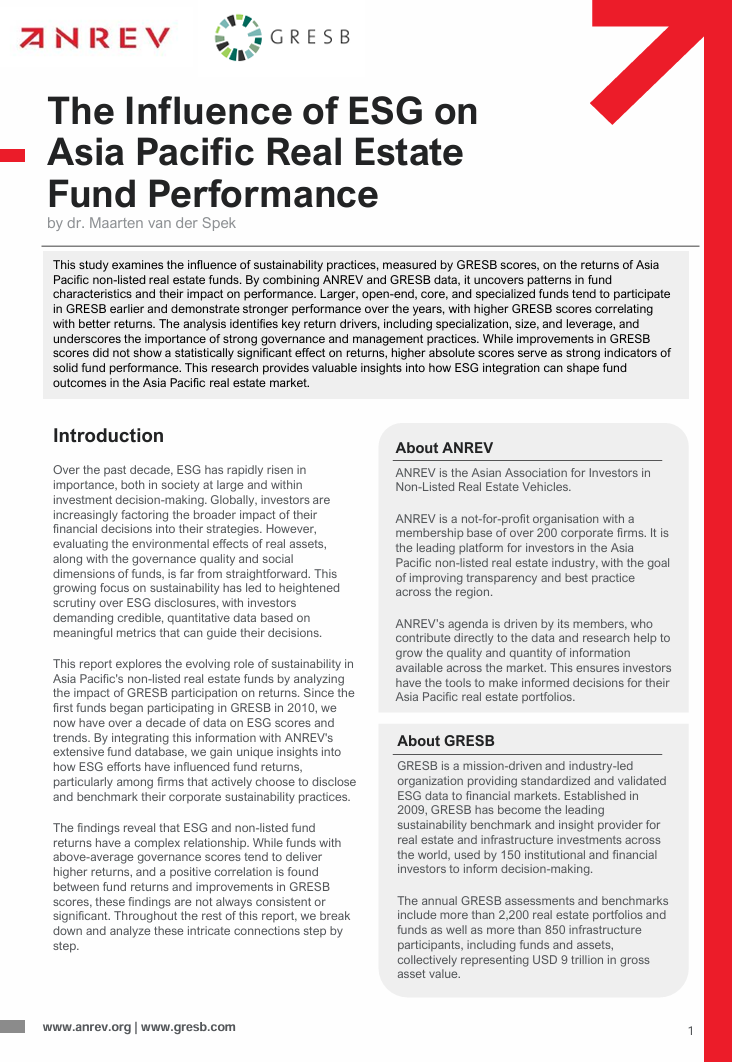
The influence of ESG on Asia Pacific real estate fund performance
Analyses ANREV and GRESB data to assess ESG influence on Asia-Pacific real estate fund returns. Finds higher governance and overall ESG scores correlate with stronger performance, though statistical significance is limited; fund size, specialisation and leverage remain primary return drivers.

ANREV (Asian Association for Investors in Non-Listed Real Estate Vehicles)
ANREV (Asian Association for Investors in Non-Listed Real Estate Vehicles) is a not-for-profit industry body supporting institutional investors in Asia-Pacific real estate funds. It provides research, indices and market data, promotes transparency and best practice, and enables informed investment decisions across non-listed real estate markets.
Australian financial institutions’ views on climate and clean energy opportunities in South and Southeast Asia
Assesses Australian financial institutions’ views on climate and clean energy investment in South and Southeast Asia, highlighting growth potential, limited current exposure, key risks, and barriers. It emphasises blended finance, policy support, and government intervention to mobilise private capital and scale regional investment.
The 12th national risk assessment: Property prices in Peril
First Street argues climate risk is reshaping US housing via higher insurance costs and climate-driven migration, with projected net residential property value losses of about US$1.2 trillion by 2055 and 84% of census tracts facing some negative valuation effects.
Incentivising climate action with executive remuneration in Australia
Provides a framework for linking climate goals to executive remuneration in Australia, emphasising alignment with credible transition strategies, measurable and sector-specific metrics, appropriate weighting, and transparent disclosure. Highlights growing adoption, implementation challenges, and guiding principles to improve investor engagement and incentive effectiveness.
Sustainable and responsible investment for central banks
NGFS reports outline how central banks can integrate sustainable and responsible investment into corporate, sovereign and broader portfolio management, using climate metrics, risk and impact frameworks, governance arrangements and practical implementation guidance, while recognising data gaps, methodological limits and trade-offs with mandates and core investment objectives.
Regulating finance for biodiversity: An assessment for the global biodiversity framework
This report assesses how financial regulation in Indonesia, Brazil, China, the EU and the US aligns with Global Biodiversity Framework targets, finding biodiversity integration generally weak and recommending stronger disclosure, due diligence, taxonomies, sanctions and sector-specific rules to redirect finance away from forest-risk activities.


