
Library | Asset Class
Multi-Asset / General
Investment strategies that allocate across multiple asset classes (e.g., equities, bonds, real estate, alternatives) for diversification.
Refine
864 results
REFINE
SHOW: 16


Australian financial institutions’ views on climate and clean energy opportunities in South and Southeast Asia
Assesses Australian financial institutions’ views on climate and clean energy investment in South and Southeast Asia, highlighting growth potential, limited current exposure, key risks, and barriers. It emphasises blended finance, policy support, and government intervention to mobilise private capital and scale regional investment.
Incentivising climate action with executive remuneration in Australia
Provides a framework for linking climate goals to executive remuneration in Australia, emphasising alignment with credible transition strategies, measurable and sector-specific metrics, appropriate weighting, and transparent disclosure. Highlights growing adoption, implementation challenges, and guiding principles to improve investor engagement and incentive effectiveness.
Breaking down silos: Navigating the intersection of environmental and social risks for investors
Examines how environmental and social risks interact to create compounding financial impacts for investors. Presents a systems-based framework and agrifood case study illustrating portfolio volatility, credit risk and supply disruptions. Recommends integrated risk assessment, value-chain finance, stewardship and blended finance to strengthen portfolio resilience.
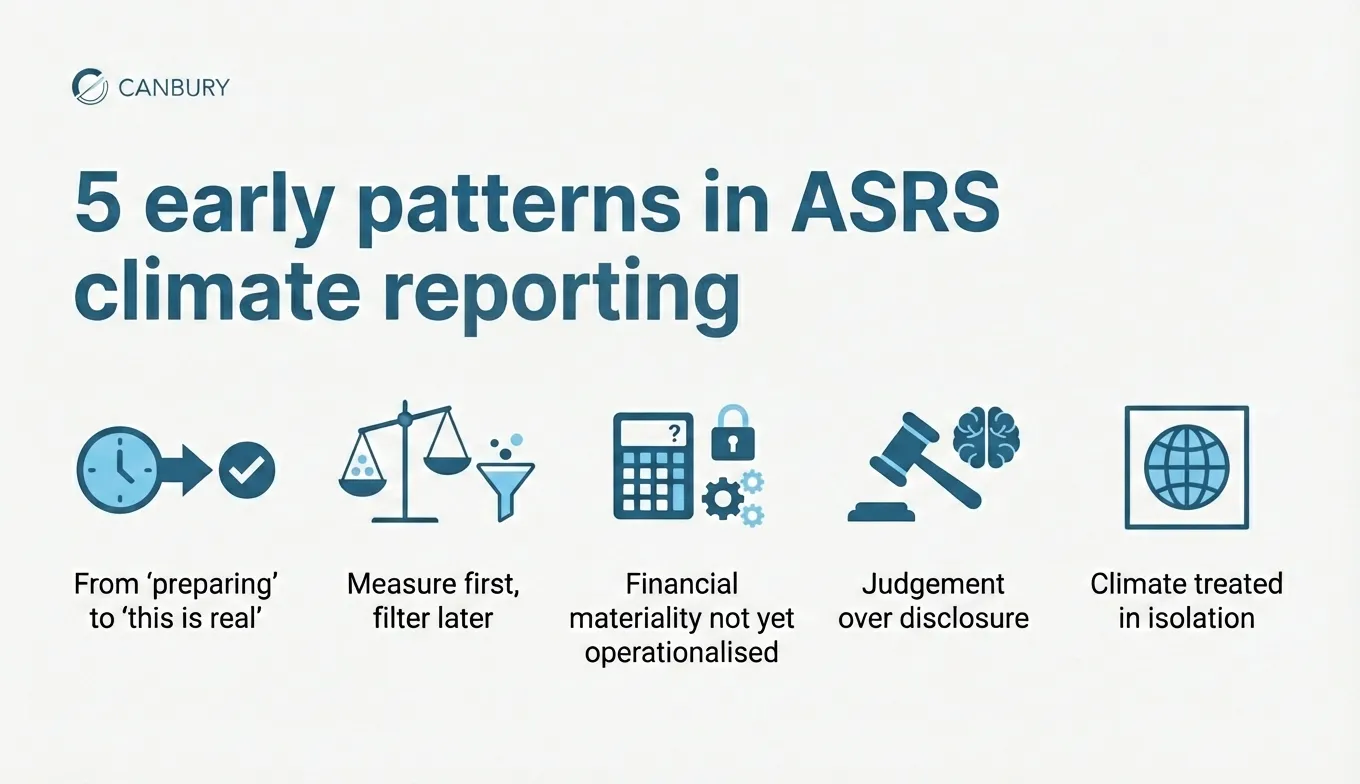
ASRS first year has landed: Here's what we’re seeing in the market
This article examines how Australian organisations are approaching the first year of mandatory ASRS climate disclosures. It highlights common implementation patterns, areas of misallocated effort, and emerging practices that prioritise financially material, decision-useful climate reporting.
Climate-related risks and opportunities and the disclosure of material information
This educational material explains how entities apply AASB S2 to identify and disclose material information on climate-related risks and opportunities affecting cash flows, access to finance and cost of capital. It outlines concepts such as value chains, dependencies and impacts, and provides a four-step process for assessing and reporting material climate-related information.

The slow forces behind this year’s fast crises
The article argues that today’s rapid global crises (political, ecological, and social) are the visible outcomes of long-building systemic pressures. Using complexity science and systemic risk analysis, it highlights how understanding these deep drivers can help societies both anticipate crises and accelerate positive, transformative change.
Mandatory climate reporting in Australia: A practical guide for 2026
Australia’s mandatory climate reporting regime began implementation from 2025, aligned with ISSB IFRS S2 standards. This guide explains regulatory expectations, governance responsibilities, emissions data requirements and practical steps organisations should take in 2026 to establish compliant climate disclosures, integrate climate risks into financial reporting, and prepare for assurance and regulatory scrutiny.

Singapore-Asia taxonomy for sustainable finance
The report outlines the Singapore-Asia Taxonomy for Sustainable Finance, a science-based classification framework defining green, transition (amber) and ineligible economic activities. It provides technical screening criteria—primarily for climate change mitigation—to guide financial institutions, investors and policymakers in directing capital towards environmentally sustainable and low-carbon transition activities across Singapore and ASEAN.
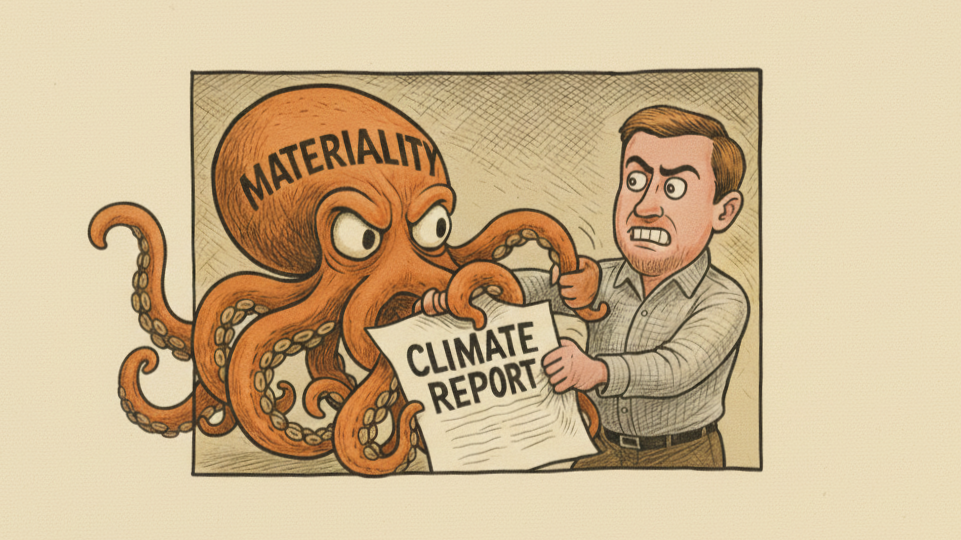
Disentangling materiality and climate reporting
This article explains how the concept of materiality applies in AASB S2 climate disclosures and why it is often misunderstood. It distinguishes between material information, climate risks, emissions reporting, and ESG double materiality assessments, offering practical guidance for preparing compliant climate reports.
A climate-aligned financial system: Leverage points for transformation
This study models the financial system’s role in climate transition using participatory system dynamics with Dutch financial actors. It identifies reinforcing feedbacks like learning, technological lock-in, finance culture and passive investment and proposes seventeen policy and institutional interventions to redirect capital towards sustainable assets and align finance with Paris Agreement goals.
Quality matters: Transforming ESG data for better decision-making
Examines weaknesses in ESG data quality affecting investment and corporate analysis, including inconsistent company reporting, provider extraction errors and structural gaps such as absent repositories. Recommends stronger reporting standards, XBRL tagging, assurance and improved collaboration among companies, regulators and data providers to produce reliable ESG data for financial decision-making.
Sustainable Finance Roundup February 2026: Disclosure, Carbon Trade, and Transition Economics
This month’s sustainability roundup traces a rapidly evolving landscape in climate governance and industrial transition, highlighting the convergence of ISSB-aligned disclosure standards and emerging carbon trade measures alongside shifting cost curves in transport and critical minerals. It underscores how tighter emissions accounting and border policies are embedding carbon competitiveness into capital allocation, while advances in electrification, AI-driven power demand and expanding legal accountability are integrating climate and nature risk into mainstream financial decision-making.
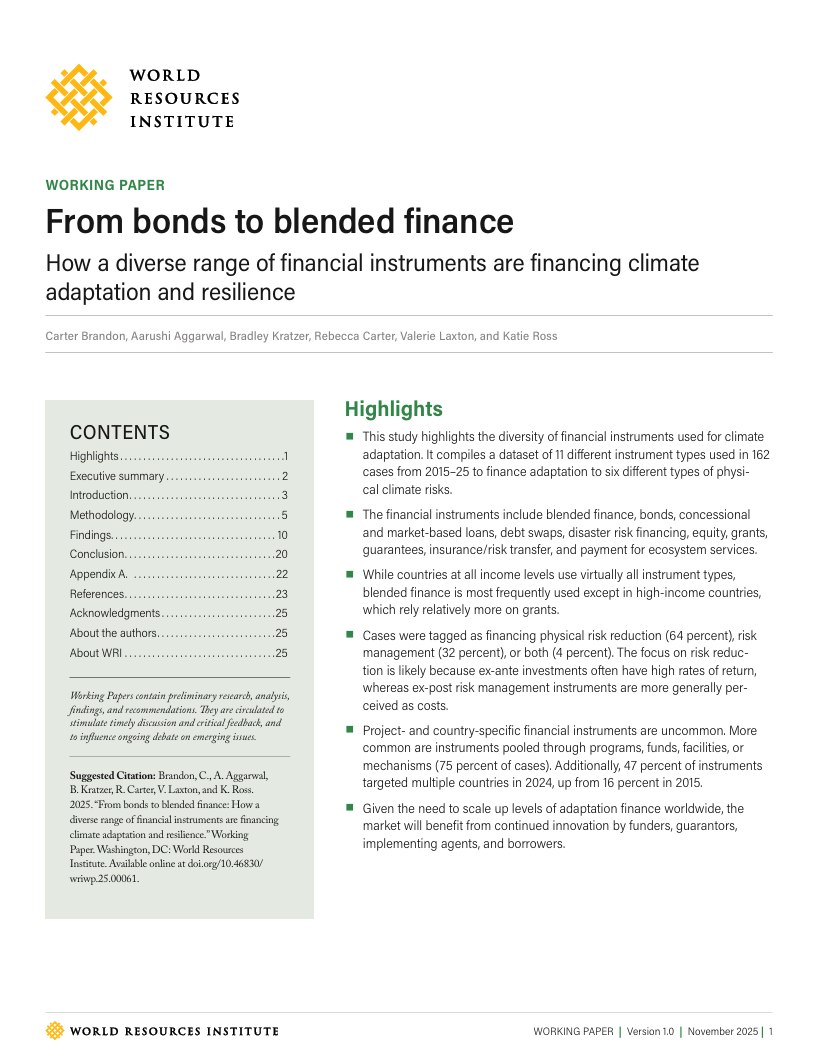
From bonds to blended Finance: How a diverse range of financial instruments are financing climate adaptation and resilience
Analyses 162 cases (2015–2025) of 11 financial instruments financing climate adaptation. Finds blended finance most prevalent, with instruments mainly supporting ex-ante risk reduction. Adaptation finance is largely pooled and increasingly multicountry. Use varies by income level, highlighting growing innovation to mobilise capital for resilience.
Total Impact Portfolio: Constructing an investment portfolio with an impact lens
This guide outlines constructing a Total Impact Portfolio (TIP), integrating risk, return and impact across all asset classes. It explains double materiality, portfolio design steps, responsible investment strategies, measurement frameworks and barriers. Case studies illustrate Australian and international asset owners embedding impact within governance, allocation and performance management.
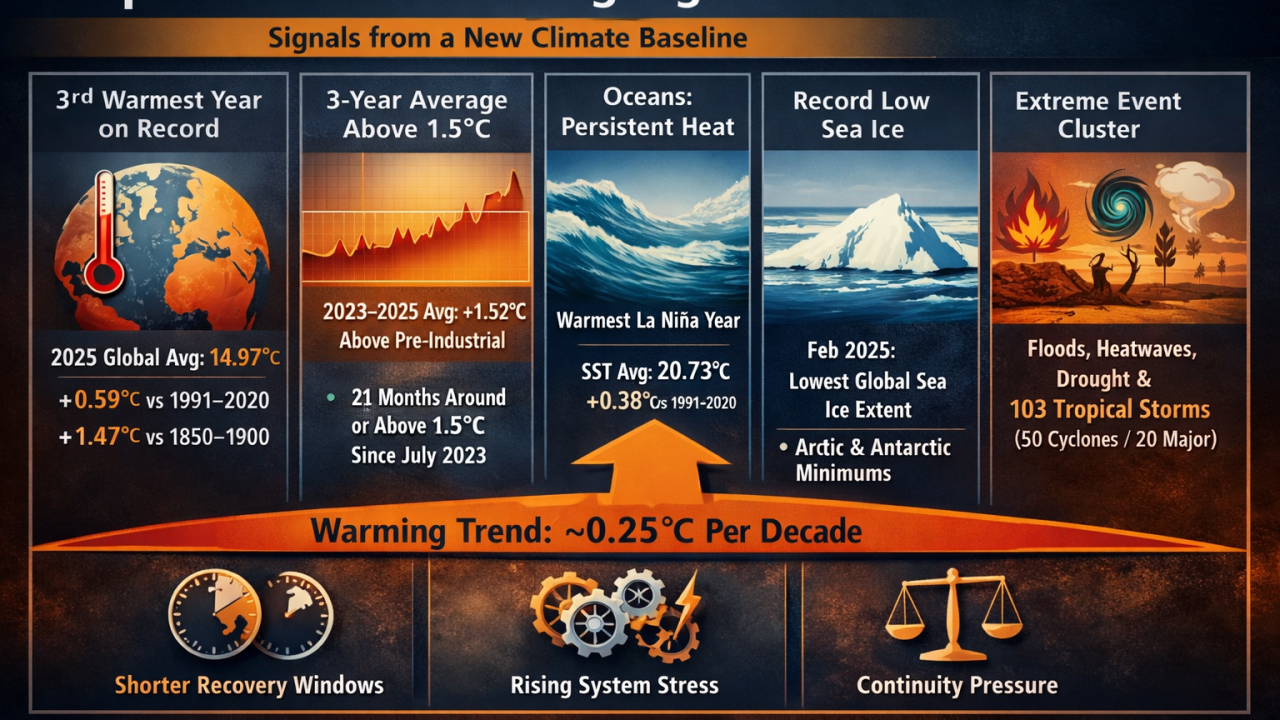
PerilScope: Strategic Deep Dive Copernicus Global Climate Highlights 2025 — From Records to Operating Conditions in the 3°C World SRP® Frame
The article interprets Copernicus’s Global Climate Highlights 2025 as a shift from episodic extremes to a structurally warmer, more volatile baseline. It argues that persistent temperature exceedances, ocean heat, cryosphere decline, and overlapping hazards demand a move from climate risk awareness to disciplined adaptation and continuity planning.
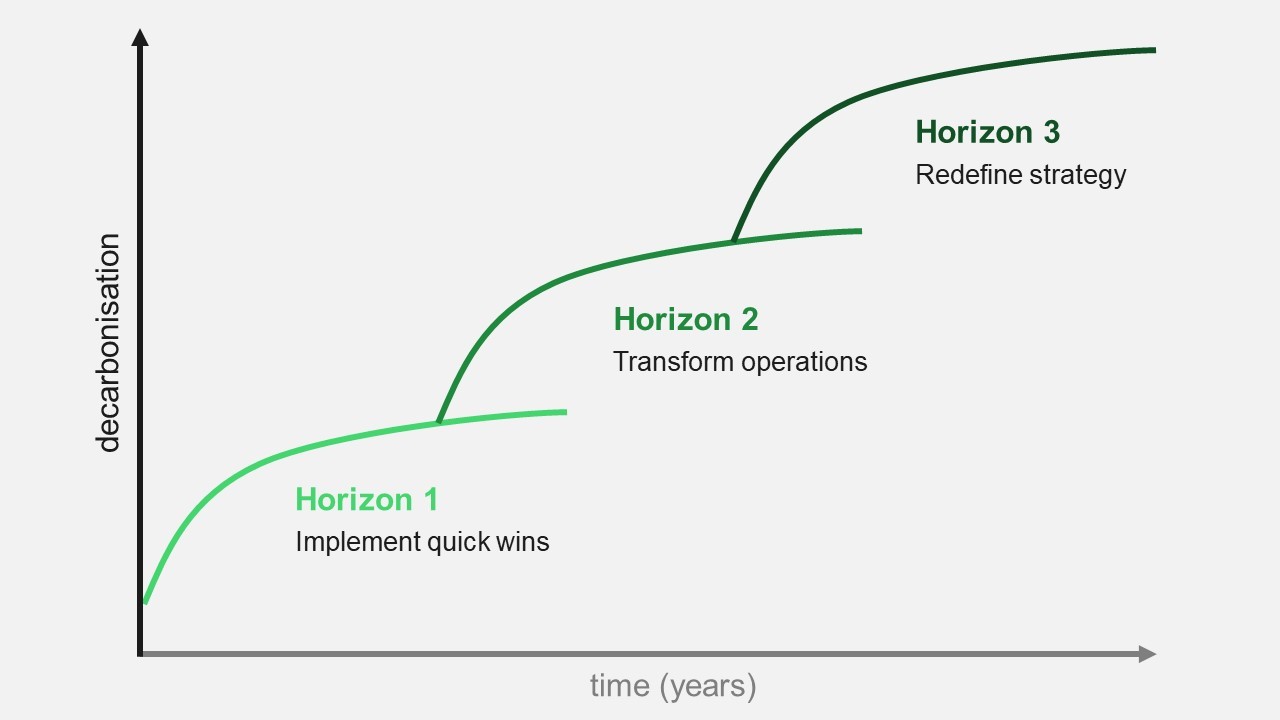
The Three Horizons of Decarbonisation
This article presents the Three Horizons of Decarbonisation framework, helping companies distinguish between short-term efficiency measures, operational transformation, and fundamental business model shifts. It explains how clear horizon identification improves capital allocation, stakeholder engagement, and the likelihood that net zero plans translate into meaningful action.


