

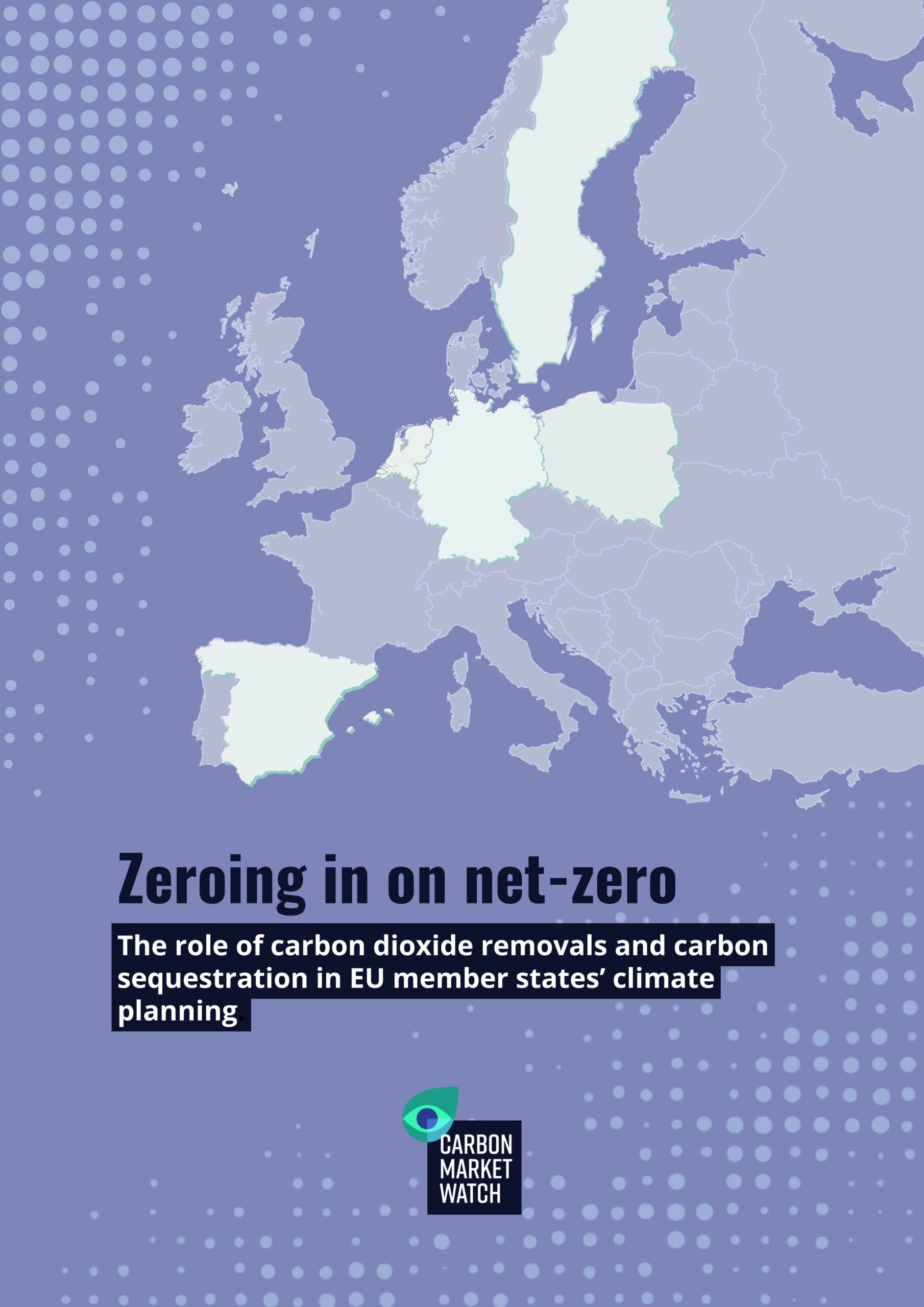
Zeroing in on net-zero: The role of carbon dioxide removals and carbon sequestration in EU member states’ climate planning
This report evaluates carbon dioxide removal and sequestration strategies in five EU member states. It finds that national climate plans often lack strategic rigour, over-rely on declining land sinks, and fail to distinguish between permanent removals and fossil carbon capture. Recommendations focus on binding targets and transparent feasibility assessments.
Please login or join for free to read more.

OVERVIEW
Introduction
To prevent the most catastrophic impacts of climate change, global emissions must be slashed rapidly in line with the Paris Agreement. Even under aggressive decarbonisation scenarios, certain emissions will remain due to technological, economic, and societal constraints. Consequently, carbon dioxide removals (CDR) — methods that permanently remove CO2 from the atmosphere — are considered unavoidable. The report stresses that a participative process is required to determine which emissions are truly unavoidable or “residual.” It warns of “mitigation deterrence,” where reliance on CDR substitutes for deep emission reductions, and emphasises the need for a stringent separation between reduction targets and CDR in climate policy.
Methodology
This analysis reviews how CDR is governed in the National Energy and Climate Plans (NECPs) and Long-Term Strategies (LTSs) of five European Member States as of July 2026. The selected countries are Germany, the Netherlands, Poland, Spain, and Sweden. These nations were chosen to maximise variation across dimensions such as policy development, land sink profiles, and economic contexts. The research evaluates whether countries have separate targets for removals, clear strategic framing, and defined use cases for residual emissions.
Country case studies: Germany
Germany aims for net greenhouse-gas neutrality by 2045, with gross emission reductions of at least 65% by 2030 and at least 88% by 2040 compared to 1990 levels. Residual emissions in 2045 are projected at roughly 160 Mt CO2eq, of which 65 Mt are classified as non-energy residual. While the federal climate act sets LULUCF net sink targets of -25 Mt for 2027–2030, current projections suggest the sector is a net emitter and may only achieve -2.2 Mt by 2030. The report notes that Germany lacks estimates for available CO2 storage capacity and separate targets for permanent removals, although research programmes like CDRterra and CDRmare are informing a forthcoming strategy.
Country case studies: Netherlands
The Netherlands has legally binding targets for climate neutrality by 2050 and a 55% reduction by 2030. Residual emissions demand is estimated at 10–40 Mt in 2050, primarily from hard-to-abate industrial processes and international shipping and aviation. The Dutch CDR roadmap includes an indicative target to build 20–25 Mt of capacity by 2040. The main financing instrument is the SDE++ scheme, which has an €8 billion budget for 2026. However, the report criticises the scheme for conflating CDR with fossil carbon capture and storage (CCS), potentially obscuring whether funds support genuine negative emissions or fossil-fuel-emitting industries.
Country case studies: Poland
Poland lacks national climate targets enshrined in law and has not yet submitted its mandatory LTS. Its NECP states that LULUCF sequestration may offset other sectors, but projections show a shortfall of 9.3 Mt CO2eq against its 2030 LULUCF target of 38.098 Mt. To reverse declining sink capacity, Poland plans to reduce timber harvesting by 5.8% by 2030 and protect 20% of publicly owned forests. Permanent CDR does not feature as a relied-upon measure, and the report suggests Poland prioritises CCS and CCU for heavy industry over addressing genuine residual emissions.
Country case studies: Spain
Spain defines residual emissions as the final 10% of emissions that cannot be eliminated, quantifying this as 29 Mt CO2eq by 2050. The country relies entirely on sequestration in biomass and soils (-37 Mt CO2eq) to balance these. However, this land sink is in jeopardy due to aridity, droughts, and forest fires, with projections showing a decline in sequestration capacity of more than 38% by 2040. Permanent removals are treated only as a last resort, and the report argues that Spain lacks a credible strategy to achieve a reliable state of climate neutrality.
Country case studies: Sweden
Sweden targets net-zero emissions by 2045, allowing for a residual emission share of 15% (approximately 20 Mt). It places a heavy emphasis on bio-CCS, with the Swedish Energy Agency authorised to distribute SEK 36 billion (approx. €3.1 billion) between 2026 and 2046 for biogenic CO2 capture and storage. Despite these incentives, Sweden lacks domestic geological storage capacity and is dependent on exports to Norway. Furthermore, the LULUCF sector has declined by roughly 10 Mt since 1990, and Sweden is projected to miss its 2030 LULUCF target by 7–19 Mt.
Conclusion
The plans examined reveal inadequate policy frameworks and implementation. Only Germany, Spain, and Sweden quantify residual emissions (at 5%, 10%, and 15% respectively). In four of the five countries, land sinks are underperforming or declining. No country has fully enshrined legally binding targets for permanent removals, and there is a general failure to distinguish between permanent CDR and fossil-fuel carbon capture, which risks delaying genuine decarbonisation.
Recommendations
The report urges the establishment of an EU-wide residual emissions strategy with quantitative, sector-specific definitions. It recommends setting separate, binding targets for permanent removals and grounding projected removal volumes in transparent feasibility assessments. Member states should acknowledge the limitations of biomass sequestration and clearly separate permanent CDR from fossil CCS and CCU in both strategic planning and financing instruments.




