
Library | Asset Class
Multi-Asset / General
Investment strategies that allocate across multiple asset classes (e.g., equities, bonds, real estate, alternatives) for diversification.
Refine
864 results
REFINE
SHOW: 16


In focus: Impact investing in Asia
Impact investing in Asia is expanding, with $80 billion allocated and strong investor satisfaction. Returns largely meet or exceed expectations, led by private equity. Capital targets financial services, energy and healthcare, addressing a $1.5 trillion SDG gap, with growing private sector participation and regional variation.

Advancing gender equality through gender lens investing
Examines gender lens investing as an approach integrating gender analysis into investment decisions to promote equality and returns. Outlines strategies, benefits, challenges, and case studies, linking to SDGs and emphasising measurement, engagement, and diverse investment practices.
Investing to reconnect financial value with people, nature and the real economy: An iterative blueprint for capital markets actors, policymakers and regulators
This report outlines a blueprint for reforming capital markets to better reflect human, social and natural capital. It proposes changes to fiduciary duty, financial analysis and policy frameworks to reduce systemic risks and align investment practices with long-term economic, environmental and social outcomes.
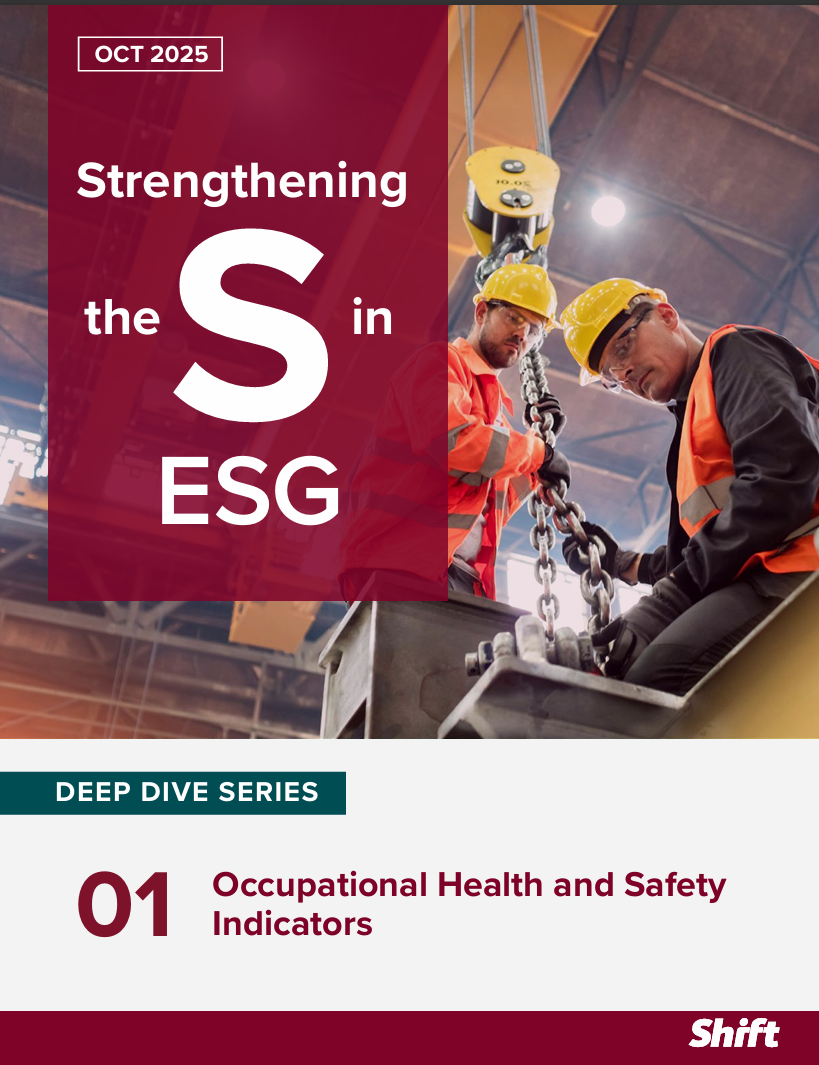
Strengthening the S in ESG series
Strengthening the S in ESG is a research series examining the design and use of social indicators and metrics within ESG frameworks. It provides guidance and analysis to improve how companies’ impacts on people are measured, supporting more decision-useful insights for investors and better alignment with real business practices.
Human rights due diligence in the financial sector: A compendium of industry case studies and practice
Examines how financial institutions implement human rights due diligence, aligned with UNGPs and OECD guidelines, using case studies. Highlights challenges in data, prioritisation and leverage, and emphasises integrating human rights into governance, risk processes and client engagement to manage impacts across lending, investment and insurance activities.
The Climateworks guide to credibility for corporate climate transition plans
Provides an Australian-focused framework for assessing the credibility of corporate climate transition plans, outlining principles, criteria and disclosure expectations. It supports companies, investors and regulators in evaluating emissions targets, governance, strategy alignment and risk management within mandatory climate reporting and net zero transition planning.
Governing for net zero: The board's role in organisational transition planning
This report guides Australian boards on integrating net zero transition planning into strategy, governance, disclosure and stakeholder engagement. It outlines directors’ legal duties, mandatory climate reporting requirements, and practical oversight questions to help organisations manage climate-related risks, opportunities and implementation.

Heightened human rights due diligence
UNDP’s training guide explains heightened human rights due diligence for companies in conflict-affected contexts, outlining frameworks, legal expectations and practical steps to assess, mitigate and remedy impacts on human rights and conflict, supported by case studies and tools to guide implementation.
Sustainable Finance Roundup March 2026: Markets, Climate Risk, and the Transition in Practice
This month’s sustainability roundup captures a shift from framework development to real-world application, where climate and nature risks are increasingly embedded across financial systems, legal accountability, and decision-making. It highlights how intensifying physical climate signals, evolving disclosures, and maturing litigation are converging with insights on sovereign risk, energy systems, and corporate strategy. Together, these developments show how sustainability is moving beyond principle—being tested, priced, and enforced across markets, regulation, and the real economy.

Private doubts, collective conformity: the Power and fragility of climate narratives
This article examines why current climate frameworks persist despite widespread professional skepticism, highlighting institutional incentives and “preference falsification” as key drivers. It calls for more open, cross-sector dialogue focused on diagnosing real problems and unlocking practical, system-level solutions.
Investor climate action plans series
This series provides guidance for investors on developing and assessing climate action plans using the ICAPs Expectations Ladder. It outlines approaches across investment, corporate engagement, policy advocacy, disclosure and governance to support alignment with net zero pathways and improve management of climate-related risks and opportunities.
Corporate climate governance
Examines how mandatory climate disclosure regimes reshape corporate governance by integrating climate risk into decision-making. Develops a spectrum from “thin” to “thick” governance, showing a shift towards stakeholder-oriented models, enhanced risk management, and long-term value optimisation, with implications for fiduciary duties and corporate strategy.
Doughnut economics for regenerative business design
An edited volume applying Doughnut Economics to business design, using case studies and critical reflections to examine how purpose, networks, governance, ownership and finance can support regenerative and distributive business models. It focuses on redesigning firms to operate within ecological and social limits.
Climate-nature scenario development for financial risk assessment
This report develops integrated climate-nature scenarios for financial risk assessment, showing that combined climate and nature policies provide a fuller view of agricultural, biodiversity and ecosystem-service risks than separate approaches, with implications for central banks, supervisors and future stress-testing frameworks.
Untapped potential: Asset owners and climate policy influence
Assesses major asset owners’ influence on climate policy, finding limited stewardship and advocacy despite significant potential. Most score poorly on climate lobbying oversight and transparency, with few aligning engagement to net zero goals. Highlights gaps in managing asset managers and industry associations, and calls for stronger, coordinated policy engagement.
Resourcing the solidarity economy: Insights on building community power through reorganising wealth
This report examines how solidarity economy organisations can be resourced through wealth redistribution, arguing they are underfunded, misrecognised and poorly served by conventional investment models. It recommends reparative, community-led financing and ecosystem support rather than profit-focused, repayable finance.


