

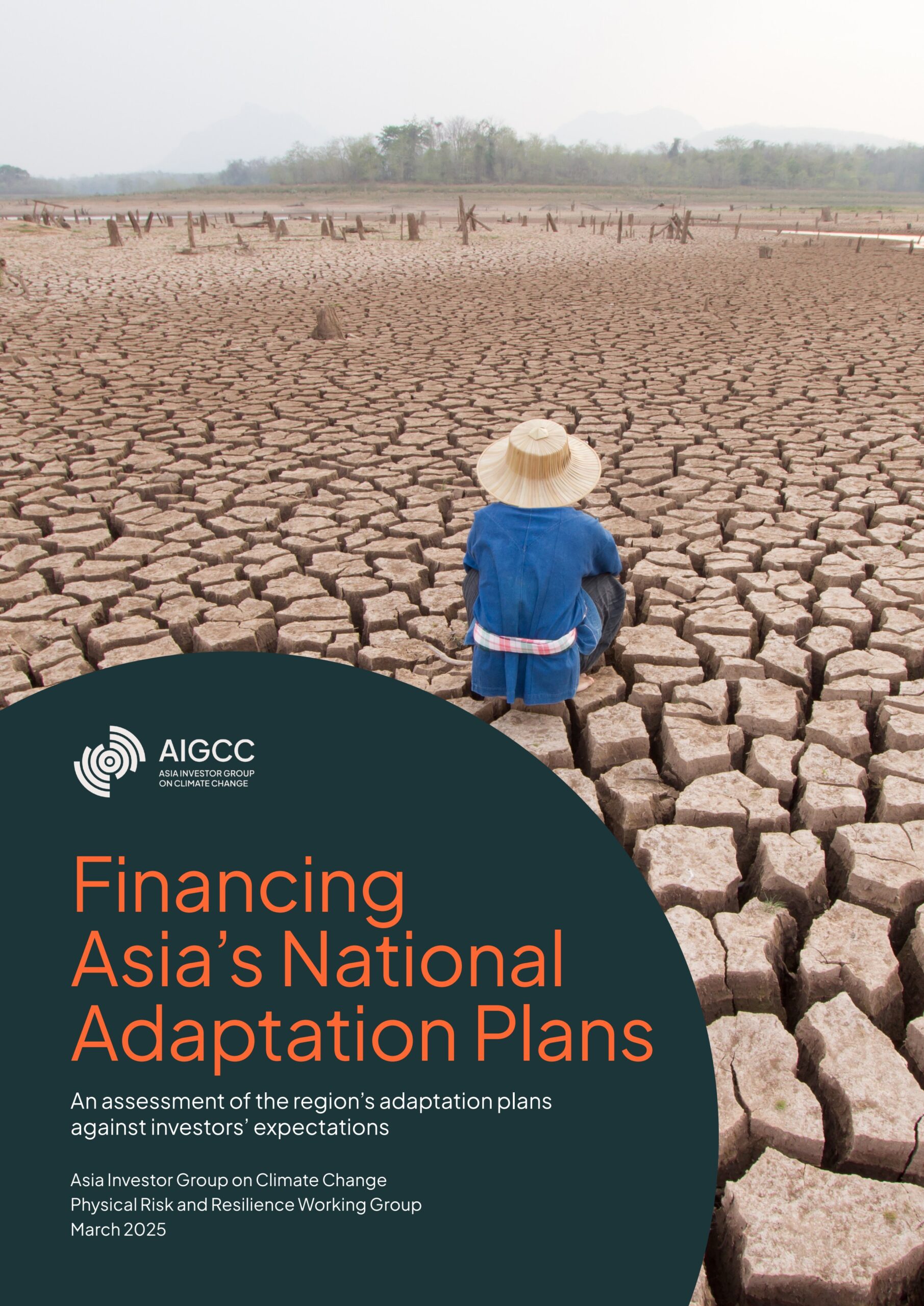
Financing Asia’s National Adaptation Plans: An assessment of the region’s adaptation plans against investors’ expectations
This benchmark report evaluates the alignment of national adaptation planning across nine Asian markets with investor expectations. Produced by the Asia Investor Group on Climate Change, it highlights progress and gaps in climate risk information and project pipelines to help unlock private capital for regional resilience.
Please login or join for free to read more.

OVERVIEW
Overview
Financing Asia’s National Adaptation Plans is a benchmark report produced by the Asia Investor Group on Climate Change (AIGCC). The report was developed by the AIGCC Physical Risk and Resilience Working Group to assess the progress of national climate adaptation planning across nine priority Asian markets: China, Hong Kong SAR, India, Indonesia, Japan, Korea, Malaysia, Singapore, and Thailand. Published in March 2025, the report provides a comprehensive snapshot of how regional governments are developing policies to address escalating physical climate risks, such as extreme heat, flooding, and sea-level rise, and whether these plans align with the requirements of the private financial sector.
Purpose
The report exists to address the significant financing gap in climate adaptation, estimated to be between USD 187 billion and USD 359 billion per year. It serves to inform institutional investors about the current status and future direction of adaptation policies in Asia, which is crucial for managing portfolio exposure to physical risks. By evaluating national adaptation plans (NAPs) against investor expectations, the document aims to encourage governments to create enabling policy environments that unlock private capital. It provides a structured dialogue tool to help policymakers understand how to make adaptation projects more bankable and how to improve the accessibility of climate data for the financial community.
Methodology
The analysis is conducted using a bespoke assessment framework consisting of seven overarching investor expectations and twelve detailed sub-expectations. These pillars include the development of physical risk data platforms, the use of multiple climate scenarios (including worst-case projections), corporate disclosure of physical risks, and the inclusion of action-oriented financing strategies. The assessment relies on publicly available documents current as of January 2025, including official NAPs submitted to the UNFCCC, Adaptation Communications (ADCOMs), national climate change strategies, and mandatory disclosure regulations. Each market is classified using a ‘Green-Amber-Red’ matrix:
- Green indicates advanced progress or full alignment with expectations.
- Amber represents mixed or moderate progress where further work or information is required.
- Red signifies that attention is urgently required or that there is an absence of the specific indicator.
The classification is based on qualitative and objective indicator assessments, such as the presence of inter-ministerial coordinating bodies or the launch of open-access hazard databases.
Use for finance professionals
Finance professionals can use this report as a resource for accelerating policy engagement and refining investment strategies related to climate resilience. Asset managers and owners can leverage the findings to advocate for stronger regulatory frameworks and mandatory corporate disclosures on physical risks at a national level. The report helps professionals understand which jurisdictions are providing the high-resolution, consistent, and credible data needed for informed decision-making and asset-level vulnerability assessments. Additionally, it highlights emerging investment opportunities in adaptation, such as resilience bonds and project pipelines in China and Japan. By using the assessment’s findings, investors can better build internal capacity to integrate climate modelling and scenario analysis into their portfolio management processes and more effectively engage with investee companies on their resilience measures.




