

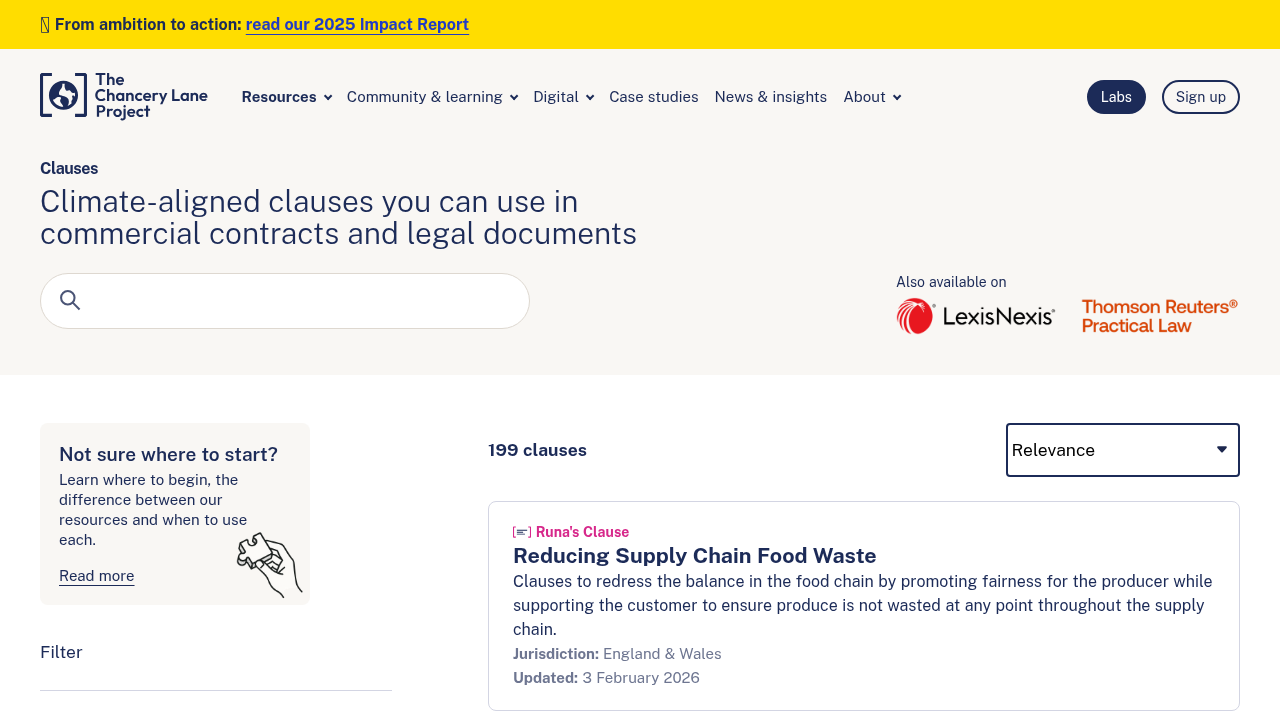
Climate Aligned Clauses Library
A comprehensive library of climate-aligned legal clauses provided by The Chancery Lane Project to help organisations integrate net zero goals into commercial contracts.
Please login or join for free to read more.

OVERVIEW
The Climate Aligned Clauses Library is a comprehensive collection of legal provisions designed to be integrated into commercial contracts and legal documentation to support global decarbonisation efforts. Developed as a collaborative legal initiative, the tool provides practical wording that shifts legal obligations toward net zero outcomes. It is a critical resource for finance professionals and legal counsel seeking to align private law agreements with institutional climate commitments.
Organisation behind the tool
The library is developed and maintained by The Chancery Lane Project, a registered charity in the United Kingdom. The project operates globally, involving a wide network of legal professionals and organisations to create and refine climate-conscious legal precedents.
What the tool does
The tool provides a searchable database of climate-aligned clauses that users can view and adapt for various legal contexts. Key features include:
- A library of ready-to-use legal clauses covering diverse sectors and contract types.
- Guidance on how to implement these provisions within existing commercial frameworks.
- Filtering capabilities to find clauses relevant to specific legal jurisdictions or industries.
- An API and Model Context Protocol for integration with legal technology and AI tools.
Target audience
The primary audience includes legal professionals, in-house counsel, and sustainability leads within corporations. It also serves policymakers, technology providers, and developers working in the legal-tech sector.
Relevance to finance professionals
Finance professionals can utilise the library to strengthen the environmental integrity of financial instruments and corporate agreements through:
- Risk assessment – Using legal obligations to mitigate climate-related transition risks and ensure contractual compliance with environmental standards.
- ESG analysis – Implementing specific metrics and reporting requirements directly into supply chain and investment contracts.
- Investment context – Aligning loan agreements, bond documentation, and shareholder agreements with long-term net zero pathways.
- Market insights – Adopting standardised climate language that reflects evolving market expectations and regulatory requirements for sustainable finance.




