

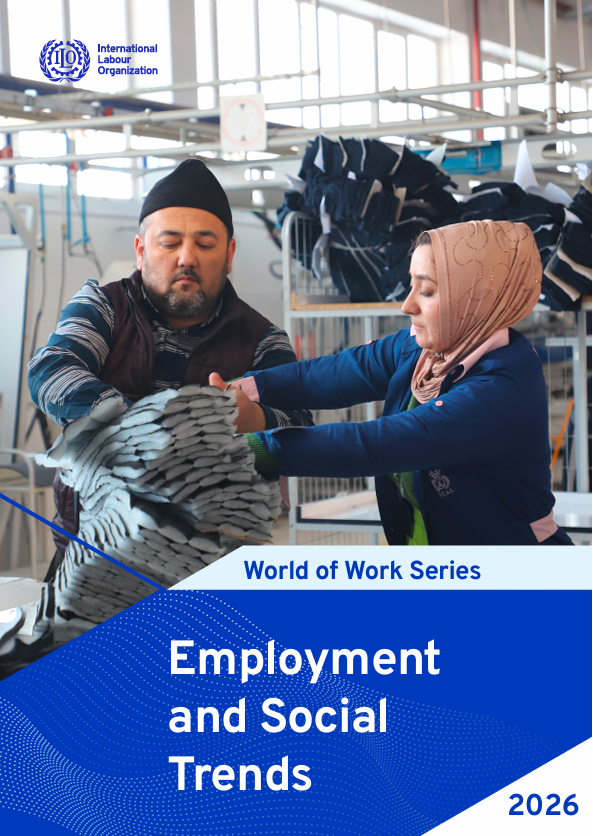
World of work series: Employment and social trends
Global labour markets remain resilient amid uncertainty, but decent work deficits persist. Informality, working poverty and gender gaps remain widespread, especially in low-income countries. Productivity growth is weak, and demographic shifts and AI add risks. Economic growth alone is insufficient to improve employment quality or social outcomes.
Please login or join for free to read more.

OVERVIEW
Global trends and outlook
Global labour markets remain resilient despite high uncertainty, with unemployment projected at 185.8 million in 2026 and the global jobs gap rising to 408 million. Economic growth is modest and confidence weak, while risks stem from trade uncertainty, debt pressures and AI adoption.
Access to employment shows limited improvement. Youth labour market conditions are stagnating, and gender gaps persist across participation and employment status. Employment quality remains a key concern, with 2.1 billion workers in informal employment and rising informality in low-income countries. Women are disproportionately represented in lower-quality roles, including 14.4% in contributing family work versus 6.1% for men.
Productivity growth remains subdued at around 2.0%, constraining wage growth and improvements in job quality. Structural transformation has slowed significantly, reducing progress in formalisation and decent work. The report highlights the need for coordinated action by governments, employers and workers to address decent work deficits rather than relying solely on economic growth.
Employment and social trends by region
Regional labour market trends vary significantly. In Africa, GDP growth is projected at 4.3% in 2026, supported by easing inflation but constrained by conflict, climate shocks and structural weaknesses. Population growth creates pressure to generate sufficient quality jobs, particularly for youth.
In the Americas, unemployment is expected to decline in Latin America and the Caribbean but increase in Northern America due to labour force growth and job losses. In the Arab States, digital transformation risks widening inequalities due to uneven adoption.
Asia and the Pacific face dual challenges of climate risks and emissions, with implications for green job creation. Europe and Central Asia are shaped by ageing populations, reducing labour supply and affecting long-term growth. Across regions, demographic shifts and AI introduce uncertainty, requiring policy adaptation to labour shortages, skills mismatches and inequality.
Shifting patterns of trade and employment
Global trade and investment trends are weakening, with declining foreign direct investment and rising trade policy uncertainty affecting employment linked to global supply chains. Trade continues to support job creation, particularly in services, which are increasing their share in international trade and employment.
Employment linked to foreign demand tends to offer higher productivity, better wages and lower informality, especially in low- and middle-income countries. However, shifts in trade patterns, including greater intraregional trade and reduced global integration, are altering employment distribution.
The report emphasises that ensuring decent work in global supply chains is essential to translating trade gains into social progress. Strengthening labour standards and improving job quality in trade-related sectors are necessary to maximise inclusive benefits from globalisation.




