

Peer groups matter: Comparative industry effects in ESG rating disagreement
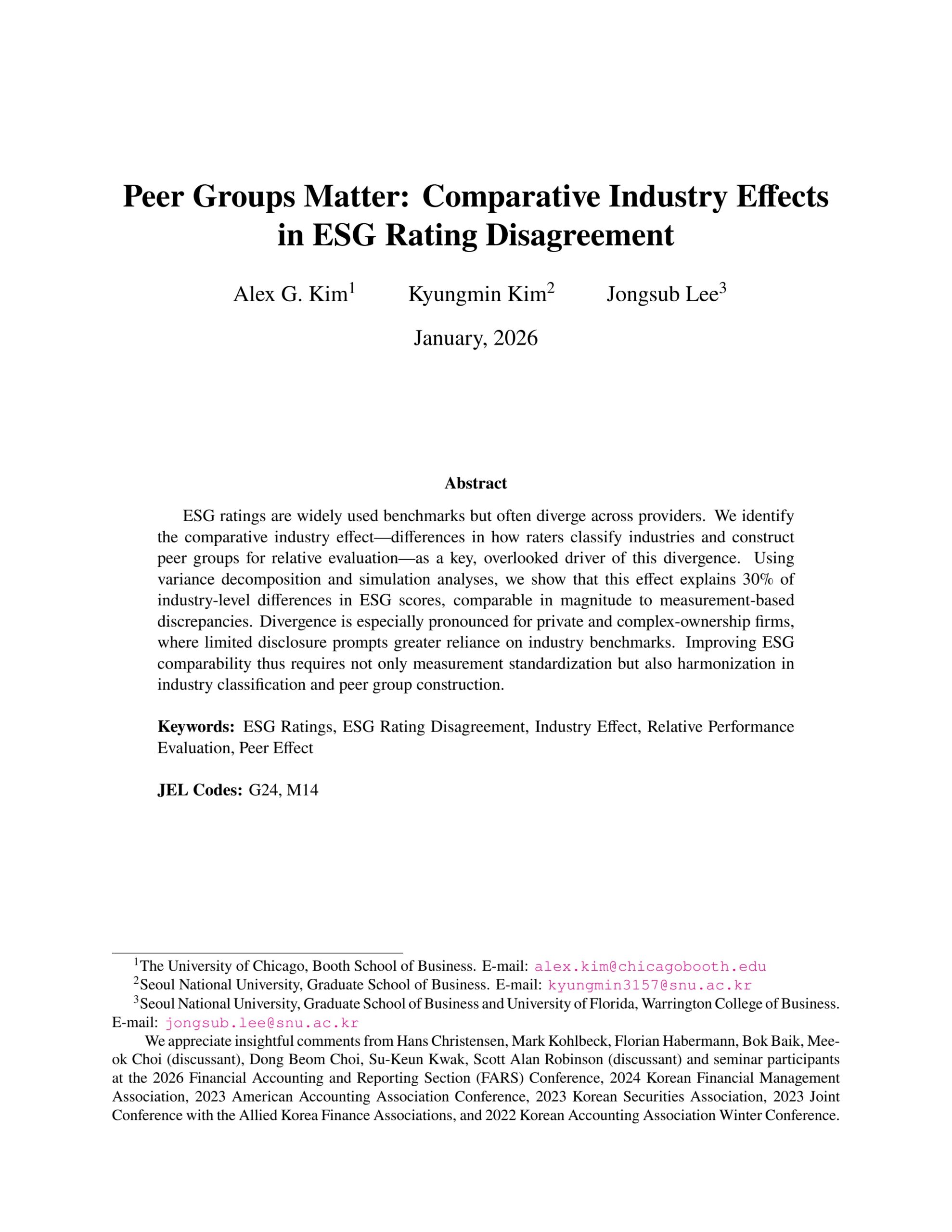
This research identifies the ‘comparative industry effect’—differences in industry classification and peer group construction—as a major driver of ESG rating divergence. It explains 30% of industry-level score differences, particularly affecting environmental ratings and firms with limited public disclosure or complex ownership structures.
Please login or join for free to read more.

OVERVIEW
Introduction
ESG ratings are increasingly utilised as benchmarks by practitioners and academics, yet they exhibit significant divergence across providers. While credit ratings show an R-squared of nearly 82%, ESG ratings often reach only 13%. Existing literature has primarily focused on firm-level factors such as scope, weight, and measurement discrepancies to explain this phenomenon. This research identifies a previously overlooked driver: the “comparative industry effect”. This effect refers to systematic industry-level differences arising from how rating agencies classify industries and construct peer groups for relative performance evaluation (RPE).
Institutional details: Industry evaluation models by ESG raters
The study examines four major ESG raters: MSCI, Refinitiv (LSEG), Sustainalytics, and S&P Global. Each rater employs a distinct historical background and proprietary industry taxonomy, such as GICS or TRBC. Unlike credit ratings, which assess risk on an absolute scale, ESG assessments typically utilise RPE. This practice means a firm’s score is determined relative to its peers. Consequently, the comparative industry effect emerges through two channels: the assignment of a single firm to different industries by different raters, and the use of varying peer group compositions even when the industry classification remains the same.
Data and sample selection
The analysis concentrates on publicly traded firms with comprehensive coverage from all four providers between 2013 and 2019. The final sample consists of 1,742 unique firms across 8,720 firm-year observations. Geographically, the sample is dominated by the Americas (50.73%), with the United States constituting 39.90% of observations. To ensure comparability across raters with different scoring scales, the researchers utilised standardised Z-scores with a zero mean and unit variance.
The existence of industry-level disagreement
Empirical evidence shows that raters disagree significantly at the industry level. For example, in the Metal Mining sector (SIC 10), MSCI assigned a markedly negative industry mean (-1.14) while S&P reported a positive average (+0.12). A specific case study of Barrick Mining Corporation illustrates this; S&P classified the firm broadly under Metals & Mining, ranking it 1st among 26 peers, whereas MSCI used a narrower Precious Metals category, ranking it 3rd among 12 peers. Such discrepancies have real market consequences, as industry-level disagreement is found to increase abnormal stock return volatility, generating firm-specific uncertainty for investors.
Understanding industry-level disagreement
Variance decomposition reveals that industry fixed effects alone explain over 50% of the variance in ESG scores, rising above 81% when industry-by-rater interactions are included. A numerical simulation using Scope 1 carbon emission metrics indicates that the comparative industry effect constitutes approximately 30% of total simulated divergence when measurement discrepancies are minimised. In this context, its magnitude is almost eight times greater than that of raw measurement divergence. This suggests that even with perfectly standardised raw data, significant rating disagreement would persist due to differing peer group benchmarks.
Economic determinants of industry-level rating disagreements
The study identifies several economic factors associated with rating discrepancies. Structural revisions to the Global Industry Classification Standard (GICS) in 2014, 2016, and 2018 were found to amplify industry-level disagreement by shifting peer group compositions. Furthermore, industry-level disagreement is significantly higher for private firms and firms operating in countries with concentrated ownership (such as Mexico, Belgium, and Sweden) compared to those with dispersed ownership (UK, US, Japan). This suggests that ESG raters rely more heavily on industry-level benchmarks when firm-level public disclosure is limited or opaque.
Conclusion
The research demonstrates that industry-level factors are a primary and persistent source of ESG rating disagreement. Improving ESG comparability requires more than just measurement standardisation; it necessitates the harmonisation of industry classifications and peer group construction frameworks. Policymakers and standard-setters are encouraged to prioritise these areas to reduce inconsistencies that can distort resource allocation. The findings highlight that the comparative peer effect is a critical, enduring component of the overall ESG rating divergence landscape.




