

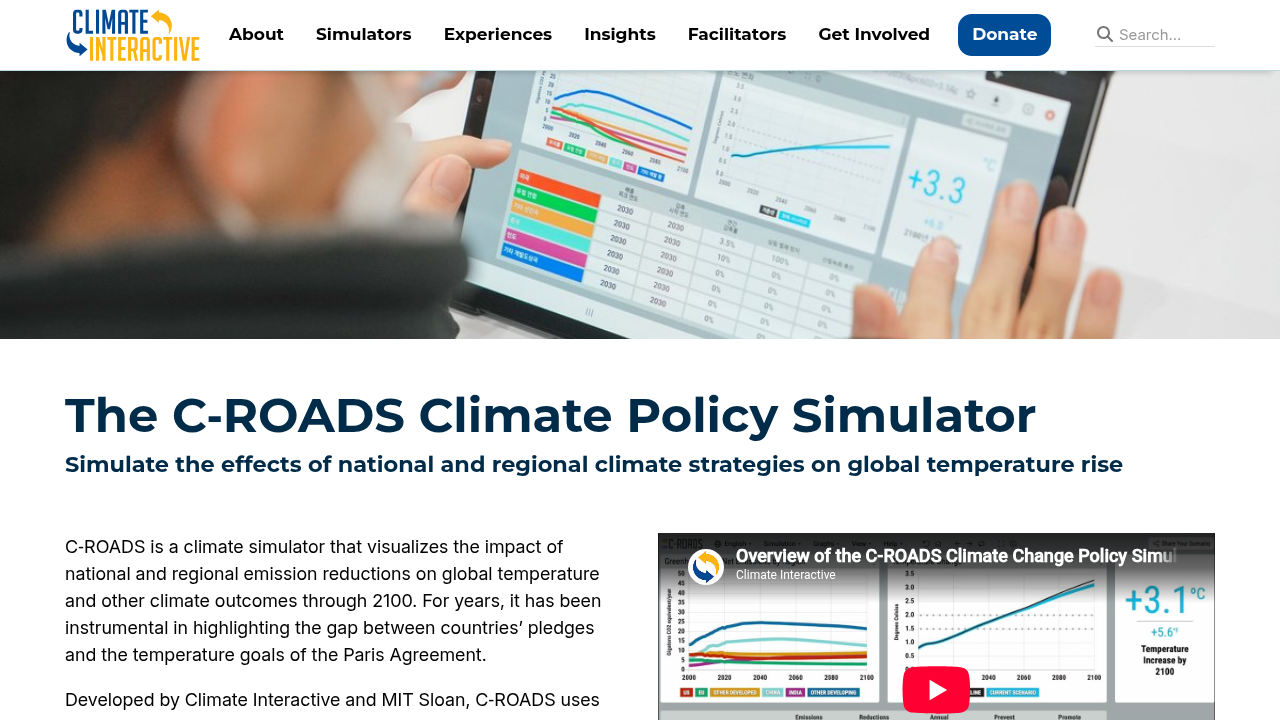
C-ROADS Climate Change Policy Simulator
C-ROADS is a policy simulation tool developed by Climate Interactive and MIT Sloan to visualise how national emission reduction pledges impact global temperature and sea levels.
Please login or join for free to read more.

OVERVIEW
The C-ROADS Climate Change Policy Simulator is a decision-support tool designed to visualise the long-term impacts of national and regional greenhouse gas emission reduction commitments. It provides a platform for understanding how various climate policies contribute to global temperature targets, such as those established in the Paris Agreement. For finance professionals, C-ROADS offers a high-level overview of how multi-national policy shifts could alter global climate trajectories and economic stability.
Organisation behind the tool
The tool is developed and maintained by Climate Interactive in collaboration with the MIT Sloan Sustainability Initiative.
What the tool does
C-ROADS functions as a system dynamics model that allows users to simulate the atmospheric and oceanic impacts of climate policies. Key features include:
- Simulating CO2 emissions, concentrations, and temperature changes based on user-defined regional commitments.
- Visualising impacts such as sea-level rise and ocean acidification.
- Analysing the gap between current national pledges (NDCs) and the goals required to limit global warming.
- Providing a comparative framework for emission pathways across major economies and regional blocs.
Target audience
The primary audience includes policymakers, climate negotiators, educators, and civil society leaders. It is also utilised by corporate strategists and financial analysts to understand the macro-level implications of international climate policy.
Relevance to finance professionals
Finance professionals can apply the simulator’s outputs to several strategic areas:
- Risk assessment – Understanding the probability of different warming scenarios helps in assessing long-term physical risks to global portfolios.
- ESG analysis – Evaluating the adequacy of national policy frameworks supports the assessment of sovereign ESG risks and transition alignment.
- Investment context – Insight into global temperature trends and emission trajectories provides a baseline for long-term thematic investing in infrastructure and energy transition.
- Market insights – Identifying the scale of required emission reductions can highlight sectors likely to face the most stringent regulatory pressures.




