

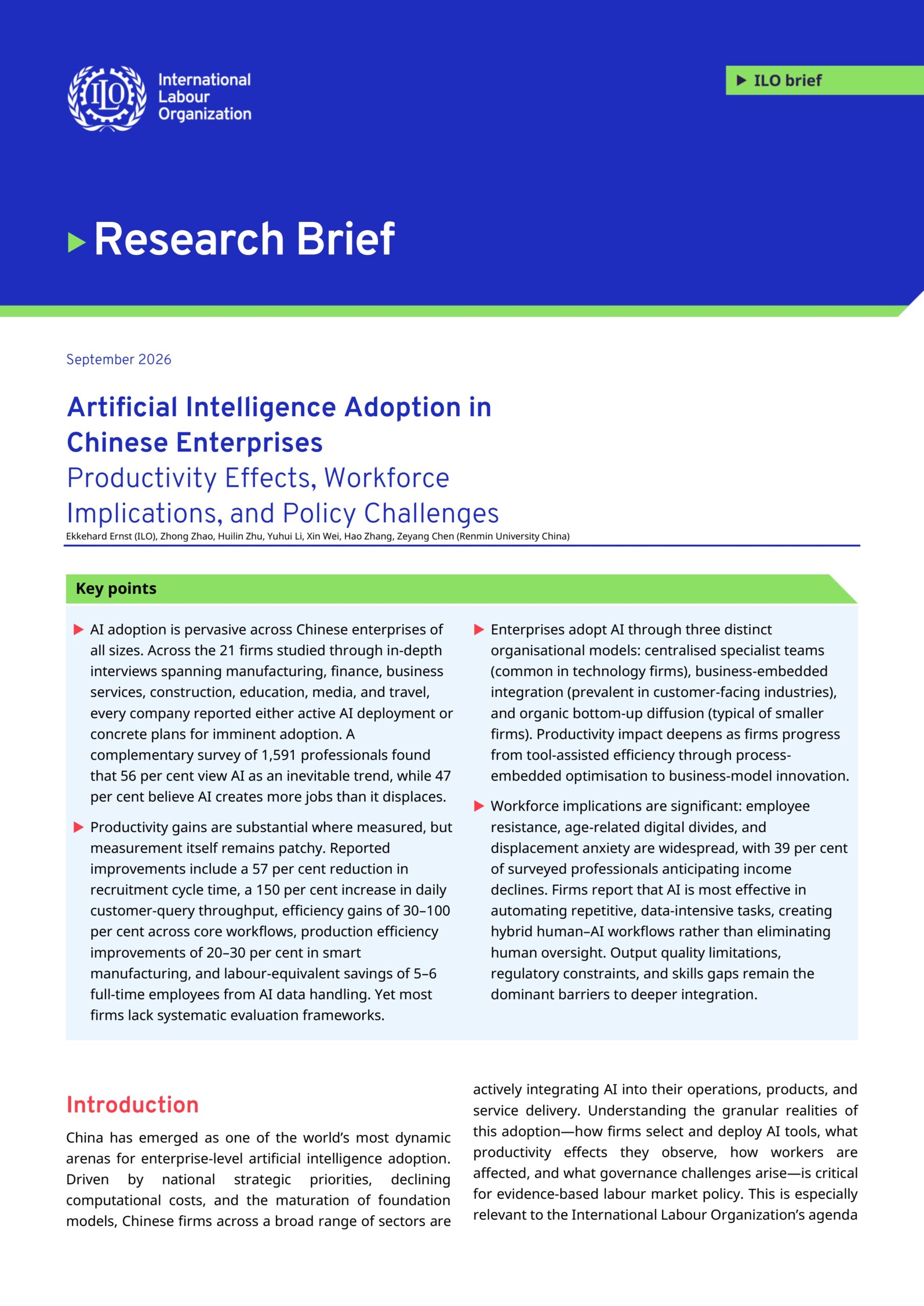
Artificial intelligence adoption in Chinese enterprises: Productivity effects, workforce implications, and policy challenges
This research explores artificial intelligence adoption within Chinese enterprises using qualitative interviews and quantitative surveys. It identifies significant productivity gains, various organisational models, and workforce impacts, including income anxiety and skills gaps. The report highlights the human–AI collaboration paradigm and offers policy recommendations for skills development and governance.
Please login or join for free to read more.

OVERVIEW
Introduction
China has emerged as one of the world’s most dynamic arenas for enterprise-level artificial intelligence (AI) adoption. Driven by national strategic priorities, declining computational costs, and the maturation of foundation models, Chinese firms across a broad range of sectors are actively integrating AI into their operations, products, and service delivery. This research brief synthesises evidence from 21 qualitative interviews and a quantitative survey of 1,591 professionals to explore adoption motivations, productivity effects, and workforce impacts.
Overview of the sample
The qualitative interview sample encompasses 21 firms representing a considerable diversity in sector, size, and ownership structure. Company sizes range from a media startup with 8 employees to a giant insurance conglomerate with 270,000 employees, with annual revenues reaching over 1.14 trillion yuan. Sectoral composition deliberately prioritises variation, with manufacturing representing 29 per cent of the sample, followed by finance, insurance, and real estate, and business services at 19 per cent each. The quantitative survey complements this with data from 1,591 respondents spanning entry-level to senior management roles.
Motivations for AI adoption
Motivations for AI adoption converge on three core dimensions: efficiency improvement, quality enhancement, and cost control. Efficiency gains are the most universally cited driver, particularly in the service sector where firms automate repetitive administrative tasks—such as screening resumes and processing documents—to free employees for higher-value work. Cost reduction is a prominent feature for smaller firms; for example, a travel services company reported that AI reduced the need for 5–6 additional staff. National policy alignment and the maturation of underlying technologies also act as significant drivers, especially for state-owned enterprises.
Patterns of AI application
AI applications cluster into several functional domains with significant cross-sectoral overlap. Customer service and client interaction are the most widely adopted categories, with at least seven firms deploying AI to handle queries or personalise service delivery. Human resource management and talent matching constitute a second major cluster, while internal operations automation—encompassing code generation, document processing, and quality inspection—is reported across all sectors. More specialised applications reflect sector-specific needs, such as walking robots for factory data collection in manufacturing and AI models for geological survey data processing.
Organisational models for AI integration
Three distinct organisational models for AI integration were identified: centralised specialist teams, common in technology firms; business-embedded integration, prevalent in customer-facing industries; and organic bottom-up diffusion, typical of smaller, flexible organisations. Firms generally progress through a depth of impact from tool-assisted efficiency to process-embedded optimisation, with only a few currently showing signs of moving towards fundamental business-model innovation.
Productivity implications
Where firms track productivity effects through quantitative metrics, the reported gains are substantial. In manufacturing, a “lighthouse factory” achieved a 30 per cent improvement in production efficiency following AI deployment. One company described a case where a client’s team dedicated to reading customer specification documents was reduced from over 10 to 2–3 employees. In the services sector, an insurance company increased daily throughput from 6,000 to 15,000 issues, representing a 150 per cent improvement, while a giant insurance group recorded a 57 per cent improvement in recruitment cycle time.
Despite these gains, a significant measurement gap remains. Most firms lack systematic evaluation frameworks, with many reporting ad hoc tracking or qualitative improvements without formal metrics. The absence of standardised metrics limits both enterprise decision-making and the evidence base available to policymakers regarding job quality and task composition.
Workforce perceptions and employment effects
The survey of 1,591 professionals reveals that 56 per cent view AI adoption as an inevitable trend. Regarding employment effects, 47 per cent believe AI creates more jobs than it displaces, though 39 per cent anticipate income declines. Significant unease exists, with approximately one-third of respondents expressing concerns about AI’s impact on social stability. Notable age-based divides were identified, with workers over 40 demonstrated markedly weaker AI application capabilities compared to younger colleagues.
Implementation challenges
Challenges cluster into five broad categories: output quality and reliability, workforce skills and resistance, regulatory and data-security constraints, system integration difficulties, and cost-to-value concerns. Output quality is the most pervasive concern, with reports of “hallucinations” and accuracy levels falling below the 95 per cent threshold required for direct client deployment. Regulatory challenges are particularly acute in the financial sector, where data firewalls prevent the direct use of AI with certain data.
The human–AI collaboration paradigm
A cross-cutting theme is the predominance of human–AI collaboration rather than full automation. Firms argue that current AI is in the human–machine collaboration stage and cannot fully replace people. Most workflows deliberately combine human experience with AI computational power, creating hybrid systems that require new skills to effectively direct, verify, and integrate AI outputs.
Future investment plans and trajectories
The sample reveals a generally forward-leaning but heterogeneous investment posture. Some firms plan to increase AI-related R&D expenditure from 20 per cent to 30 per cent, while others focus on building industry expert knowledge bases or “plug-and-play” product lines. However, startup-stage caution remains in some sectors, and the pace of investment is contingent on firm-specific factors including digital maturity and resource availability.
Implications for labour and employment policy
The pervasive skills gap demands urgent policy attention, including the cultivation of an “AI mindset” and lifelong learning programmes designed for mid-career and older workers. Policymakers should support transition and redeployment for workers in routine clerical and administrative roles where displacement pressures are heaviest. Coherent AI governance frameworks are needed to balance innovation with worker protection, alongside policies that support small and medium enterprise (SME) access to AI capabilities to ensure productivity gains are broadly distributed.
Methods and limitations
The research synthesises evidence from qualitative semi-structured interviews with 21 Chinese enterprises and a quantitative survey of 1,591 professionals. Limitations include the small, purposively selected interview sample and the self-reported nature of productivity data, which has not been independently verified. The findings represent a point-in-time snapshot of a rapidly evolving technological and regulatory landscape.




