

Impact Management Project
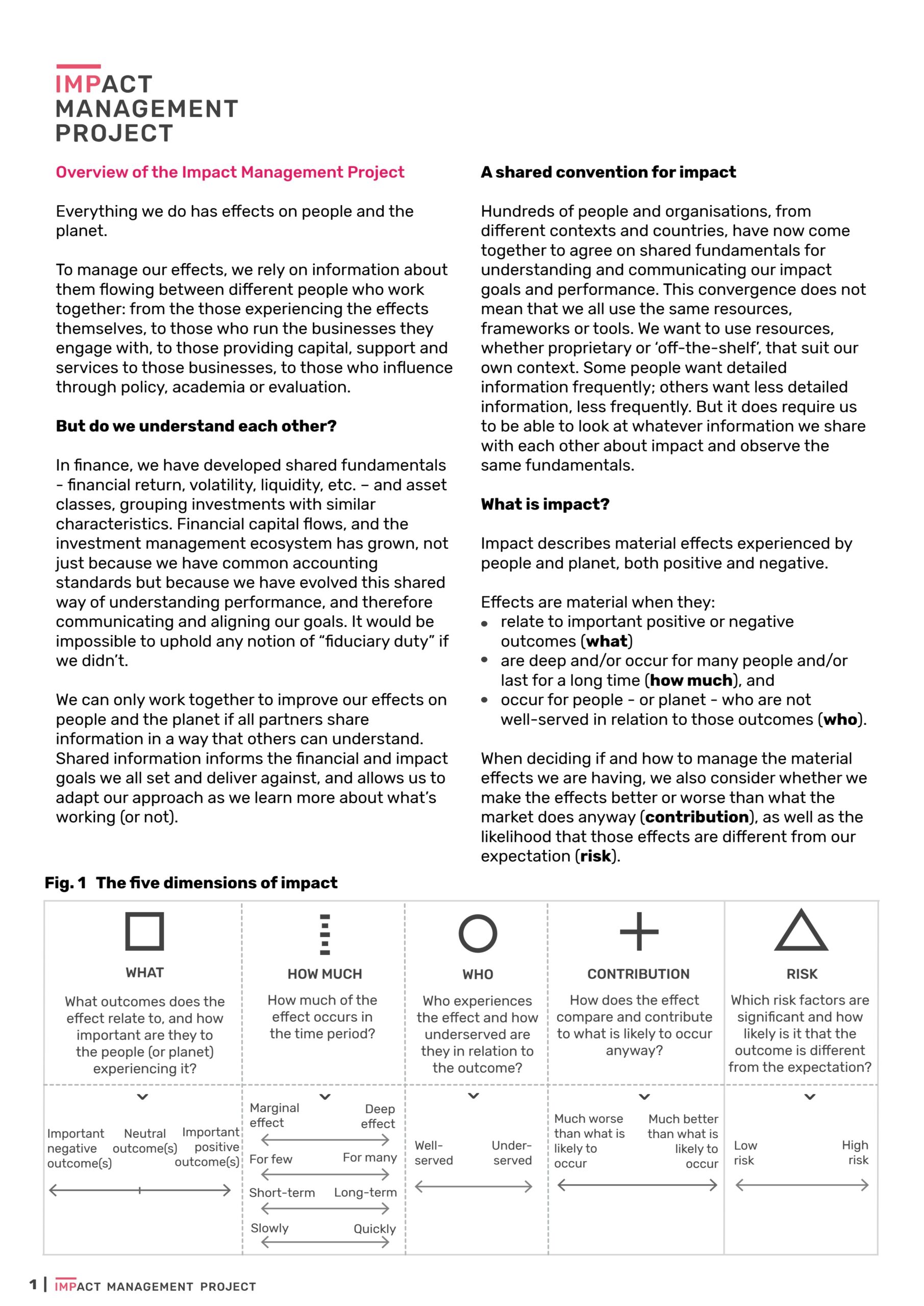
The Impact Management Project provides a shared convention for understanding and managing material effects on people and the planet. It introduces five dimensions of impact: what, how much, who, contribution, and risk. The framework assists businesses and investors in using data-driven assessments to mitigate negative outcomes and increase positive performance.
Please login or join for free to read more.

OVERVIEW
Overview of the Impact Management Project
The Impact Management Project (IMP) provides a framework for managing the effects of activities on people and the planet. Effective management depends on information flowing between stakeholders, including those experiencing the effects, business operators, capital providers, and those influencing policy or evaluation. This initiative developed shared fundamentals for understanding performance, which allows for the communication and alignment of goals. Without these shared fundamentals, it would be impossible to uphold concepts such as fiduciary duty. Improved effects are only possible if partners share information in a way that others can understand and use to adapt their approach based on results.
A shared convention for impact
Hundreds of people and organisations from different contexts and countries have agreed on shared fundamentals for understanding and communicating impact goals and performance. This convergence does not mandate specific resources or tools; instead, it allows entities to use proprietary or ‘off-the-shelf’ resources that suit their context. While the level of detail and frequency of information may vary among stakeholders, all participants must observe the same fundamentals when sharing impact information. This allows for a common understanding across the investment management ecosystem, facilitating the alignment of financial and impact goals.
What is impact?
Impact describes material effects experienced by people and the planet, including both positive and negative outcomes. Effects are material when they relate to important outcomes (what); are deep, occur for many people, or last for a long time (how much); and occur for people or the planet that are not well-served (who). When managing material effects, businesses consider their contribution—whether they make effects better or worse than the market would anyway—and the risk that those effects are different from the expectation. These five dimensions help stakeholders distinguish between marginal and deep effects and evaluate outcomes over the short or long term.
How do these dimensions help us to manage our impact?
Impact management is the process of identifying material effects and striving to prevent negative ones while increasing positive performance. Materiality is determined by analysing and assessing data across the five dimensions of impact: what, how much, who, contribution, and risk. Businesses collect data as a ‘set’ across these dimensions to benchmark performance alongside financial results. Most business models generate a range of effects; for example, a company might support high-quality jobs but also have harmful sourcing practices. Since positive and negative effects do not typically cancel each other out, management involves setting specific goals to mitigate negative impacts over time.
What type of data do businesses need to measure and manage impact?
The type of data used as evidence of impact varies according to the level of evidence required. Businesses may rely on activity or output data that serves as a proxy for outcomes, such as the number of patients receiving insulin. They also use direct measurement of change in effect, such as the percentage change in Body Mass Index. Direct feedback from those experiencing effects, such as customer surveys indicating improved quality of life, is another key source. Finally, external evaluations are used to remove bias, consider attribution, and uncover other outcomes driven by an effect.
What information do investors need to measure and manage impact?
Investors’ information needs vary by investment strategy. Direct private equity funds may require detailed performance data for underlying businesses to actively manage impacts. Conversely, asset owners in public equity products often require summarised information for decision-making. Current methods to summarise performance include overall ratings of a business’s impact performance, which can be aggregated to provide portfolio-level scores, the assurance of an intermediary’s impact management processes, and the aggregation of performance against specific metric sets that demonstrate material positive or negative effects.
Understanding the impact of investments
Investors select investments based on whether the impact goals of underlying businesses align with their own, ranging from broad commitments like “avoid harm” to detailed objectives like addressing specific social challenges. Investment impact is a function of the underlying business goals and the contribution the investor makes to enable those goals. Strategies to contribute include signalling that impact matters to influence market pricing, active engagement to provide expertise and networks, growing new or undersupplied capital markets, and providing flexible capital that accepts disproportionate risk-adjusted returns to generate specific kinds of impact.
Appendix examples
The report provides three examples of food businesses. Example 1 describes a business with material negative effects, such as harmful emissions generating 15 tonnes CO2e per 10,000 cups and packaging with only 20% recycled content. Example 2 involves a business with less material negative environmental effects but which contributes positively to decent work, such as paying $180 per month (20% above local minimum wage). Example 3 describes a company tackling malnutrition in South Asia with products providing 200 kcal per 100g, addressing a market shortage of nutritional food for 2,000,000 children.
Appendix: impact risk
Impact risk is the likelihood that impact will be different from expectation and that the difference will be material. Risk factors include evidence risk, external risk, execution risk, and stakeholder participation risk. Other factors include drop-off risk, where impact does not endure; unexpected impact risk, where unexpected positive or negative impacts occur; efficiency risk, where impact could have been achieved with fewer resources; and contribution risk, where an intervention leads to a worse effect than would have otherwise occurred.



