

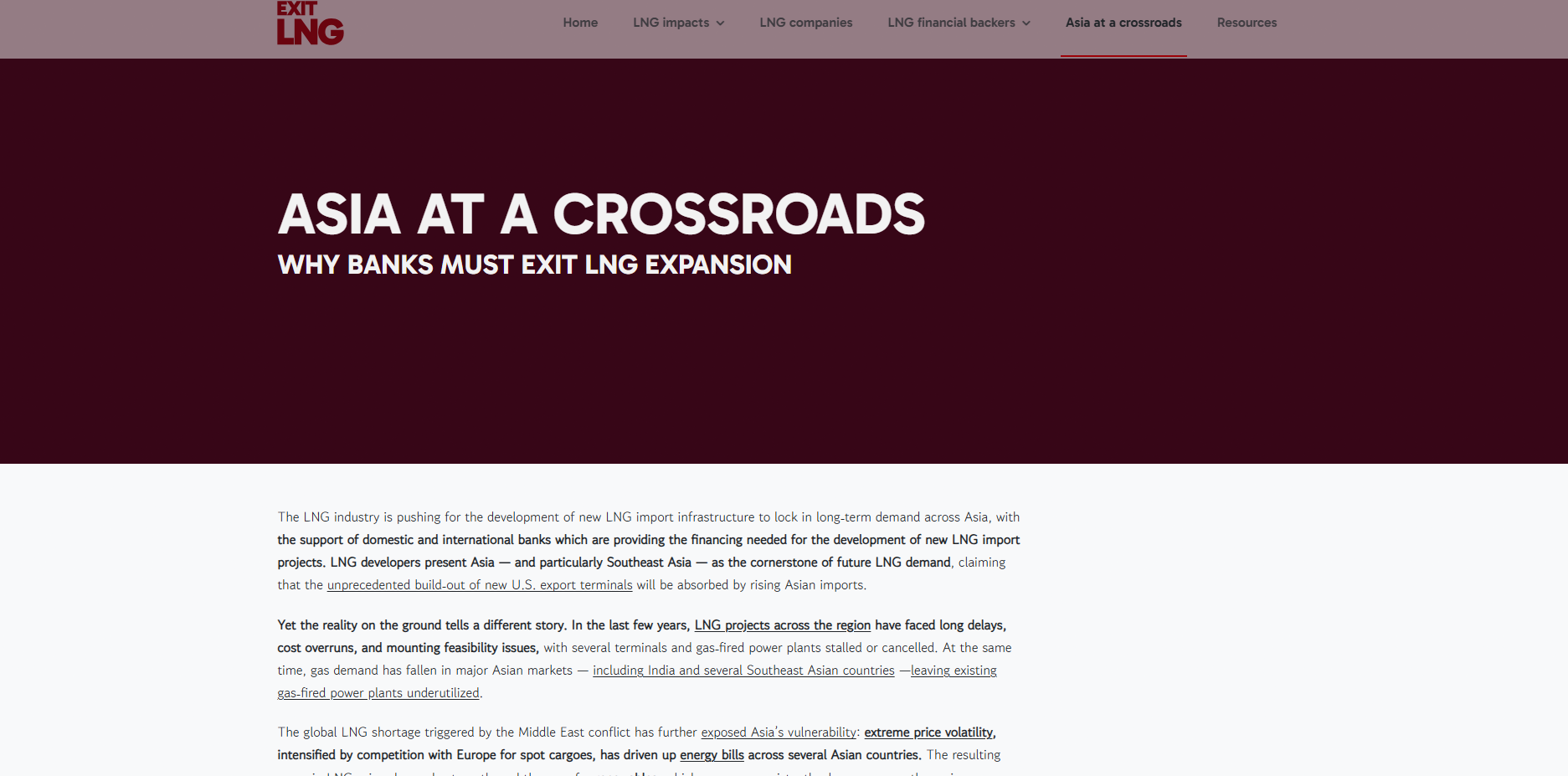
Asia at a crossroads: Why banks must exit LNG expansion
This resource examines banks’ role in financing liquefied natural gas (LNG) expansion in Asia, focusing on Bangladesh, the Philippines and Thailand. It explores energy security, price volatility, stranded asset risks and climate commitments, advocating for LNG financing exclusions and a transition towards renewable energy.
Please login or join for free to read more.

OVERVIEW
Asia at a Crossroads is an online resource examining the role of financial institutions in supporting liquefied natural gas (LNG) expansion in Asia. It explores the economic, environmental and social risks associated with LNG development and the alternatives offered by renewable energy. The resource helps finance professionals understand fossil fuel financing risks and energy transition considerations.
Organisation behind the resource
The resource was developed by Reclaim Finance through Exit LNG, a collaborative initiative involving civil society organisations, including BankTrack, Market Forces, Rainforest Action Network and Urgewald.
What the resource does
– Provides country briefings on LNG development in Bangladesh, the Philippines and Thailand.
– Examines financial institutions supporting LNG infrastructure and gas-fired power generation.
– Analyses energy import dependency, project delays, cost overruns and energy market volatility.
– Outlines financing exclusion policies and the potential for renewable energy development.
Target audience
The resource primarily targets banks, financial institutions, insurers and sustainability professionals. It is also relevant to policymakers, energy researchers and civil society organisations.
Relevance to finance professionals
– Risk assessment – Identifies stranded asset risks, project feasibility concerns and exposure to volatile LNG prices.
– ESG analysis – Supports assessments of fossil fuel financing policies and climate commitments.
– Market insights – Examines LNG demand, energy security and renewable energy competitiveness.
– Investment context – Supports understanding of long-term energy infrastructure risks and transition financing opportunities.




