

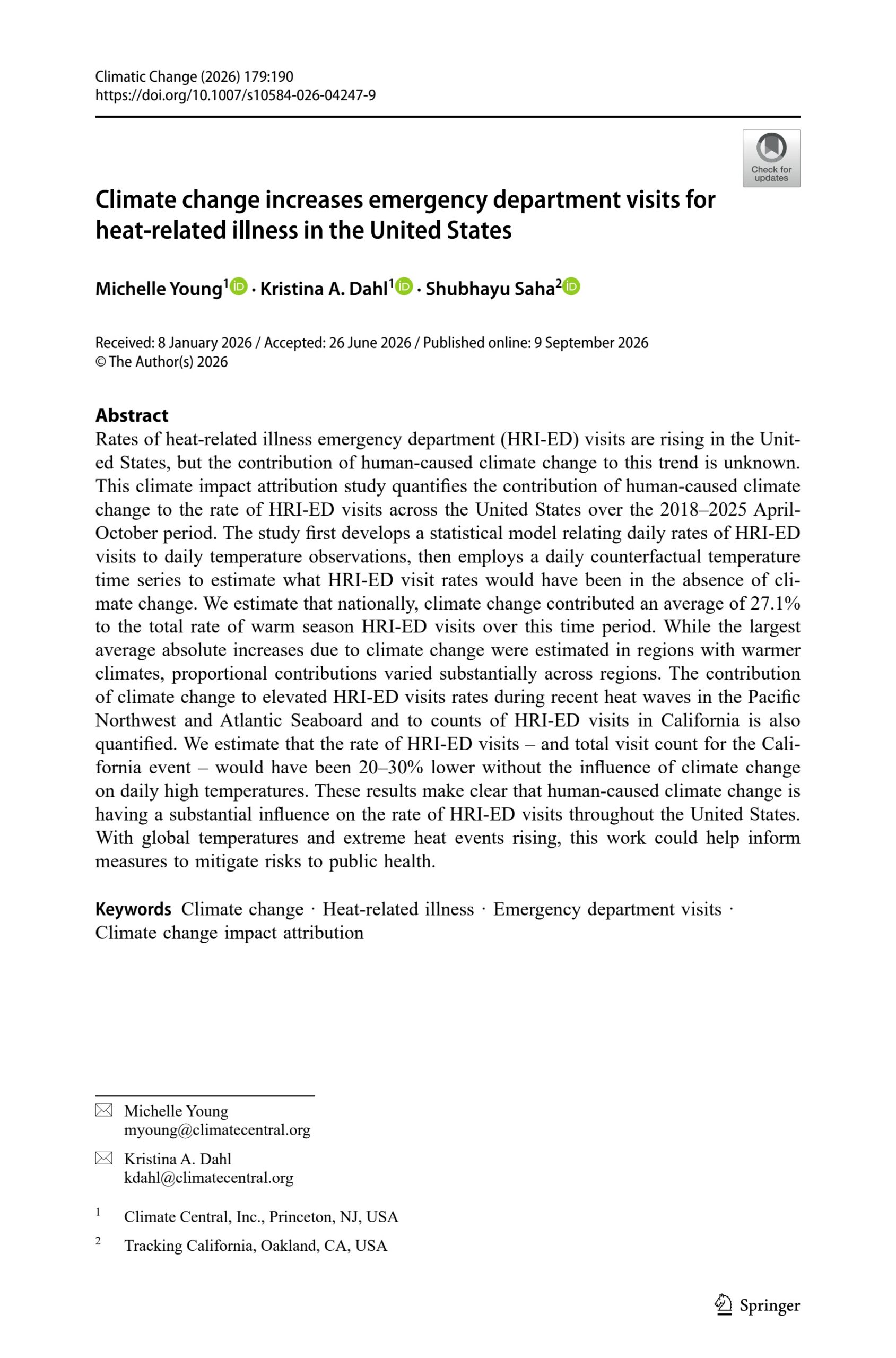
Climate change increases emergency department visits for heat-related illness in the United States
This research quantifies human-caused climate change’s contribution to heat-related illness emergency department visits across the United States. Between 2018 and 2025, climate change contributed approximately 27.1% to the national visit rate, with specific regional impacts exceeding 40% during peak months and significant burdens recorded during major heatwave events.
Please login or join for free to read more.

OVERVIEW
Introduction
Exposure to extreme heat presents a significant public health hazard in the United States and globally, linked to various chronic and acute health outcomes. Heat-related illness (HRI) encompasses conditions such as heat stroke, exhaustion, rhabdomyolysis, heat syncope, heat cramps and heat rash. Vulnerable populations include children, older adults, people experiencing homelessness and outdoor workers. Recent data shows that from 2006 to 2010, approximately 326,000 individuals were diagnosed with HRI in emergency departments (ED), with roughly 12% requiring hospital admission. From 2008 to 2020, HRI-ED visit rates increased by an average of 2.85% annually, and age-adjusted mortality rose by nearly 17% from 2016 to 2023. This study fills a research gap by quantifying the contribution of human-caused climate change to these rising rates across the United States from 2018 to 2025.
Methods
The researchers utilised daily HRI-ED visit rate data for the April–October period from the Centres for Disease Control and Prevention’s National Environmental Public Health Tracking Network. Temperature observations were sourced from the European Centre for Medium-Range Weather Forecasts Reanalysis (ERA5) gridded daily maximum 2-metre air temperature (Tmax) data. The study employed the Climate Shift Index framework to estimate counterfactual daily maximum temperatures (Tmax-cf) — representing a climate without anthropogenic warming. Statistical models were developed using region-specific exponential functions to relate Tmax to visit rates, adjusted for seasonal variability using a dual harmonic Fourier series. For the state of California, a negative-binomial count model was used to estimate actual visit counts based on available state-level data from Tracking California.
Results
Nationally, during the 2018–2025 study period, human-caused climate change increased the daily rate of HRI-ED visits from a counterfactual average of 94.7 per 100,000 visits [95% eCI: 94.4, 94.9] to an observed average of 129.9 per 100,000 visits. On average, climate change contributed 27.1% [95% eCI: 26.9, 27.3] to the total rate of warm-season HRI-ED visits. While the absolute difference between observed and counterfactual rates was greatest during the summer months, specifically peaking in July, the proportional contribution of climate change to these rates peaked in September. This indicates that climate change is extending the period during which heat poses a severe health risk into the shoulder seasons.
Regional and monthly results
Regional analysis revealed that the Southern Plains experienced the largest climate-driven increase, with rates rising from 168.1 to 225 per 100,000, representing a 25.4% [95% eCI: 25.1, 25.8] contribution. In the Southwest, climate change boosted the average rate by 22.9%. Conversely, regions with milder climates, such as the Northeast and Mountain West, showed smaller absolute increases (21–24 per 100,000) but higher proportional contributions, ranging between 28% and 40%. The highest average daily percentage contributions were recorded in September, reaching between 27% and 44% across most regions. Notably, in August, climate change contributed 45.5% and 45.7% of the observed HRI-ED visit rates in New York and the Northwest regions, respectively.
Heatwave events and California HRI-ED visit counts results
The impact of climate change was particularly pronounced during extreme heatwave events. During the July 2019 heatwave on the US Eastern seaboard, the peak regional rate of HRI-ED visits reached 1,645 per 100,000 on 20 July. Climate change was estimated to have increased this rate by 581 per 100,000 [95% PI: 290, 914], accounting for over one-third of the total. Similarly, during the June 2021 Pacific Northwest heatwave, the peak rate was 6,763 per 100,000 on 28 June, with climate change contributing an estimated 1,834 per 100,000 [95% PI: 1677, 1996].
In California, between 2018 and 2023, climate change was estimated to have increased the total number of HRI-ED visits from 27,904 [95% eCI: 27,477, 28,338] to 35,134. On average, 21% [95% eCI: 19.3, 21.8] of California’s HRI-ED visits over this period were attributable to climate change. During the record-setting September 2022 heatwave in California, which caused hundreds of deaths, climate change accounted for approximately 30% of visits over a 10-day period. On 6 September, when the statewide average Tmax peaked at 37 °C, the state recorded 332 HRI-ED visits, 99 of which were attributed to the influence of climate change.
Discussion
The findings indicate that anthropogenic warming accounts for 20–30% of observed HRI-ED visit rates across the United States. The study demonstrates that the health burden of climate change varies significantly in both space and time, with substantial impacts observed even outside peak summer months. These results align with prior evidence suggesting that adverse health impacts can occur below extreme heat thresholds. The research identifies several limitations, including a focus on daily population-weighted maximum temperatures rather than nighttime temperatures or humidity, and the exclusion of lagged effects over multiple days. Future modelling could incorporate these factors to provide a broader understanding of climate impacts on ED utilisation.
Conclusion
The study concludes that human-caused climate change has a clear and substantial influence on HRI-ED visit rates throughout the United States. As global temperatures continue to rise, the increasing frequency and intensity of extreme heat will likely place additional burdens on already strained healthcare systems suffering from understaffing. Quantifying these contributions can help inform national, state and local-level public health preparedness and adaptation strategies, including emergency department staffing during the heat season. Mitigating risks for vulnerable groups remains critical as warming continues.




