

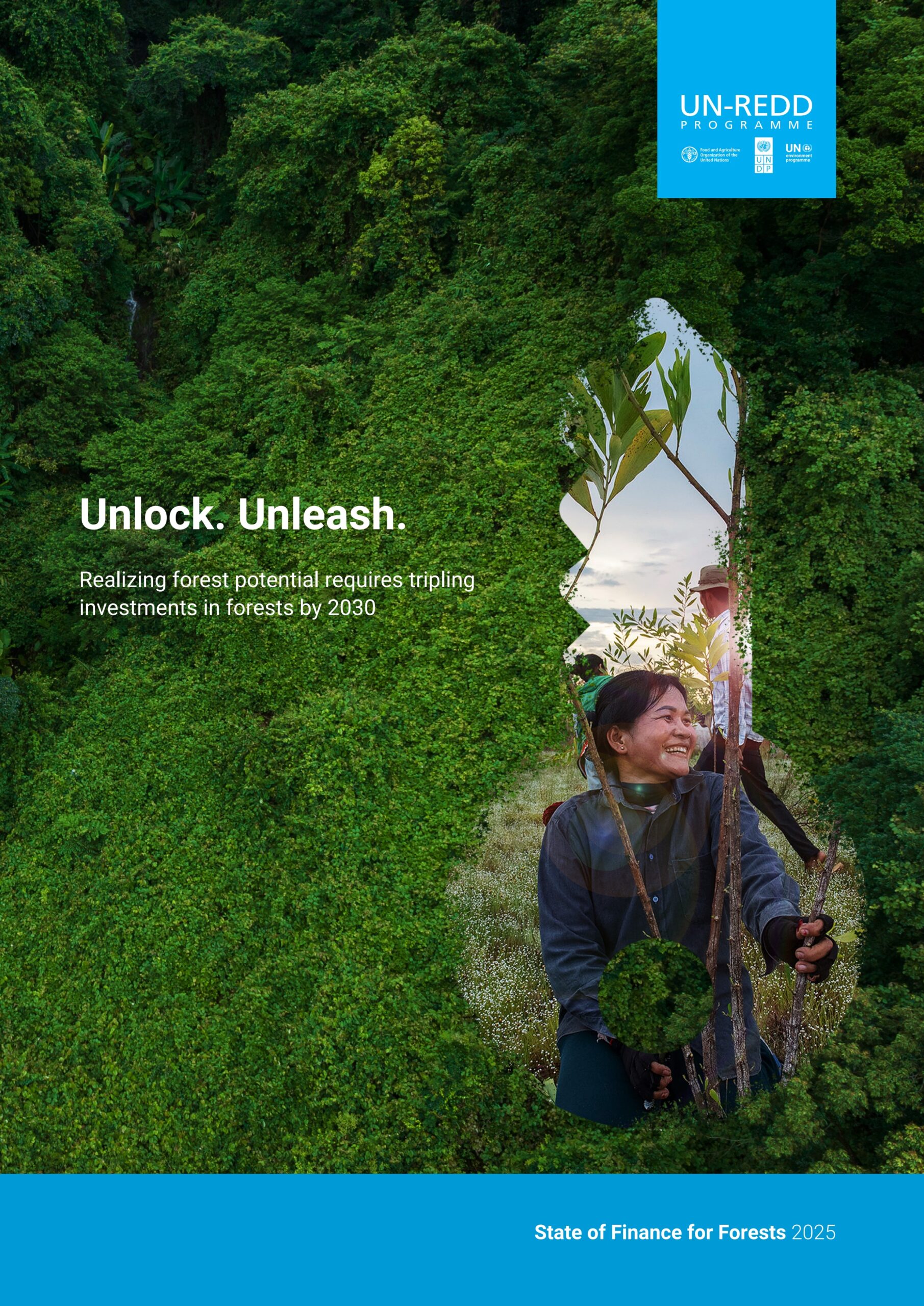
State of Finance for Forests 2025: Unlock. Unleash.
This report provides a 2023 overview of global forest finance, highlighting a US$ 216 billion annual gap to meet 2030 targets. Recommendations include tripling investments, scaling private sector engagement, and redirecting US$ 8.9 trillion in active financing from companies associated with high deforestation risks and harmful agricultural subsidies.
Please login or join for free to read more.

OVERVIEW
Executive summary
The State of Finance for Forests 2025 report provides a global overview of public and private financial flows to forests in 2023. It benchmarks these flows against the investments required to unlock the potential of forests to address climate change, biodiversity loss, and land degradation. The report reveals that forests are significantly underfunded; to achieve international targets, annual forest investments must more than triple from US$ 84 billion in 2023 to US$ 300 billion by 2030, reaching US$ 498 billion by 2050.
Chapter 1: introduction
Forests cover approximately 30 per cent of the Earth’s land area and are vital for climate stability and biodiversity, housing roughly 80 per cent of terrestrial species. Despite their importance, forests continue to disappear at alarming rates. Between 2015 and 2020, an estimated 10 million hectares were lost annually. Deforestation increased by 4 per cent between 2021 and 2022, reaching 6.6 million hectares—21 per cent above the limit required to eliminate deforestation by 2030. The need to scale up forest finance is critical to meet goals established under the Paris Agreement and the Kunming-Montreal Global Biodiversity Framework.
Chapter 2: Current finance flows to forests
In 2023, financial flows to forests totalled roughly US$ 84 billion. Public finance was the primary source, accounting for 91 per cent (US$ 77 billion) of total flows. Of this, US$ 75 billion came from domestic government spending, with 41 per cent concentrated in China and the United States of America. Public international forest finance contributed US$ 2.9 billion, with Africa being the largest recipient. However, only US$ 362 million of international public finance reached Indigenous Peoples and local communities (IPs and LCs), despite their role in safeguarding 36 per cent of the world’s intact forest landscapes.
Private forest finance was limited to US$ 7.5 billion in 2023. Approximately 39 per cent was channelled through certified commodity supply chains, and 23 per cent through impact investing. Emerging asset classes like carbon markets attracted US$ 1.3 billion. These positive flows are significantly outweighed by potentially harmful finance; private financial institutions provided US$ 8.9 trillion in active financing to companies with high deforestation risks as of November 2024. Furthermore, environmentally harmful agricultural subsidies reached approximately US$ 406 billion in 2023.
Chapter 3: Investment needs and the forest finance gap
To reach climate, biodiversity, and land degradation targets, annual forest investments must increase to US$ 300 billion by 2030. This creates an annual forest finance gap of US$ 216 billion. The area under nature-based solutions (NbS) needs to expand by an additional 1 billion hectares by 2030 and 1.8 billion hectares by 2050. Forest protection is the most cost-effective intervention, requiring US$ 32 billion annually by 2030 to cover 80 per cent of the required land area.
Reforestation of 100 million hectares by 2030 would require US$ 96 billion per year due to high input, transaction, and opportunity costs. Tropical forest countries alone require an estimated US$ 67 billion annually across six complementary NbS interventions. Restoration efforts in these regions will demand approximately US$ 33 billion annually to regenerate millions of hectares of degraded land.
Chapter 4: Key findings and recommendations
The report recommends that governments take a lead role by establishing robust policy and legal frameworks to de-risk private sector investment. Aligning diverse finance sources with forest-related development goals is essential to maximise impact. Recommendations include accelerating financial innovation through the use of sovereign green bonds, debt-for-nature swaps, and blended finance mechanisms. Expanding the use of high-integrity carbon markets can also unlock reliable revenue streams.
The report emphasises the importance of promoting inclusive and equitable finance by ensuring targeted support reaches women and IPs and LCs. Finally, there is an urgent need to redirect capital away from deforestation-related activities. Reducing and redirecting the trillions of dollars in harmful financial flows and hundreds of billions in agricultural subsidies is critical to achieving global conservation and restoration objectives.




