
Library | Location
Global
Refine
1736 results
REFINE
SHOW: 16


Towards a systemic understanding of sustainable well-being for all in cities: A conceptual framework
The purpose of this framework is to guide the design and evaluation of public policies, as well as provide tools for conducting thorough assessments and monitoring progress across various socio-ecological dimensions of sustainable well-being in different urban settings on a universal scale.

Can ESG add alpha? An analysis of ESG tilt and momentum strategies
This research explores the impact of environmental, social, and governance (ESG) factors on investment returns, focusing on ESG Tilt and ESG Momentum strategies. The study reveals that both strategies outperformed the global benchmark, providing empirical evidence that ESG factors can enhance portfolio performance.
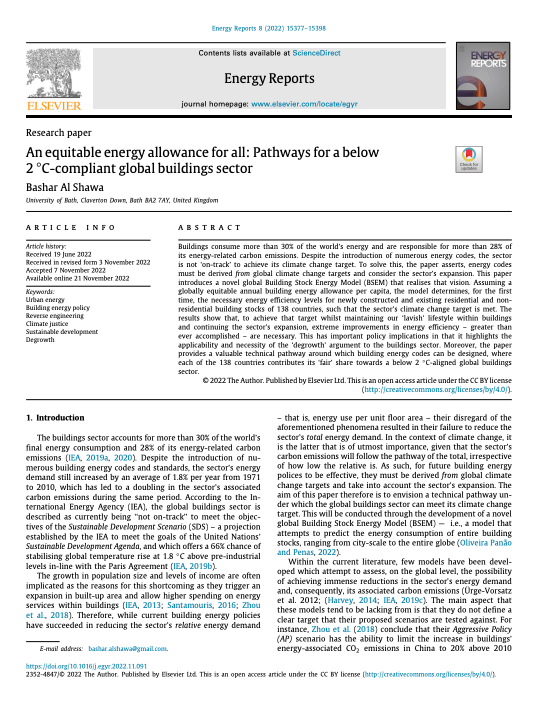
An equitable energy allowance for all: Pathways for a below 2◦ C-compliant global buildings sector
The article asserts that building energy codes must be derived from global climate change targets. Thus, an innovate global Building Stock Energy Model is developed to determine the required energy efficiency levels for building stocks of 138 countries in alignment with the Paris Agreement’s below 2°C climate change scenario.
A comprehensive overview of global biodiversity finance
This report aims to provide a comprehensive overview and an aggregate estimate of global biodiversity finance. It aims to provide an outline of government support that is potentially harmful to biodiversity and offers recommendations for improving the assessment, tracking, and reporting of biodiversity finance.
What Doughnut Economics means for business: Creating enterprises that are regenerative and distributive by design
This guide is intended for businesses and individuals who want to implement Doughnut Economics principles. It provides guidance on how to redesign a business through its strategic decisions and operations by focusing on purpose, networks governance, ownership and finance. The paper explores barriers and innovations to sustainable business design.

Integrity matters: Net zero commitments by businesses, financial institutions, cities and regions
As the global community faces a climate crisis, the report recommends setting standards and criteria for achieving net zero emissions, addressing concerns about greenwashing, and calling for a just transition for developing countries. The report advocates for a collaborative 'ambition loop' to accelerate global efforts toward a sustainable future.

United Nations Research Institute for Social Development (UNRISD)
United Nations Research Institute for Social Development (UNRISD) is an autonomous research institute within the UN system that undertakes interdisciplinary research and policy analysis on the social dimensions of contemporary development issues.

Environmental Research: Climate
Environmental Research: Climate is a multidisciplinary, open access journal devoted to addressing important challenges concerning the physical science and assessment of climate systems and global change in a way that bridges efforts relating to impact/future risks, resilience, mitigation, adaptation, security and solutions in the broadest sense.

Recommendations of the Taskforce on Nature-related Financial Disclosures
This report aims to provide a unified approach to the disclosure of natural dependencies, impacts and risks for financial institutions and corporates. As the issue of natural loss and climate change continues to grow, a harmonised way of tackling these risks needs to be agreed to safeguard against material impacts.

Taskforce on Nature-related Financial Disclosures (TNFD)
Task Force on Nature-related Financial Disclosures (TNFD) spearheads the integration of nature considerations into global finance, addressing biodiversity and ecosystem challenges. TNFD provides practical tools and databases, shaping sustainable finance practices.

How can businesses thrive in a sustainable economy?
How can businesses thrive while still respecting planetary boundaries and meeting the essential needs of all people? This report provides a framework for businesses to transition to sustainable models by addressing unsustainable characteristics and adopting regenerative and distributive practices. The report highlights examples of businesses implementing these strategies and provides a Sustainable Business Model Canvas for businesses and investors to assess alignment with a sustainable economy.

Applying economics – not gut feel – to ESG
This report advocates for the application of mainstream economics to evaluate environmental, social, and governance (ESG) issues for long-term financial and social returns. It identifies how conventional thinking around ten key ESG issues can be overturned when applying mainstream economics principles to provide better ESG insights.

Investors can assess nature now: A guide to assessing water and deforestation issues in investment portfolios
First Sentier Investors presents a five-step approach for sector and company-level assessments of nature and biodiversity with a focus on freshwater and forests.

The New Climate Economy (The Global Commission on the Economy and Climate)
The New Climate Economy is major international initiative that provides independent and authoritative evidence for nations, cities and companies to focus on their core economic and social goals, while reducing the risk of dangerous climate change. The initiative is The Global Commission on the Economy and Climate’s flagship project.
Aggregate confusion: the divergence of ESG ratings
The research investigates the disagreement in Environmental, Social and Governance (ESG) ratings between rating providers. Three factors are identified: measurement divergence, scope divergence and weight divergence. The paper argues for a standardisation of ESG indicators and measurement procedures to reduce the discrepancy in ESG ratings.

Inter-agency Task Force on Financing for Development
The Inter-agency Task Force on Financing for Development (IATF) supports the implementation of the 2030 Agenda for Sustainable Development. IATF annually reports on the global implementation of financing for development outcomes and advises on its progress and gaps, and provides recommendations.


