

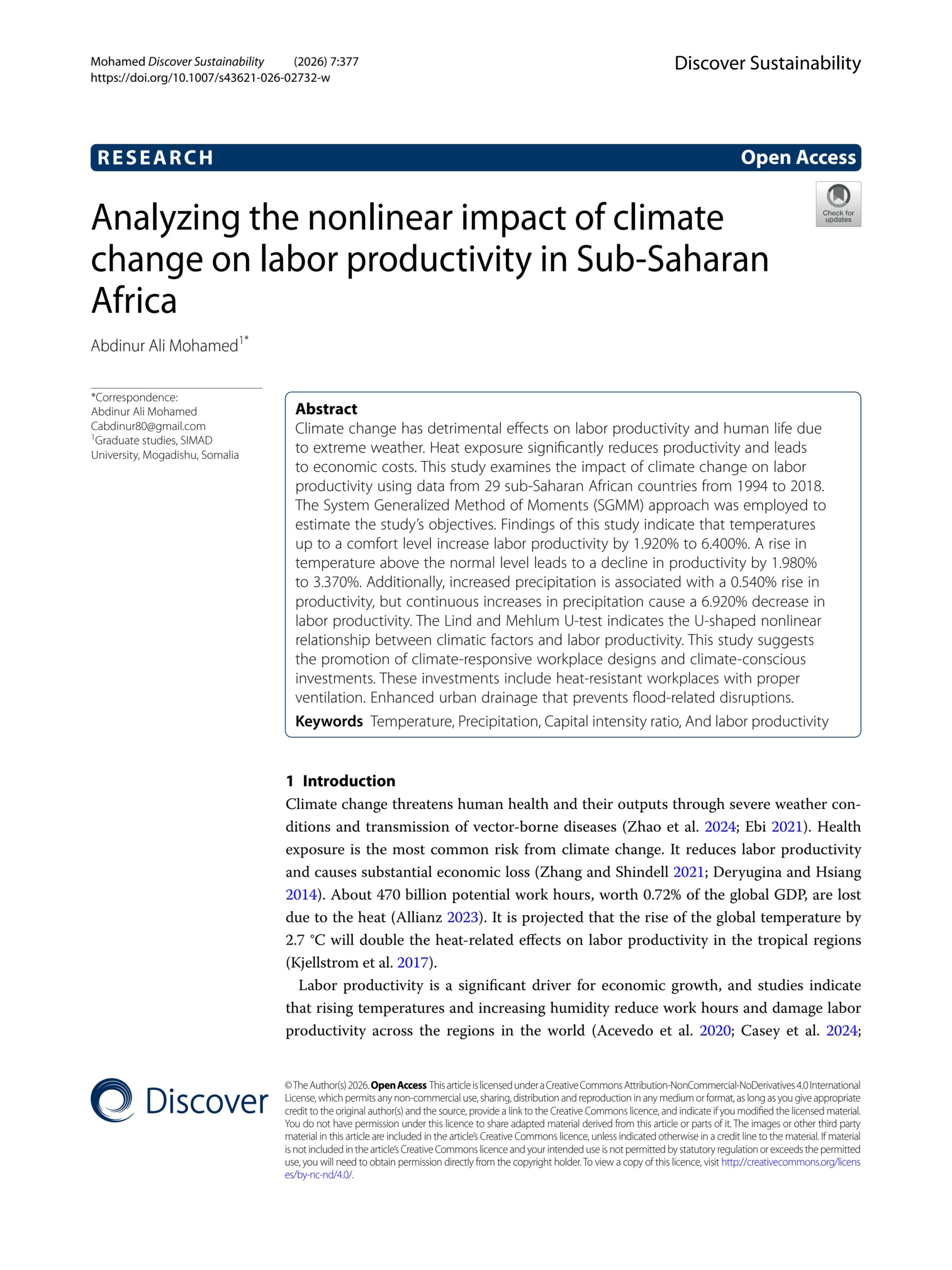
Analyzing the nonlinear impact of climate change on labor productivity in Sub-Saharan Africa
This research examines the nonlinear effects of climate change on labour productivity across 29 Sub-Saharan African countries between 1994 and 2018. Using the System Generalized Method of Moments, it identifies an inverted U-shaped relationship where extreme heat and excessive precipitation significantly diminish productivity, necessitating climate-resilient infrastructure and adaptive policies.
Please login or join for free to read more.

OVERVIEW
Introduction
Climate change poses a critical threat to human health and economic outputs through severe weather conditions and the transmission of vector-borne diseases. Health exposure is the most common risk associated with climate change, reducing labour productivity and causing substantial economic loss. Approximately 470 billion potential work hours, valued at 0.72% of global GDP, are lost annually due to heat stress. It is projected that a 2.7°C rise in global temperatures will double the heat-related effects on labour productivity in tropical regions. Labour productivity is a significant driver of economic growth, but rising temperatures and increasing humidity damage performance across the world.
Literature review
Previous research identifies climate-related labour productivity losses in South Asia, particularly in India, where rising temperatures have led workers to migrate from the agriculture sector. Latin American countries such as Brazil and Mexico have also experienced declines in productivity due to extreme heat events. Nations in Africa are heavily reliant on climate-sensitive sectors like agriculture, water resources, and energy, where productivity is closely tied to environmental conditions. Sub-Saharan African economies are particularly vulnerable as they rely on labour-intensive industries where a significant portion of the workforce engages in outdoor employment. These regions often have limited capacity to automate production processes, exacerbating their exposure to climate-induced disruptions.
Model specification and the data
This study investigates the channels through which climate change impacts labour productivity in 29 Sub-Saharan countries using panel data from 1994 to 2018. The dependent variable is labour productivity, calculated by dividing total output by the total labour force. Independent variables include the capital intensity ratio, which measures capital available per worker, alongside temperature and precipitation. The model incorporates squared terms for temperature and precipitation to capture potential nonlinear relationships. Data were sourced from the World Development Indicators and the World Bank’s Climate Change Knowledge Portal.
Methodology
The research applies a two-step System Generalized Method of Moments (SGMM) approach. This method provides superior performance compared to pooled OLS and fixed effect models for dynamic model estimation by addressing biases and endogeneity. SGMM is particularly effective when data exhibits persistence and when the time dimension is smaller than the number of cross-sectional units. To mitigate the risk of overfitting, the number of instruments was kept below the number of groups by using the ‘collapse’ option. The validity of the model was confirmed through AR(2) autocorrelation and Hansen tests, ensuring no second-order autocorrelation or invalid overidentifying restrictions.
Results and discussion
Descriptive statistics highlight significant variability among the countries studied. The mean temperature was 24.5°C, ranging from 17.633°C to 29.166°C, while annual precipitation averaged 1084.852 mm. Labour productivity showed significant disparities, with a high standard deviation and range. Diagnostic tests confirmed that the variables could be utilised together without multicollinearity complications. Furthermore, the Westerlund Panel Cointegration Test confirmed the presence of a long-term equilibrium relationship between the studied variables, suggesting they move together over time despite short-term fluctuations.
Estimation of the output and the discussion
Findings indicate that higher capital intensity positively impacts labour productivity by providing better tools and machinery to workers. Temperature has a nuanced effect; up to a certain comfort level, it increases labour productivity by 1.920% to 6.400%. This may reflect seasonal variations where moderate warmth extends growing seasons. However, temperatures above this optimal level lead to a decline in productivity by 1.980% to 3.370%. Precipitation also exhibits a nonlinear impact; an initial increase is associated with a 0.540% rise in productivity, supporting agricultural activities, but excessive rainfall causes a sharp 6.920% decrease due to flooding and infrastructure damage. The Lind and Mehlum U-test validated these U-shaped nonlinear relationships.
Conclusion
Climate change, specifically temperature and precipitation extremes, significantly affects labour productivity in Sub-Saharan Africa. The study suggests that governments and development partners should invest in infrastructure that minimises worker exposure to climate stressors, such as heat-mitigating workplaces with enhanced ventilation and improved flood control systems. Policymakers should incentivise the adoption of labour-saving and climate-adaptive technologies, such as mechanisation and solar-powered cooling systems. Labour policies must also account for health impacts by expanding occupational health infrastructure, training workers on heat safety, and incorporating heat exposure standards into regulations to preserve worker well-being and economic output.




