

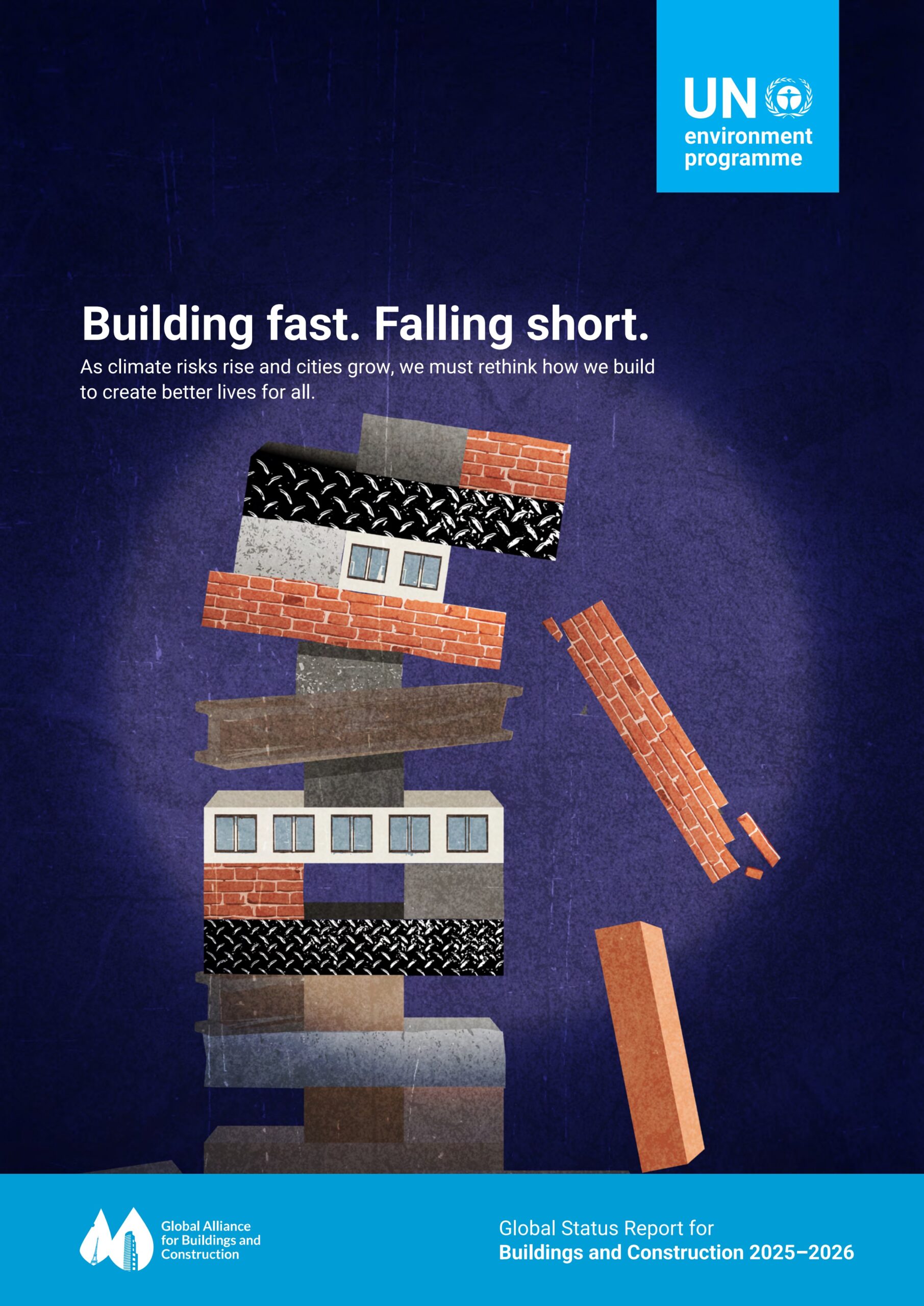
Building fast. Falling short. Global Status Report for Buildings and Construction 2025–2026
The 2025–2026 Global Status Report for Buildings and Construction examines the sector’s slow progress toward net-zero targets. Despite rising floor area and investment, building emissions and energy intensity remain off track. The report recommends urgent fossil-fuel phase-outs, upgraded building codes, and increased renewable energy deployment to meet 2030 milestones.
Please login or join for free to read more.

OVERVIEW
Foreword
Martin Krause, Director of the Climate Change Division, notes that the buildings sector generates over a tenth of global GDP and employs nearly one in ten people worldwide. However, it also accounts for more than a third of global CO₂ emissions and almost half of global material use. While global floor area has expanded rapidly, energy demand and emissions have grown more slowly. Yet, new construction continues to outpace decarbonisation, and renovation of existing buildings remains far too slow. The report argues that buildings should be viewed as a platform for delivery to meet housing needs and strengthen climate resilience simultaneously.
Political statement
Representatives from Kenya, Brazil, and France provide statements supporting the report. Kenya emphasises the demand for resilient and inclusive housing solutions due to rapid urbanisation. Brazil underlines the importance of strong data and continuous monitoring to turn climate ambition into real action. France welcomes a decade of progress since COP 21 but notes that the sector remains off track, requiring stronger building codes, faster renovation, and increased investment in low-carbon materials.
Executive summary
The global buildings and construction sector is currently 3.5 GtCO2 off the required trajectory. To get on track for the International Energy Agency (IEA) Net Zero Emissions (NZE) scenario by 2030, a 56 per cent decline in emissions from 2024 levels is required. Global buildings’ floor area reached 273 billion square metres in 2024, a 1.7 per cent increase from the previous year. While operational emissions rose by 6.5 per cent between 2015 and 2024, energy demand increased by an estimated 11 per cent, and floor area grew by 20 per cent. This decoupling is attributed to the declining carbon intensity of electricity and heat.
Introduction
The Global Status Report for Buildings and Construction (GSRBC) provides an annual snapshot of progress in decarbonising the sector. It assesses policies, finance, and technologies to determine alignment with the Paris Agreement. The sector is central to global challenges, including living costs and resource scarcity, especially as approximately 50 per cent of the building stock expected to exist in 2050 is yet to be constructed.
Global trends in buildings and construction
The construction market is projected to grow from USD 11.39 trillion in 2024 to USD 16.11 trillion by 2030. Residential buildings dominate the global stock at 77 per cent. Construction cost inflation has eased following a 2022 peak, with residential inflation projected to stabilise around 3.9 to 4.0 per cent through 2025 and 2026. However, regional patterns remain uneven, with the Middle East seeing a 49 per cent increase in building energy consumption between 2010 and 2024.
Buildings and construction sector carbon emissions
The sector accounts for approximately 37 per cent of global carbon emissions. Embodied emissions from cement, steel, and aluminium used in buildings represent 9 per cent of global emissions, remaining static at around 2.1 GtCO₂. Operational emissions reached 9.9 GtCO₂ in 2024. Governments are recommended to adopt fossil-fuel phase-out plans for heating and cooking and leverage public procurement to demand low-carbon solutions across the supply chain.
Buildings’ energy demand, efficiency and intensity
Buildings and construction accounted for 28 per cent of global energy consumption in 2024, a 2 per cent increase from 2023. Energy intensity remained stable at 129 kWh/m², indicating a stagnation in efficiency gains. Since 2015, intensity has reduced by 8.5 per cent, which is only half of the reduction needed to reach net-zero goals. To align with a 2050 pathway, energy intensity must fall by 25 per cent by 2030.
Buildings’ energy supply, renewable energy share and electrification
The share of renewables in buildings’ energy supply reached 17.3 per cent in 2024. This represents a 4.7 percentage point increase since 2015, but is only a quarter of the increase required to stay on track for 2050. The contribution of on-site renewables has stalled at approximately 5 per cent. The report recommends designing roadmaps for renewable deployment and coupling electrification initiatives with clean energy supplies.
Policies for or a climate-resilient buildings and construction sector
By 2024, 20 countries had submitted Nationally Determined Contributions (NDCs) with extensive strategies for the sector, though none were G20 members. Alarmingly, under the revised NDC 3.0 round launched in 2025, no country has yet published an extensive strategy for the sector. NDCs should include measures for building energy codes, appliance efficiency, and circular material supply chains.
Building energy codes around the world
Global building energy code coverage is approximately 60 per cent of new construction. As of 2024, only Canada and the United States have zero-emissions aligned building codes, and these are voluntary at the state level. The report calls for mandatory compliance and enforcement mechanisms, including regular inspections and performance verification, to ensure codes translate into real energy savings.
Green building certification around the world
The uptake of green building certification schemes has tripled since 2015, increasing by 13.6 points globally. In 2024, the gap to a net-zero-aligned pathway reduced for the first time. Governments are encouraged to integrate certification requirements into building codes and public procurement frameworks to reinforce market uptake.
Investment in sustainable and resilient buildings
Global investment in building energy efficiency reached USD 275 billion in 2024, a 38 per cent increase since 2015. However, there is a total cumulative investment gap of USD 1.3 trillion for the 2015–2024 period. To reach 2030 goals, an additional USD 3.6 trillion in cumulative investment is required. Recommendations include implementing fiscal incentives, tax benefits, and gender-responsive financing.
Future-proofing the buildings sector: monitoring resilience and adaptation risks
Governments should collect data on hazard exposure, structural vulnerability, and adaptation capacity to protect building users. Guidelines from organisations like the World Federation of Engineering Organizations provide a framework for integrating resilience across the building life cycle. Adaptation is described as a continuous collaborative process rather than a one-time intervention.
Roadmaps to drive transformation: from strategy to implementation
Roadmaps are identified as essential tools for decarbonisation. Countries such as Bangladesh, Jordan, Ghana, and Senegal are currently implementing building sector roadmaps. These roadmaps should be coupled with strategies to align buildings with national climate commitments and housing plans, while promoting women’s participation in technical and leadership roles.
Priority actions: accelerating the observed progress
Policymakers are urged to focus on seven priority areas: reversing emission trends through fossil-fuel phase-outs; reducing energy intensity by 25 per cent by 2030; increasing renewable energy share to 46 per cent; integrating buildings into NDCs; deploying ZEB-aligned codes in all G20 countries; using green certifications to amplify policy; and addressing housing affordability alongside climate change.
Building on a strong foundation: scaling up the GSRBC
The GlobalABC, formed at COP21, now has 400 members including 71 countries. The GSRBC is scaling into a global evidence platform by expanding indicators, providing more granular regional evidence, and fostering greater support for action to accelerate the sector’s transition.




