

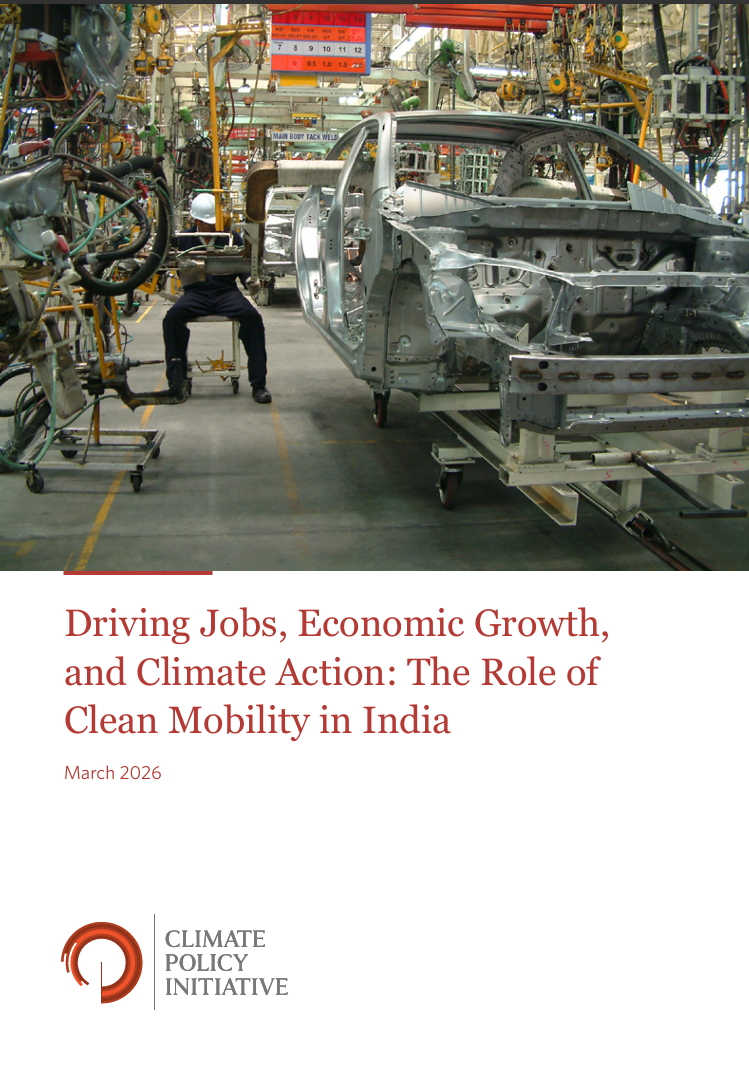
Driving jobs, economic growth, and climate action: The role of clean mobility in India
India’s transition to full electric vehicle adoption by 2047 could increase manufacturing output, create new jobs, reduce oil import dependence, and lower transport emissions. The report highlights substantial investment, infrastructure, and workforce reskilling requirements, with policy coordination and domestic manufacturing identified as critical to capturing long-term economic and climate benefits.
Please login or join for free to read more.

OVERVIEW
Introduction
India’s automotive sector contributes 7.1% of GDP and supports more than 30 million jobs. Rising oil imports and transport emissions have increased pressure to electrify mobility. The report assesses how a full transition to electric vehicles (EVs) by 2047 could affect manufacturing, employment, energy security and emissions.
EV Transition Scenarios
The report models a business-as-usual (BAU) pathway and a 100% EV adoption scenario by 2047. Total vehicle sales are projected to rise from 31 million in 2026 to 54.5 million by 2047. Under BAU, EV sales reach 44 million by 2047, while full electrification lifts sales to 59 million. Two- and three-wheelers are expected to electrify first, followed by passenger and commercial vehicles.
Impact on the automotive industry and the economy
A full EV transition could substantially expand manufacturing activity. Under the 100% EV scenario, cumulative automotive manufacturing revenue between 2031 and 2047 increases by INR57 lakh crore, while EV component markets could reach INR20.5 lakh crore annually by 2047. The report identifies localisation and domestic value addition as critical to reducing import dependence and improving export competitiveness.
Automotive manufacturing gross value added (GVA) increases by INR13.5 lakh crore, while electricity sector GVA rises by INR9 lakh crore. Petroleum product production GVA declines by INR5.2 lakh crore because of lower fossil fuel demand. EV adoption could avoid imports of 1,085 million tonnes of crude oil and 631 million tonnes of liquefied natural gas between 2031 and 2047, reducing foreign exchange expenditure by an estimated INR86.4 lakh crore. However, EV component imports may increase without stronger localisation policies.
Impact on employment
Employment patterns are expected to shift rather than contract. Vehicle and component manufacturing employment could increase to 5.4–5.8 million jobs by 2047. Charging infrastructure could support up to 2 million jobs, while battery recycling may add more than 423,000 jobs. However, ICE-related service, repair and fuel retail employment may decline because EVs require less maintenance and refuelling infrastructure.
Around 40% of ICE component manufacturing workers may require reskilling. Total skill development costs are projected at INR33,999 crore under the 100% EV scenario. The report recommends industry-led and state-supported retraining programmes to support labour mobility into EV manufacturing and charging infrastructure.
Environmental impact
Full EV adoption could significantly reduce transport emissions by 2047. Tailpipe carbon monoxide emissions decline by around 55%, while hydrocarbon, nitrogen oxide and particulate matter emissions fall by about 28–29% relative to BAU. Carbon dioxide emissions from road transport decline by 48%, with cumulative reductions of up to 2.3 billion tonnes between 2031 and 2047. Electrifying trucks and tractors is identified as particularly important because of their high fuel use and emissions intensity.
Ecosystem readiness and required investment
The report estimates cumulative investment requirements of INR45.5 lakh crore under the 100% EV scenario. This includes renewable energy and transmission infrastructure, EV component manufacturing and charging infrastructure. Public charging points could increase to 3.8 million by 2047.
Policy landscape and financing pathways
The report recommends long-term policy certainty, blended finance, concessional lending and public-private partnerships to mobilise investment. Short-term priorities include expanding production-linked incentives, supporting EV workforce training and strengthening electricity networks. Longer-term measures include EV sales mandates, charging infrastructure funding and transition finance for component manufacturers and oil- and gas-related industries.




