

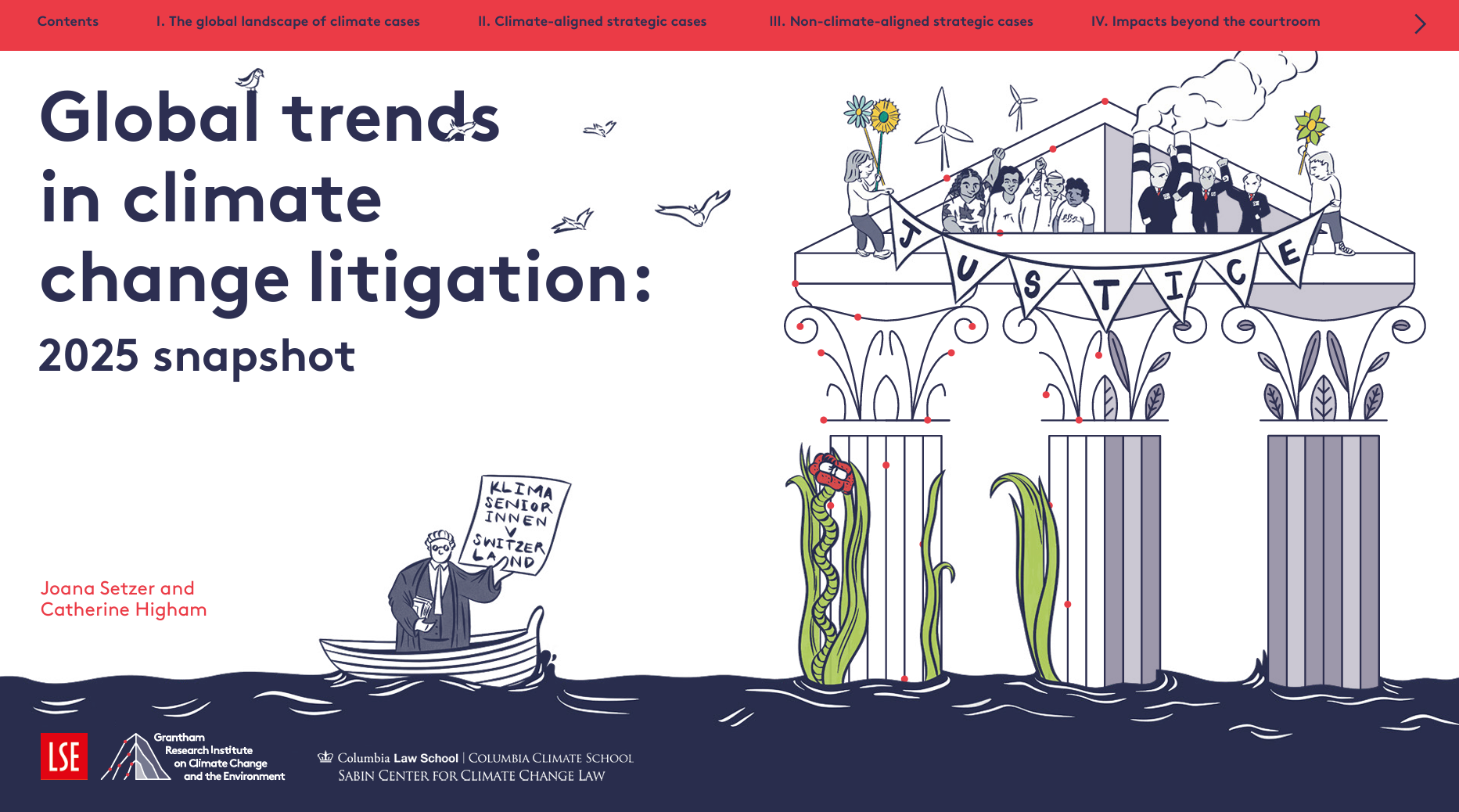
Global trends in climate change litigation series
This series reviews global developments in climate change litigation, tracking case numbers, jurisdictions, claimant and defendant trends, and evolving legal strategies. Drawing on international litigation databases, it analyses patterns in claims against governments and corporations, highlighting emerging themes in climate governance, accountability and legal risk.
Please login or join for free to read more.

OVERVIEW
Overview
The Global trends in climate change litigation series is an annual benchmark initiated in 2019 by the Grantham Research Institute on Climate Change and the Environment, in collaboration with the Sabin Center for Climate Change Law.
It provides a structured overview of developments in climate-related litigation worldwide, examining how legal systems are being used to advance or challenge climate policy, corporate conduct and regulatory action.
Purpose
The purpose of the series is to track and assess patterns in climate litigation across jurisdictions. It reviews cases brought against governments, corporations and financial actors, and situates these developments within broader climate governance frameworks.
The benchmark aims to improve understanding of how litigation is shaping accountability, legal standards and regulatory expectations in relation to climate change.
Methodology
The series draws primarily on the Climate Change Laws of the World database and the Sabin Center’s climate litigation databases.
Cases are included where climate change science, policy or law is a material issue before judicial or quasi-judicial bodies. The reports apply a consistent classification framework, categorising cases by jurisdiction, claimant and defendant type, legal basis and strategic intent.
They also distinguish between climate-aligned and non-climate-aligned litigation, enabling comparative analysis across years.
Relevance for finance professionals
For finance professionals, the series provides insight into emerging legal and regulatory risks linked to climate change.
It supports analysis of liability exposure, governance expectations, disclosure practices and fiduciary duties affecting issuers, directors, asset managers and financial institutions.
The benchmark can inform risk assessment, stewardship activity, due diligence and broader evaluation of transition and physical climate risks within investment and lending portfolios.
LINKS & ATTACHMENTS
-
R21819 - 2025 - Global trends in climate change litigation 2025 snapshot

-
R21819 - 2024 - Global trends in climate change litigation 2024 snapshot
-
R21819 - 2023 - Global trends in climate change litigation 2023 snapshot
-
R21819 - 2022 - Global trends in climate change litigation 2022 snapshot
-
R21819 - 2021 - Global trends in climate change litigation 2021 snapshot
-
R21819 - 2020 - Global trends in climate change litigation 2020 snapshot



