

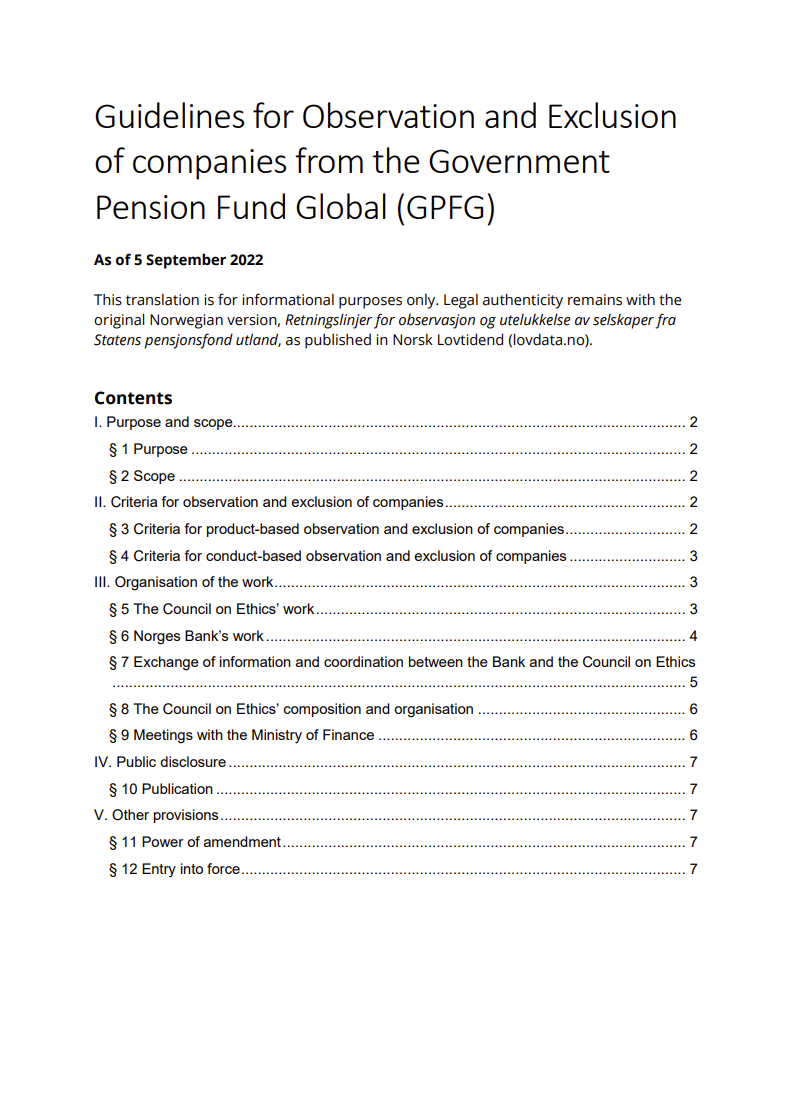
Guidelines for observation and exclusion of companies from the government pension fund global (GPFG)
The guidelines define ethical criteria for observing or excluding companies from Norway’s Government Pension Fund Global. They cover prohibited products, unacceptable conduct, coal thresholds, governance roles of the Council on Ethics and Norges Bank, and transparency requirements for decisions and reviews.
Please login or join for free to read more.

OVERVIEW
I. Purpose and scope
The guidelines aim to ensure that the Government Pension Fund Global (GPFG) is not invested in companies that cause or contribute to serious violations of fundamental ethical norms. They apply to the Council on Ethics and Norges Bank in their work on observing and excluding companies from the GPFG’s equity and fixed-income portfolios, including companies in, or considered for, the reference index.
II. Criteria for observation and exclusion of companies
Criteria for product based observation and exclusion of companies
The GPFG shall not be invested in companies involved in the development or production of weapons that violate fundamental humanitarian principles, including nuclear, chemical and biological weapons, antipersonnel mines and cluster munitions. Exclusion also applies to companies producing tobacco, tobacco products, or cannabis for recreational use.
Mining companies and power producers may be observed or excluded if they meet defined thermal coal thresholds. These include deriving 30 per cent or more of income from thermal coal, basing 30 per cent or more of operations on thermal coal, extracting more than 20 million tonnes annually, or having coal-based power capacity exceeding 10,000 MW. Forward-looking plans to reduce coal exposure and increase renewable energy activities may be considered in assessments.
Criteria for conduct based observation and exclusion of companies
Companies may be excluded or placed under observation where there is an unacceptable risk of involvement in serious or systematic human rights violations, violations of international humanitarian law, severe environmental damage, unacceptable greenhouse gas emissions at an aggregate company level, gross corruption or other serious financial crime. Other particularly serious breaches of fundamental ethical norms may also trigger action.
III. Organisation of the work
The council on ethics work
The Council on Ethics monitors GPFG investments and identifies companies that may breach the criteria. It independently investigates cases, gathers relevant information, and provides recommendations to Norges Bank on observation, exclusion, or revocation of decisions. Companies under review are given an opportunity to present information and comment on draft recommendations. The Council also maintains routines to reassess whether grounds for exclusion or observation continue to exist and publishes its selection principles.
Norges bank work
Norges Bank makes final decisions on observation and exclusion, based on the Council’s advice or, in certain cases, at its own discretion. In conduct-based assessments, the Bank considers factors such as severity, likelihood of recurrence, corporate governance, remedial actions and whether ownership engagement could reduce risks. Green bonds issued by excluded coal companies may be exempt if independently verified or included in recognised indices. Observation may be used where outcomes are uncertain or developments are evolving.
Exchange of information and coordination between the bank and the council on ethics
Regular coordination between Norges Bank and the Council on Ethics supports effective information exchange and alignment of measures. Both parties share relevant company information, coordinate company engagement, and establish procedures clarifying responsibilities and communication.
The council on ethics composition and organisation
The Council consists of five members appointed by the Ministry of Finance, based on nominations from Norges Bank, for four-year terms. It operates independently, supported by a dedicated secretariat, and reports annually to the Ministry. Regular evaluations of its work are required.
Meetings with the ministry of finance
The Ministry, Norges Bank and the Council on Ethics meet at least annually to discuss activities and inform parliamentary reporting on GPFG management.
IV. Public disclosure
Norges Bank publishes decisions on observation and exclusion, while the Council on Ethics publishes its recommendations. A public list of excluded and observed companies is maintained, and annual reporting covers progress on ownership measures and related actions.
V. Other provisions
The Ministry of Finance may amend the guidelines. The current provisions entered into force on 5 September 2022, replacing earlier guidelines adopted in 2010.




