

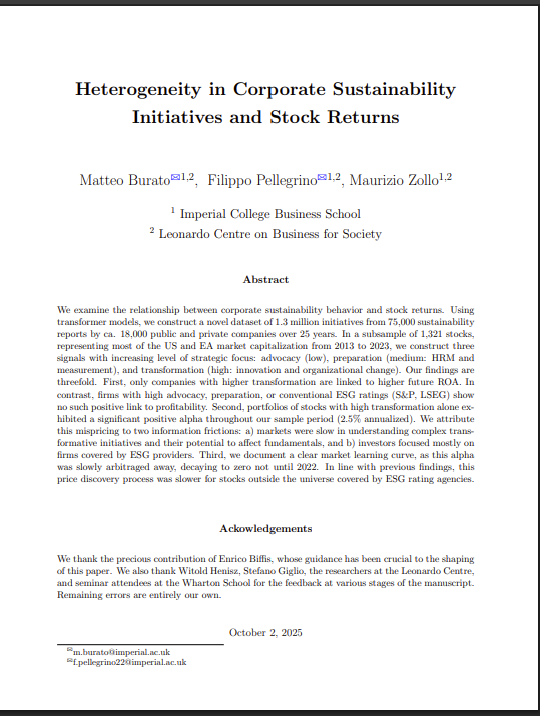
Heterogeneity in corporate sustainability initiatives and stock returns
The study shows only transformative sustainability initiatives predict higher future profitability and generate positive abnormal stock returns. Advocacy, preparation and standard ESG ratings do not. Markets initially mispriced transformative actions, but learning gradually eliminated the alpha by 2022.
Please login or join for free to read more.

OVERVIEW
Introduction
The paper analyses how different types of corporate sustainability initiatives relate to firm profitability and stock returns. Rather than relying on aggregate ESG ratings, it distinguishes between symbolic and substantive sustainability behaviour. The study asks which sustainability strategies affect fundamentals and whether equity markets price these differences efficiently.
Related literature
Existing research provides mixed evidence on sustainability and financial performance. Asset pricing studies debate whether sustainability reflects investor preferences, risk premia or transition dynamics, while strategic management research emphasises firm capabilities and adaptation. A key limitation is the heavy reliance on ESG ratings, which show low inter-rater reliability, limited transparency and aggregation bias. These weaknesses obscure distinctions between symbolic actions and initiatives that materially alter firms’ business models.
Data
The authors construct a novel dataset, GOLDEN, using AI-assisted analysis of around 75,000 sustainability reports, identifying 1.3 million concrete sustainability initiatives across 25 years. Firms are characterised by three signals reflecting strategic focus: advocacy (e.g. philanthropy and communication), preparation (e.g. internal systems, measurement and risk monitoring) and transformation (e.g. innovation, asset changes and organisational restructuring). The equity sample covers 1,321 large, liquid US and Euro Area stocks from 2013 to 2023, representing most market capitalisation. Accounting, market and factor data are matched with conservative lags to reflect information availability.
Results: Profitability
Regression analysis shows strong heterogeneity in outcomes. Only transformation initiatives are positively and significantly associated with higher future profitability. A one percentage point increase in the transformation signal predicts a 2–3 basis point increase in return on assets over one to three years across EBITDA, EBIT and net income measures. Advocacy initiatives are negatively associated with profitability, while preparation initiatives show no statistically meaningful effect. Conventional ESG ratings from S&P and LSEG do not predict higher future profitability and are often negatively related. Further analysis shows that ESG ratings mainly reward preparatory actions rather than transformative ones, highlighting a disconnect between rated sustainability and value creation.
Results: Abnormal returns to sustainability initiatives
Portfolio analysis shows that only firms with high transformation scores generate statistically significant abnormal returns. A high-transformation portfolio delivers a monthly alpha of around 0.17–0.21%, equivalent to roughly 2.0–2.5% annually, after controlling for market, size and value factors. Portfolios based on advocacy, preparation or ESG scores show no robust alpha. Additional tests reject a risk-based explanation: the transformation signal does not proxy for a priced risk factor, and high-transformation portfolios do not exhibit higher downside risk. The evidence supports a mispricing explanation driven by information frictions, as investors struggle to interpret complex and non-standardised sustainability disclosures.
From rudimentary to substantive pricing of sustainability
Rolling regressions reveal a clear market learning process. Early in the sample, markets did not distinguish between different sustainability strategies, generating temporary abnormal returns across categories. Over time, alphas linked to advocacy, preparation and ESG scores were arbitraged away. The transformation-related alpha persisted longer and decayed to zero only by late 2022. Mispricing lasted longer for firms outside major ESG rating coverage, indicating slower information diffusion where analyst attention is weaker.
Concluding remarks
The study concludes that only substantive, transformative sustainability initiatives improve firm fundamentals and generate temporary excess returns. Symbolic actions and standard ESG ratings do not reliably signal value creation. For managers, the results suggest prioritising genuine transformation over compliance or signalling. For investors, reliance on ESG scores alone risks missing value-relevant sustainability transitions, although these opportunities have diminished as markets have learned to price them.




