

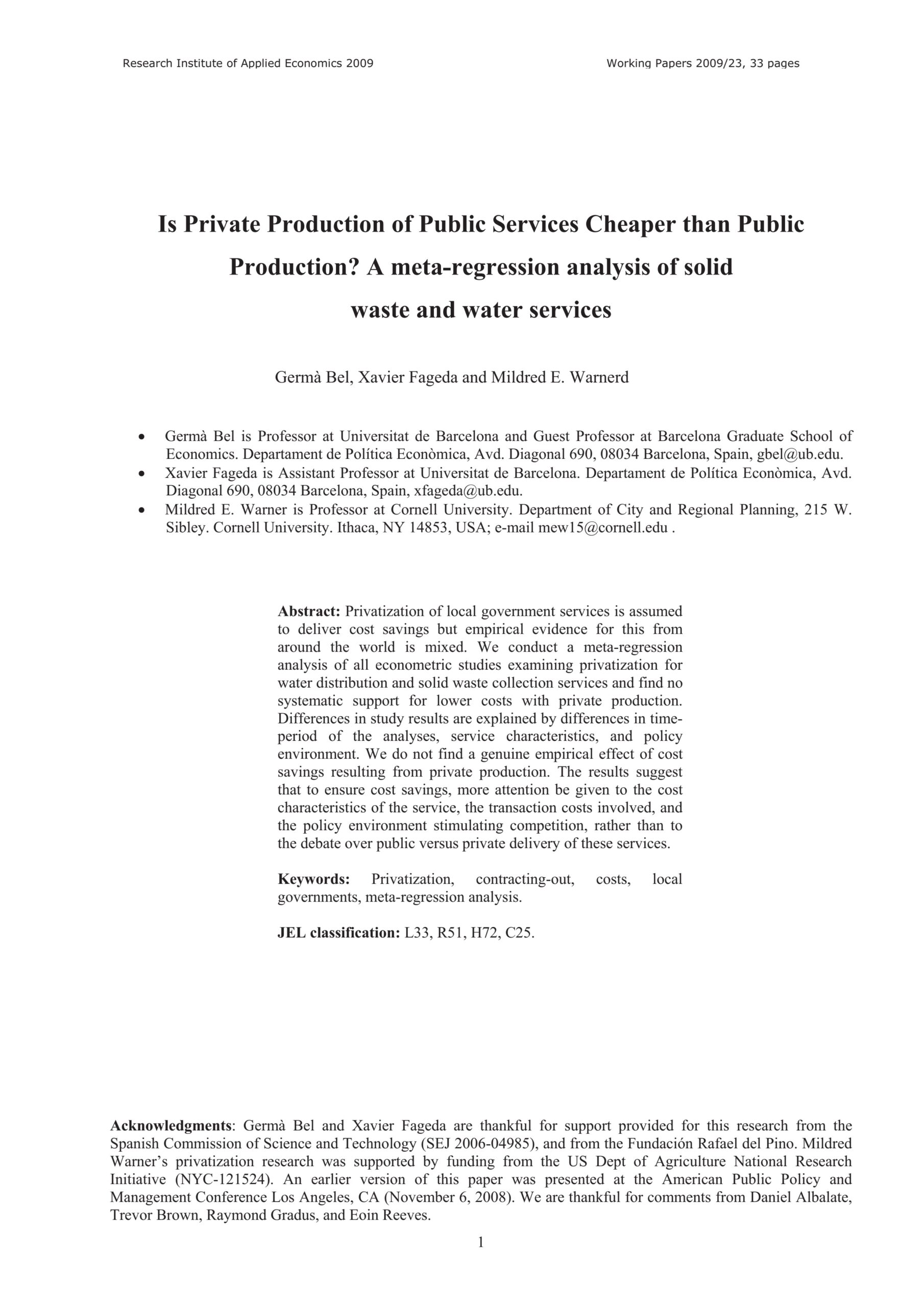
Is private production of public services cheaper than public production? A meta-regression analysis of solid waste and water services
This meta-regression analysis of 27 studies on water and solid waste services finds no systematic evidence that private production reduces costs. Results suggest cost outcomes depend more on service characteristics, transaction costs, and market competition than ownership. The study also identifies publication bias favouring studies reporting privatisation cost savings.
Please login or join for free to read more.

OVERVIEW
Introduction
This research evaluates the long-standing assumption that the privatisation of local government services delivers significant cost savings. Despite three decades of experimentation with contracting out, empirical evidence remains mixed. While some individual studies report cost reductions under private ownership, others fail to find statistically significant differences. Descriptive meta-analyses have previously indicated that the weight of evidence does not support systematic savings. This study conducts a meta-regression analysis (MRA) of 27 empirical studies—providing 46 total observations—comparing the costs of public and private production in two sectors with extensive contracting experience: solid waste collection and water provision. By statistically analysing the characteristics of each regression model, the research assesses the overall weight of evidence concerning production costs at the local level.
Relationship to the theoretical and empirical literature on privatisation and costs
Theoretical expectations for cost savings are rooted in public choice and property rights literatures, which argue that competition and private ownership provide incentives for managers to reduce costs and curtail excessive public supply. Conversely, transaction costs and industrial organisation theories emphasise factors that may undermine these savings, such as the costs of contracting, monitoring, and the impact of market structures. Transaction cost theory suggests that cost savings are less likely when asset specificity is high and contracts are incomplete. In the case of water services, asset specificity is measured at 4 on a 1–5 scale, compared to 3 for solid waste. Furthermore, the ease of service measurement is 2.4 for water and 2.0 for waste, while the average number of providers is significantly lower for water (0.8) than for waste (2.6). These differences suggest that privatisation is theoretically less likely to yield savings in the water sector than in solid waste collection.
Methodology
The study employs a meta-regression analysis to provide a systematic test for cost differences across diverse studies. The methodology follows the approach of Stanley and Jarrell (1989), where the dependent variable is the reported t-statistic for the coefficient of private production in various cost models. This allows for an assessment of whether there is a genuine empirical effect regarding the relationship analysed. The model also incorporates moderator variables such as sample size, the year of data collection, functional form, service type, and geographic area. To address potential publication bias—where studies with statistically significant findings are more likely to be published—the researchers implement the funnel asymmetry test (FAT) and the meta-significance test (MST). These tests help determine if the reported results are contaminated by bias or if a true empirical effect exists.
The empirical strategy
The sample comprises 46 observations from 27 studies conducted between 1960 and 2005 across regions including the US, the UK, Europe, and Africa. The analysis finds that the coefficient for sample size is negative but not statistically significant, meaning that larger, more robust studies are not more likely to report cost savings. Consequently, there is no statistical support for a systematic empirical effect of private production on costs. The variable for the year of data collection is positive and significant, indicating that more recent studies are even less likely to find cost differences between public and private delivery. Geographic analysis shows that studies from the US are less likely to find significant cost differences. While there is modest evidence that savings are more likely in solid waste than in water—potentially due to scale economies and lower transaction costs—the overall results suggest that private production is not systematically less costly.
Conclusion
The meta-regression analysis concludes that privatisation does not lead to systematic cost savings for water and solid waste services. The research highlights that initial reports of savings in earlier studies may have been influenced by small sample sizes and publication bias. The results suggest that cost outcomes are dependent on specific service characteristics, transaction costs, and the local policy environment rather than the form of ownership. For services like water distribution, which are natural monopolies with high asset specificity, private production is unlikely to yield savings. The primary benefit of competition may actually be the internal efficiency improvements it spurs in public organisations through benchmarking pressure. Policy-makers are advised to focus on service characteristics, contract monitoring, and fostering competition rather than the binary debate over public versus private delivery.




