

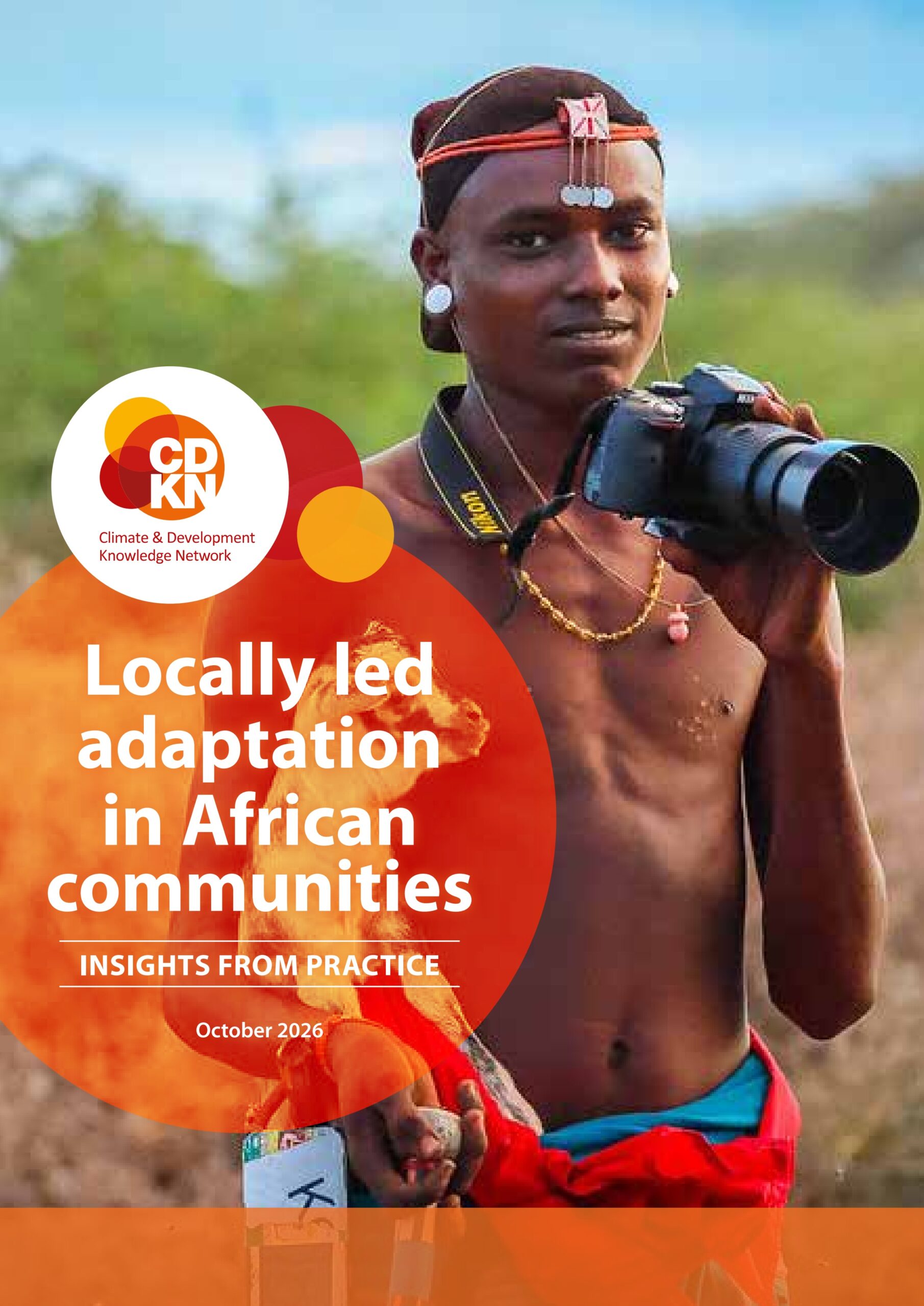
Locally led adaptation in African communities: Insights from practice
This report examines practitioners’ experiences of locally led adaptation (LLA) in Africa. It emphasises the necessity of social equity, the integration of indigenous knowledge, and the role of local institutions. It offers strategic recommendations for governments and funders to decentralise climate finance and support community-driven resilience initiatives effectively.
Please login or join for free to read more.

OVERVIEW
Introduction
Across Africa, communities have long adapted to climate variability using local knowledge and indigenous practices. However, these efforts often remain under-recognised in national planning and under-supported by international adaptation finance mechanisms. Locally led adaptation (LLA) reflects a broader trend towards ‘localisation’, favouring the delivery of localised development benefits and stronger community leadership. Evidence indicates that top-down approaches frequently fail because they are poorly aligned with local realities. For instance, in Ghana, top-down dam projects intended for irrigation remained non-functional, while in South Sudan, a donor bias towards mobile money proved ineffective in a cash-based economy with minimal electricity access. Currently, international climate finance is heavily biased towards international organisations and consultants; a study found that just 0.17% of funding mentioned ‘locally led’ terms between 2016 and 2023.
Understanding climate risks and resilience
Understanding climate risk begins with community-based mapping of observed environmental changes and their impacts on diverse groups. African communities are on the front lines of change, but climate change is often one of many risks, frequently amplifying existing vulnerabilities related to land tenure, conflict, and social norms. Indigenous and local knowledge (ILK) is critical for identifying these drivers. In Benin, the Survie project leverages traditional knowledge to protect sacred forests, which serve as biodiversity reservoirs and regulate water cycles. Knowledge brokering is employed to connect producers and users of information, challenging structural barriers that prevent the recognition of local wisdom. Intersectionality is also vital, as characteristics such as age, gender, marital status, and disability interact to create unique experiences of vulnerability and power.
How community-led interventions are increasing resilience
Effective LLA requires moving from risk assessment to action by engaging communities in their own languages and framing conversations around their dominant concerns, such as food insecurity or water scarcity. In Ghana, ‘collaborative hubs’ helped women farmers translate climate experiences into local songs broadcast on community radio. Sustainability is enhanced when LLA is embedded in existing community institutions, such as natural resource management committees. In Kenya, the Herder Conservation Network uses a mobile application to map rangelands and wildlife, enabling herders to develop grazing strategies that avoid depleting resources.
Youth leadership and intergenerational knowledge transfer are foundational to equitable adaptation. The ‘Conservation Cup’ in Kenya has successfully restored 600 hectares of degraded land by linking football tournaments to tree planting. In Cameroon, the ‘Urban Art 4 Climate’ initiative has empowered over 800 young people aged 15–22 to use creative expression for climate awareness. Gender equality is also central; on Senegal’s Niodior Island, women-led organisations prevent sea-level rise through innovative shell midden restoration. Introduced technologies, such as solar-powered irrigation in South Sudan, provide direct responses to rainfall unreliability, putting resource management under community control.
The critical role of national and subnational policies
National and subnational institutions are essential for devolving authority and creating enabling conditions for LLA. Governance systems vary significantly across the continent; for example, Kenya has devolved substantial development planning and budgetary authority to county levels, enabling climate-smart decisions to be made closer to affected people. Conversely, in centralised systems like Ethiopia and Namibia, the focus is on creating national platforms for knowledge diffusion that cascade to local levels. Policy and LLA have a reciprocal relationship: successful local projects can drive national policy changes. In Benin, demonstrating the value of sacred forests led to the formal recognition of indigenous environmental knowledge in national biodiversity management frameworks.
How external financing partnerships can strengthen equitable, community-based adaptation
External finance must be accountable to communities to be effective. Practitioners emphasise that adaptation finance should begin with community-defined priorities rather than donor agendas. Transparency is a key requirement; partners in Kenya and Namibia work to ensure communities own the projects rather than feeling they belong to the external implementing partner. Dedicated budgets are needed for process elements, including institutional strengthening and ethical safeguarding. Peer-to-peer learning is also a powerful catalyst; a CDKN workshop in Machakos, Kenya, allowed practitioners from Cameroon, Mozambique, and South Sudan to share ideas, such as adapting Kenyan sand dam techniques for other semi-arid contexts.
Conclusions and recommendations
LLA is fundamentally about who drives decisions. It requires hybrid knowledge systems that combine indigenous experience with scientific data. Recommendations for local implementing actors include costing in-kind community inputs and ensuring marginalised groups participate meaningfully in decision-making. Governments are encouraged to legislate for decentralised development and integrate community-led processes into National Adaptation Plans (NAPs) and Nationally Determined Contributions (NDCs). Funding partners should provide multi-year, core financial support to facilitate trust-building and institutional strengthening, while avoiding the creation of parallel structures that might undermine existing local capacity.




