

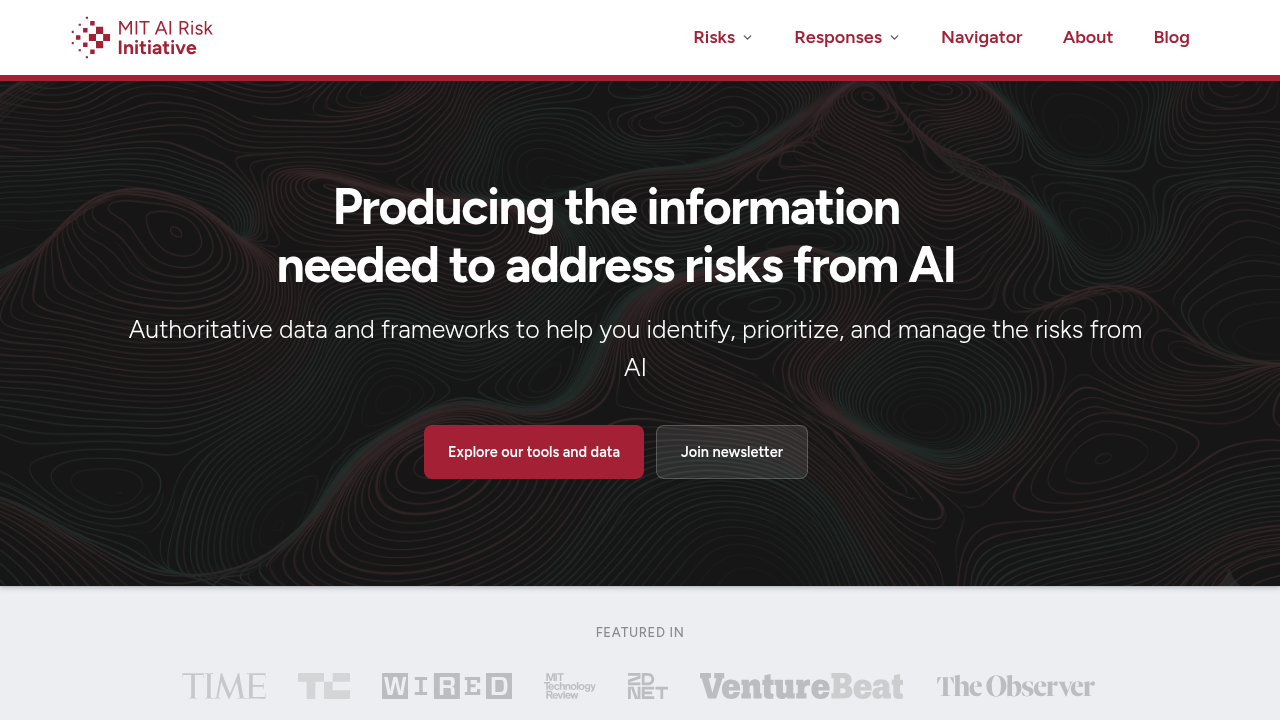
MIT AI Risk Repository
The MIT AI Risk Repository is a comprehensive database of over 1,600 AI risks and real-world incidents. It provides frameworks and data to help finance professionals and organisations identify, prioritise, and manage technical, social, and regulatory risks associated with artificial intelligence.
Please login or join for free to read more.

OVERVIEW
The MIT AI Risk Repository is a comprehensive database and framework designed to help organisations identify, prioritise, and manage the various risks associated with artificial intelligence. Developed as part of a broader initiative to foster responsible AI governance, the tool centralises data on hundreds of unique AI-related risks and real-world incidents. For finance professionals, it provides a rigorous, evidence-based foundation for assessing the technical and operational risks inherent in AI-enhanced financial systems and services.
Organisation behind the tool
The repository is developed and maintained by the MIT AI Risk Initiative, based at the Massachusetts Institute of Technology (MIT). The project involves collaboration with academic researchers and is supported by data from various external AI governance and safety organisations.
What the tool does
The tool provides a multi-layered classification system for AI risks, including:
- A living repository of over 1,600 classified AI risks across various domains and subdomains.
- The AI Risk Navigator, which allows users to explore connections between different datasets and taxonomies.
- An AI Incident Tracker that monitors real-world harms, categorised by severity, developer, and national security impact.
- Mapping of global AI laws, policies, and frameworks to specific risk types to assist with governance compliance.
- Detailed summaries of external AI risk frameworks and expert consensus surveys on severe AI harms.
Target audience
The primary users include AI researchers, policy makers, corporate risk officers, and legal professionals. It is also designed for anyone integrating risk management across the AI value chain, from developers to end-users.
Relevance to finance professionals
The tool can be applied in finance in the following ways:
- Risk assessment – Evaluating the reliability and safety of LLMs and automated systems used in trading or credit scoring.
- ESG analysis – Monitoring the environmental impact of AI compute and the social implications of algorithmic bias or misinformation.
- Investment context – Assessing the long-term viability and regulatory exposure of AI-driven companies within an investment portfolio.
- Market insights – Understanding how global AI governance and laws may impact the operational landscape for financial technology.




