

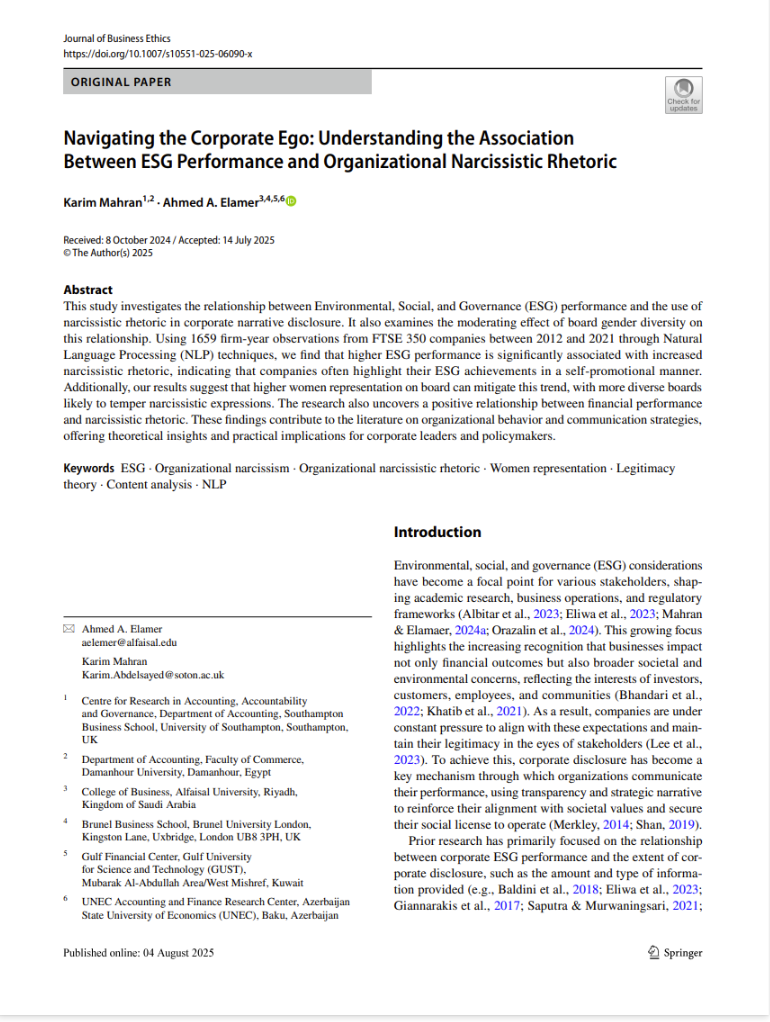
Navigating the corporate ego: Understanding the association between ESG performance and organizational narcissistic rhetoric
This study analyses 1,659 FTSE 350 observations to explore the link between ESG performance and organisational narcissistic rhetoric. Findings indicate that high ESG performance correlates with increased self-promoting language, though greater board gender diversity mitigates this effect. Additionally, strong financial results are positively associated with narcissistic corporate narratives.
Please login or join for free to read more.

OVERVIEW
Introduction
Environmental, Social, and Governance (ESG) factors are central to stakeholder interests and regulatory frameworks. Companies face pressure to maintain legitimacy by aligning with societal values through corporate disclosures. While previous research focuses on the quantity of disclosure, this study examines the rhetorical strategies used. It investigates how ESG performance influences organisational narcissistic rhetoric and whether the proportion of women on the board moderates this relationship, offering insights for practitioners and policymakers.
Organisational narcissism and narcissistic rhetoric
Organisational narcissism is a collective trait ranging from healthy self-confidence to destructive arrogance. Extreme narcissism manifests as entitlement, superiority, and a dismissal of external feedback. To protect their identity and legitimacy, organisations employ narcissistic rhetoric in annual reports—using self-aggrandising language to highlight achievements and assert authority. This narrative serves as a strategic tool to reinforce the entity’s status and reputation.
Literature review and hypotheses development
Legitimacy theory suggests organisations align with social norms to secure acceptance. The authors propose that firms with strong ESG performance use narcissistic rhetoric to project leadership and pioneer status (H1). Conversely, gender socialisation theory posits that female directors bring collaborative and ethical decision-making styles. Consequently, a higher proportion of women on the board is hypothesised to temper self-promotional language, fostering more balanced communication (H2).
Research design
The study analyses 1,659 firm-year observations from 200 UK FTSE 350 companies between 2012 and 2021. This sample excludes financial firms due to differing regulations. The authors employ Natural Language Processing (NLP) to measure narcissistic rhetoric in annual reports using a specific wordlist (e.g., ‘authority’, ‘superiority’). ESG scores were sourced from Refinitiv Eikon. The models control for variables such as firm size, profitability (ROA), and board independence.
Empirical results and discussion
The analysis confirms a positive, statistically significant relationship between ESG performance and narcissistic rhetoric (coefficient = 0.03, p < 0.01). Firms with superior ESG ratings utilise more self-promotional language to reinforce their legitimacy. Crucially, the presence of women on the board negatively moderates this association (interaction term coefficient = -0.045, p < 0.05). This supports the view that gender-diverse boards encourage measured communication. Additionally, financial performance (ROA) is positively linked to narcissistic rhetoric (coefficient = 0.006, p < 0.01).
Additional analysis and robustness checks
Further testing reveals that environmental and social performance significantly drive narcissistic rhetoric, whereas governance scores do not. A 2-Stage Least Squares (2SLS) regression addresses endogeneity, confirming the robustness of the main findings (p < 0.01). An alternative measurement using ChatGPT to classify sentence tone also yields consistent results (coefficient = 0.01, p < 0.01), validating the NLP methodology.
Conclusion
The study concludes that high ESG performance drives organisations to adopt narcissistic rhetoric, potentially to leverage their sustainability credentials for market positioning. However, board gender diversity acts as a corrective mechanism, promoting transparency. The authors recommend that policymakers introduce guidelines to curb excessive self-promotion and that investors scrutinise disclosures for authenticity. Corporate leaders are advised to balance confidence with integrity to maintain long-term credibility.




