

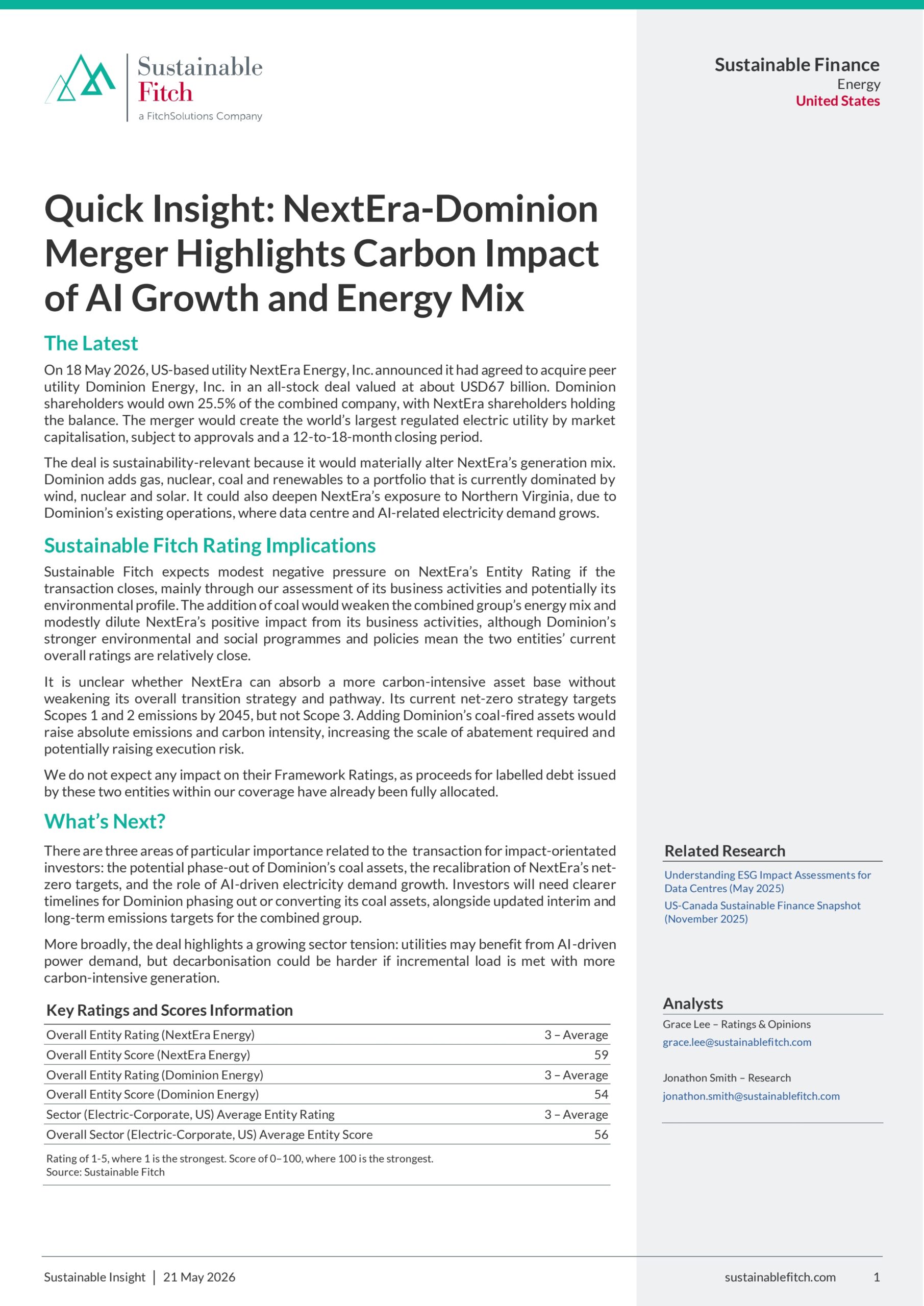
Quick insight: NextEra-Dominion merger highlights carbon impact of AI growth and energy mix
Sustainable Fitch analyses the USD67 billion all-stock merger between NextEra Energy and Dominion Energy. This transaction creates the world’s largest regulated electric utility. However, the addition of coal assets may weaken NextEra’s environmental profile and complicate its decarbonisation pathway amidst growing AI-driven electricity demand in Northern Virginia.
Please login or join for free to read more.

OVERVIEW
The latest
On 18 May 2026, the US-based utility NextEra Energy, Inc. announced that it had reached an agreement to acquire its peer utility, Dominion Energy, Inc. This all-stock deal is valued at approximately USD67 billion. Under the terms of the transaction, Dominion shareholders would own 25.5% of the combined company, while NextEra shareholders would hold the balance. This merger is set to create the world’s largest regulated electric utility by market capitalisation, though it remains subject to necessary approvals and is expected to have a 12-to-18-month closing period.
This deal is considered highly sustainability-relevant because it will materially alter the generation mix of NextEra. Dominion Energy adds a diverse range of assets including gas, nuclear, coal, and renewables to a portfolio that is currently dominated by wind, nuclear, and solar power. Furthermore, the merger could deepen NextEra’s exposure to Northern Virginia through Dominion’s existing operations. This region is seeing significant growth in electricity demand related to data centres and AI-driven technology.
Sustainable Fitch rating implications
Sustainable Fitch expects the transaction to exert modest negative pressure on the Entity Rating of NextEra Energy if it closes. This pressure stems mainly from the assessment of its business activities and its environmental profile. The addition of coal-fired assets is expected to weaken the energy mix of the combined group and modestly dilute the positive impact NextEra currently generates from its business activities. However, the overall ratings of the two entities are currently relatively close, as Dominion maintains stronger environmental and social programmes and policies.
There remains uncertainty regarding whether NextEra can successfully absorb a more carbon-intensive asset base without weakening its overall transition strategy and pathway. The current net-zero strategy for NextEra targets Scope 1 and Scope 2 emissions by 2045, but notably excludes Scope 3 emissions. The inclusion of Dominion’s coal-fired assets would increase both absolute emissions and carbon intensity, thereby increasing the scale of abatement required and potentially raising execution risks. No impact is expected on the Framework Ratings for labelled debt issued by these entities, as the proceeds have already been fully allocated.
What’s next?
There are three areas of particular importance for impact-orientated investors regarding this transaction: the potential phase-out of coal assets from Dominion, the recalibration of net-zero targets for NextEra, and the role of electricity demand growth driven by AI. Investors will require clearer timelines for the phasing out or conversion of coal assets, alongside updated interim and long-term emissions targets for the combined entity. More broadly, the deal highlights a growing tension within the sector: while utilities may benefit from power demand driven by AI, decarbonisation could become more difficult if this incremental load is met with carbon-intensive generation.
Key ratings and scores information
Sustainable Fitch provides specific ratings for both entities. NextEra Energy has an Overall Entity Rating of 3 – Average and an Overall Entity Score of 59. Dominion Energy also has an Overall Entity Rating of 3 – Average, with an Overall Entity Score of 54. These scores are compared against the Sector (Electric-Corporate, US) Average Entity Rating of 3 – Average and an Average Entity Score of 56. The rating system uses a scale of 1-5, where 1 is the strongest, and the scores range from 0–100, where 100 is the strongest. The report authors are Grace Lee from Ratings & Opinions and Jonathon Smith from Research. Related research includes a May 2025 report on ESG impact assessments for data centres and a November 2025 US-Canada sustainable finance snapshot.
A Sustainable Fitch Analytical Product provides assessments of the Environmental, Social, and Governance qualities of issuers or financial instruments. These products, which include ratings, scores, and second-party opinions, are not credit ratings. They are provided by Sustainable Fitch, which is a Fitch Solutions company and an affiliate of Fitch Ratings. These assessments are not considered investment advice and are not an opinion on the value of financial instruments or securities. Sustainable Fitch does not audit or verify the accuracy of the information provided to it by third parties for these reports.




