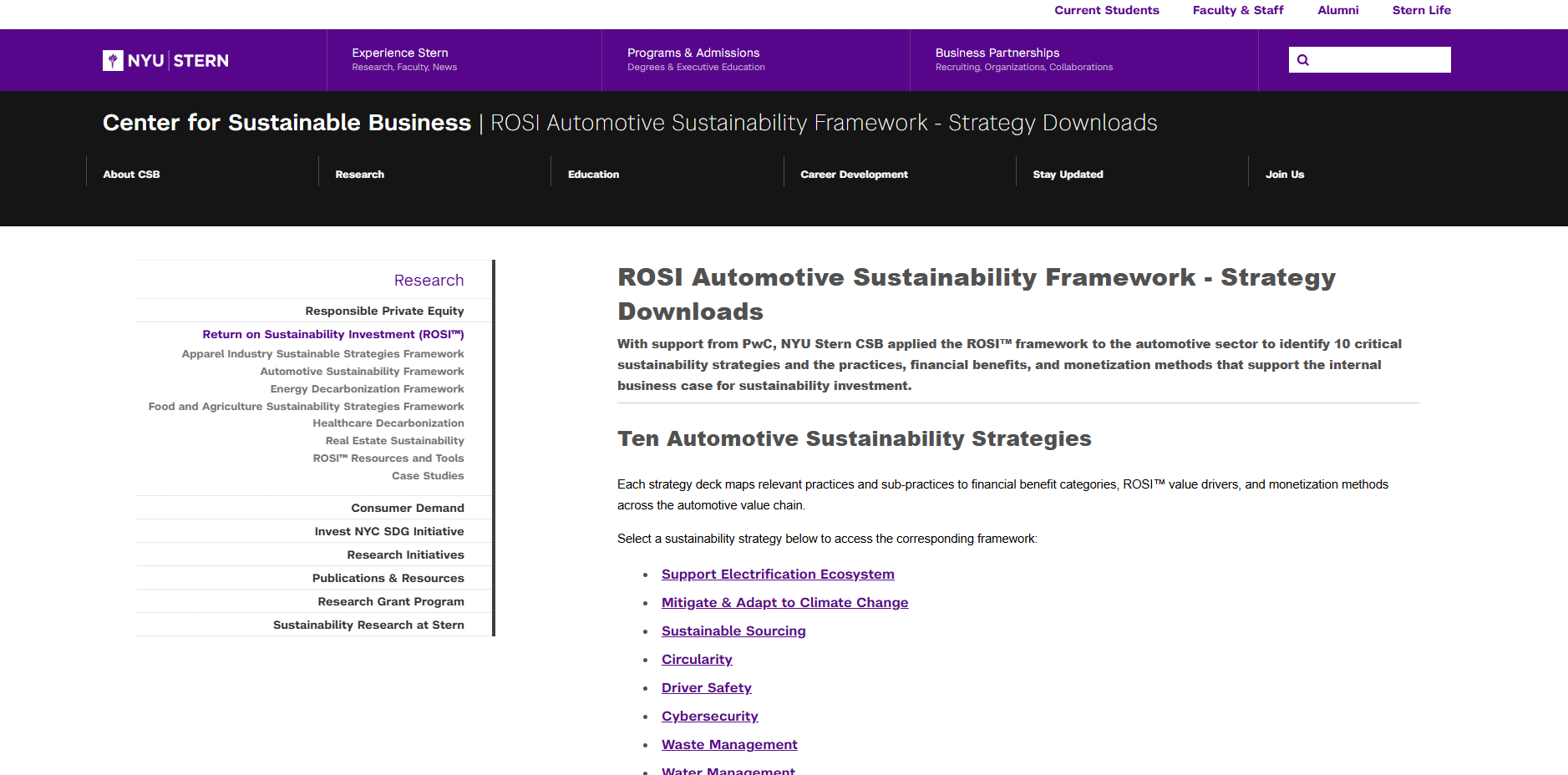
ROSI Automotive Sustainability Framework: Strategy Downloads
This series examines the financial benefits of integrating sustainability into automotive industry strategies and operations. It provides frameworks and monetisation methodologies for assessing environmental, social and governance practices, supporting financial decision-making, risk management, operational efficiency and long-term value creation across the automotive value chain.
Please login or join for free to read more.

OVERVIEW
Background and purpose
The Return on Sustainability Investment (ROSI™) Automotive Sustainability Framework is a research series developed by the NYU Stern Center for Sustainable Business. The automotive research dates back to at least 2019, with the strategy-specific series published in 2025.
The series aims to establish the relationship between corporate sustainability practices and financial performance by providing methodologies and tools for quantifying tangible and intangible financial benefits.
Scope
The framework examines sustainability strategies across the automotive value chain, including climate change mitigation and adaptation, waste management, water management, chemical management, electrification, circularity, cybersecurity, sustainable sourcing, driver safety, and supplier and employee well-being.
Methodology
Drawing on research and engagement with industry stakeholders, the framework identifies material sustainability strategies and maps their associated practices and sub-practices across the automotive value chain.
The ROSI™ methodology assesses financial benefits through factors including risk management, stakeholder engagement, operational efficiency, talent management, supplier relationships, innovation, customer loyalty, media coverage, and sales and marketing.
These factors are linked to financial performance measures, including revenue growth, profitability and corporate valuation. The series provides proposed monetisation methods to quantify sustainability-related financial benefits.
Relevance to finance professionals
Finance professionals can use the framework to integrate ESG considerations into corporate financial analysis, evaluate sustainability-related expenditure, assess financial risks and opportunities, and develop business cases for sustainability investments.
The methodology also supports investment due diligence, corporate valuation, scenario analysis and capital allocation by connecting sustainability performance with financial outcomes.
LINKS & ATTACHMENTS
-
Go to source

-
3463 - 2025 - Investing in the electrification ecosystem in the auto industry Proposed benefits & monetization methods
-
3463 - 2025 - Mitigating and adapting to climate change in the auto industry Proposed benefits & monetization methods
-
3463 - 2025 - Investing in sustainable sourcing in the auto industry Proposed benefits & monetization methods
-
3463 - 2025 - Investing in circularity in the auto industry Proposed benefits & monetization methods
-
3463 - 2025 - Investing in driver safety in the auto industry Proposed benefits & monetization methods
-
3463 - 2025 - Investing in cybersecurity in the auto industry Proposed benefits & monetization methods
-
3463 - 2025 - Investing in waste management in the auto industry Proposed benefits & monetization methods
-
3463 - 2025 - Investing in water management in the auto industry Proposed benefits & monetization methods
-
3463 - 2025 - Investing in supplier & employee well-being in the auto industry Proposed benefits & monetization methods